
- The Australian Dollar retreats on Tuesday, giving back some of Monday's gains as the US Dollar regains strength.
- Hawkish comments from Fed officials and hotter US inflation reinforce expectations of another interest rate hike in December.
- China's narrowing trade surplus adds pressure to the Aussie, while investors await crucial US inflation data.
AUD/USD trades around 0.6905 on Tuesday, down 0.31% on the day at the time of writing, as the Australian Dollar (AUD) loses some ground against the US Dollar (USD) following Monday's strong rebound. The Aussie remains under pressure amid rising expectations of further monetary tightening by the Federal Reserve (Fed), while disappointing Chinese trade data weigh on sentiment.
The latest figures from China, Australia's largest trading partner, showed that the Trade Surplus narrowed to $105.28 billion in October from $133.53 billion in September, missing market expectations of $125.8 billion.
Despite the narrowing surplus, Chinese exports and imports continued to expand on an annual basis, suggesting that external trade activity remains resilient. Nevertheless, the weaker-than-expected headline figure provides limited support for the Australian Dollar.
Meanwhile, the US Dollar benefits from increasingly hawkish expectations surrounding the Fed's monetary policy outlook. According to the CME FedWatch tool, markets now assign an approximately 99% chance to a 25-basis-point interest rate hike in December, up from 84% a day earlier.
Fed Governor Christopher Waller reinforced these expectations on Tuesday, stating that “We need to raise rates to put downward pressure on inflation.” He also acknowledged that monetary policy has been less restrictive than previously anticipated.
The US Consumer Price Index (CPI), published by the Bureau of Labor Statistics (BLS) on Tuesday, rose 0.4% MoM in October, exceeding market expectations of 0.3%, although slowing from September's 0.6% increase. Meanwhile, the Core CPI, which excludes volatile food and energy prices, increased 0.3%, above forecasts of 0.2% and matching the previous month's reading. The stronger-than-expected inflation figures reinforce concerns about persistent price pressures in the US economy, strengthening the case for additional interest rate increases.
AUD/USD technical analysis
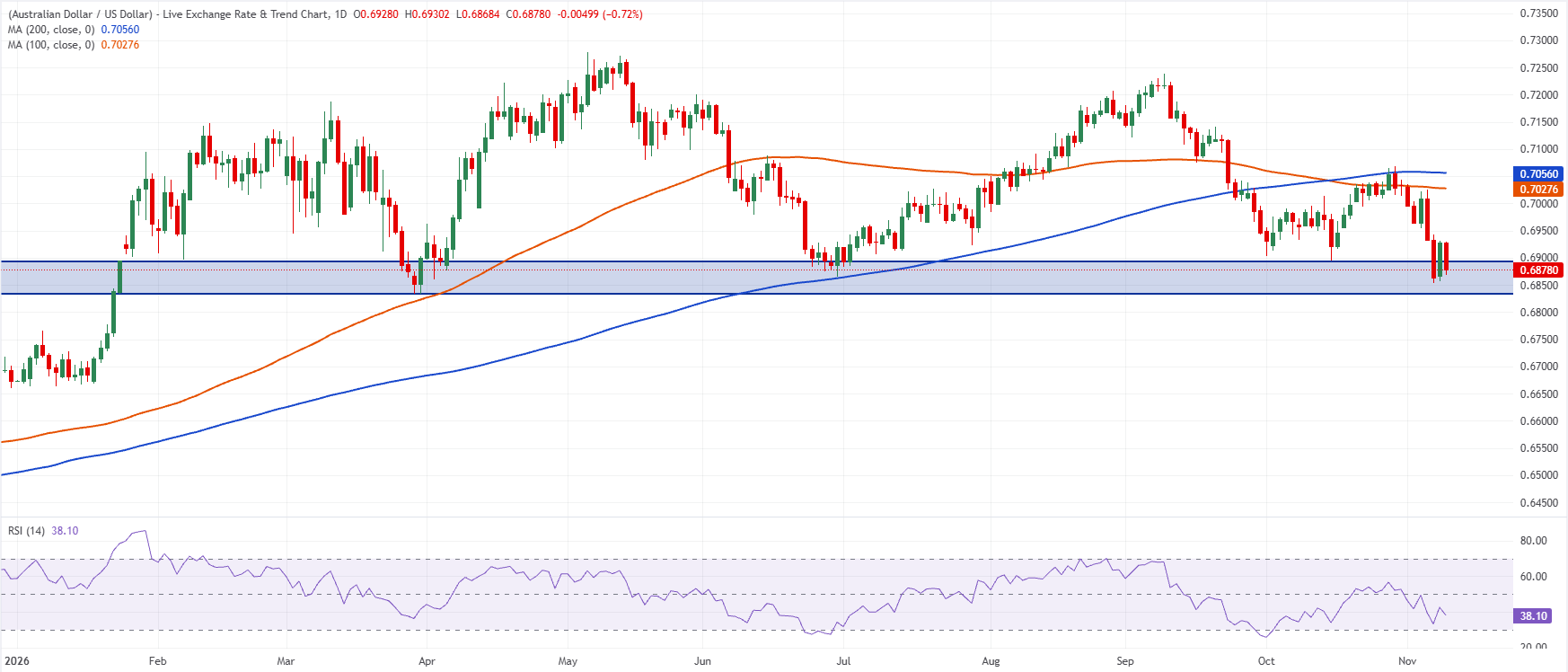
In the daily chart, AUD/USD trades at 0.6878, maintaining a bearish near-term tone as spot holds decisively beneath the 100-day simple moving average (SMA) at 0.7028 and the 200-day SMA at 0.7056. The pair’s inability to reclaim these medium-term averages suggests rallies remain capped for now, while the Relative Strength Index (14) around 38 hints at subdued momentum consistent with a shallow recovery rather than a sustained uptrend.
On the downside, failure to maintain a foothold above 0.6894 could revive selling pressure, exposing the recent low around 0.6855. A break below this level would bring the March low at 0.6834 back into focus. A decisive move beneath this support could confirm a deeper bearish extension.
(The technical analysis of this story was written with the help of an AI tool. Know more.)