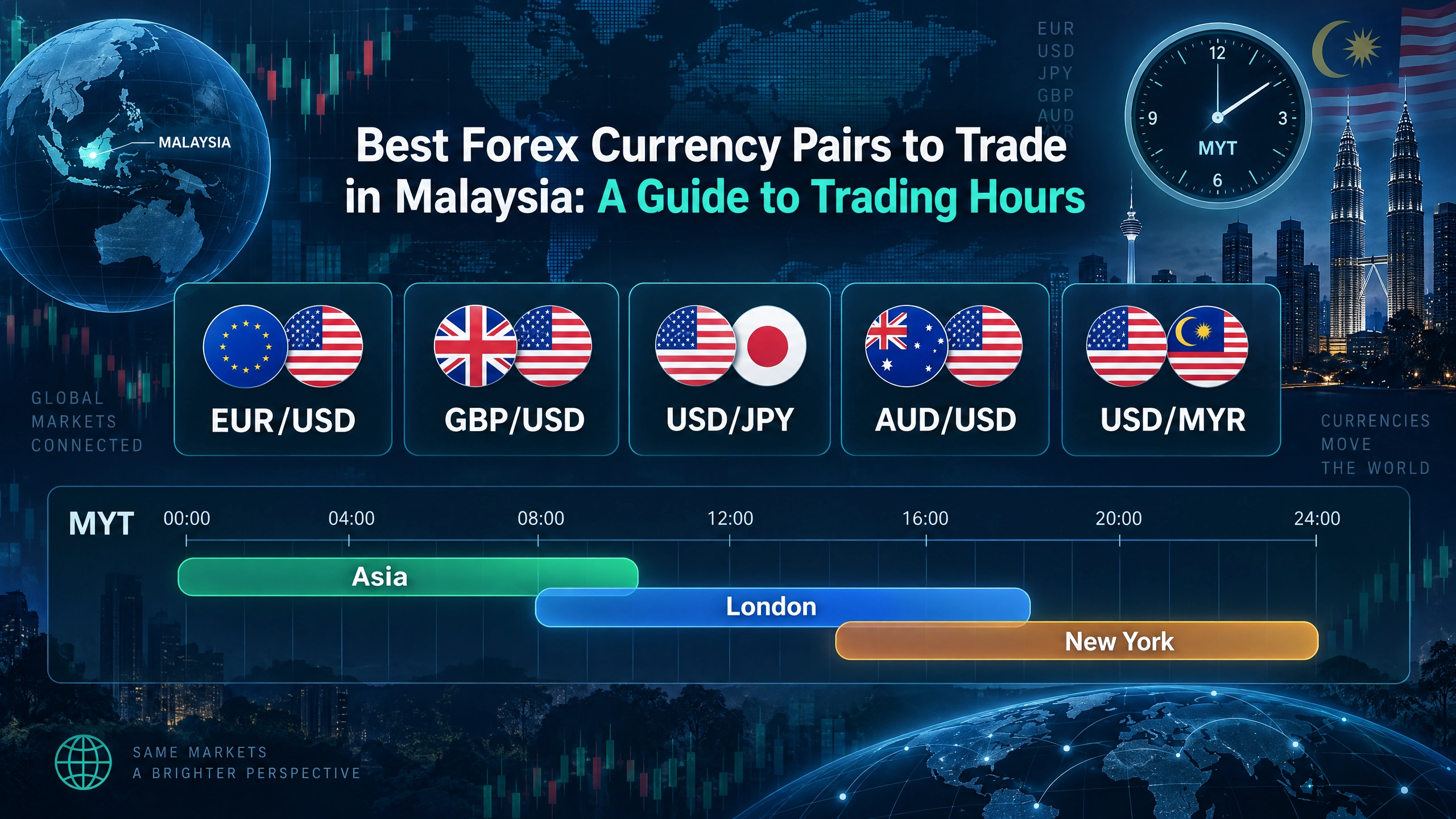
At 8 am in Kuala Lumpur, a trader opens a laptop before work. Tokyo’s financial markets are getting into their stride, London is still asleep, and New York will not begin its regular working day for several hours.
The trader has two choices: watch EUR/USD, the world’s most heavily traded currency pair, or examine USD/JPY, whose two currencies are closely connected to the Asian trading day.
The obvious choice is not necessarily the sensible one.
For Malaysian beginners, the best forex pair is not simply the one with the highest turnover or the largest daily price swings. It is the one whose active trading hours coincide with the time they can devote to watching prices, assessing risks, and managing positions.
That distinction matters in a market that operates almost continuously from Monday morning in Asia to Saturday morning in Malaysia. Forex trading may be open around the clock on weekdays, but its opportunities are not distributed evenly.
Forex Trading Hours in Malaysia: Why the Clock Matters More Than the Currency
Malaysia’s time zone gives local traders access to both Asian and Western markets, but the most active hours depend on which currencies they trade.
Malaysia follows Malaysia Time (MYT), UTC+8, throughout the year. Unlike London and New York, it does not change its clocks for daylight saving time.
That makes the international forex timetable less straightforward than it first appears.
Major forex sessions in Malaysian time (MYT)

The difference is not trivial. A Malaysian trader who expects London to open at 3pm all year may find that the relevant market activity shifts by an hour in late October.
There is another complication. Britain and America change their clocks on different dates. For a few weeks each year, the overlap between London and New York shifts relative to Malaysia.
The London–New York overlap, often regarded as one of the busiest periods for major currency pairs, generally falls between 8pm and midnight MYT during the northern summer, and between 9pm and 1am during winter.
What this means for a Malaysian trader
8 am–12 pm: The Asian session is underway. USD/JPY and AUD/USD deserve attention.
3 pm–6 pm: London enters the market during British summer time. EUR/USD and GBP/USD become more relevant.
8 pm–11 pm: European and American participation often overlaps. EUR/USD is a natural candidate for evening traders.
These are windows for observation, not promises of profitable trades. A busy market can offer tighter spreads and more opportunities, but it can also move abruptly when economic data surprises investors.
The first decision, therefore, is not which currency pair to buy or sell. It is which part of the trading day a Malaysian beginner can follow consistently.
Best Forex Pairs Malaysia: Five Options Worth Watching
EUR/USD and USD/JPY are reasonable starting points for beginners, but they serve different schedules.
The Bank for International Settlements’ 2022 Triennial Survey found that the US dollar was on one side of 88.5% of global foreign-exchange transactions. EUR/USD accounted for about 22.7% of global turnover, while USD/JPY represented approximately 13.5%.
These figures establish the importance of the two pairs. They do not establish which is most profitable, nor which is easiest to trade at any particular hour.
For beginners, liquidity, transaction costs, and the timing of market activity are more useful selection criteria than popularity alone.
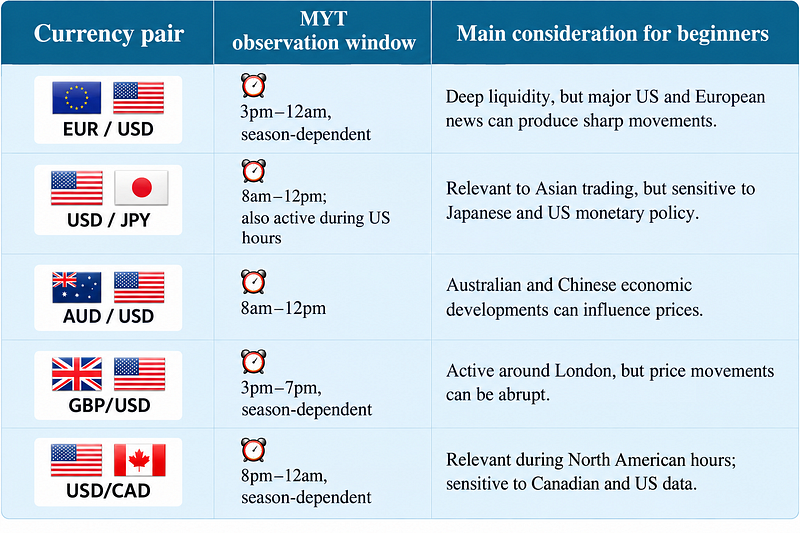
Windows are editorial starting points, not statistically verified for optimal trading hours. Seasonal shifts and individual broker conditions matter.
USD/JPY: A practical morning option
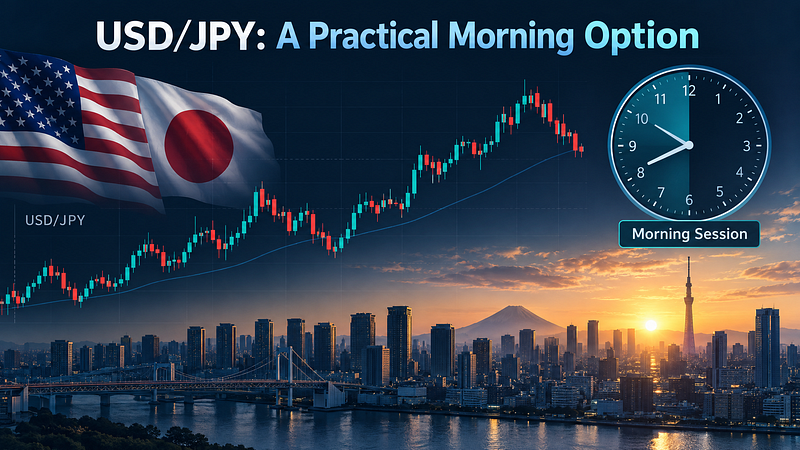
A beginner forex trader in Malaysia who can spend 30 minutes studying charts before work may find USD/JPY more convenient than EUR/USD.
Tokyo’s financial day coincides with Malaysia’s morning. Japanese economic announcements, Bank of Japan decisions and regional market developments can therefore influence the pair while Malaysian traders are awake.
Consider a trader who checks charts from 8 am to 9 am. They might review the previous day’s US dollar movement, mark the overnight high and low, and observe how USD/JPY behaves as Japanese trading activity develops.
This is a manageable routine. It is not a reason to place an order every morning.
USD/JPY can also react sharply to US inflation figures or Federal Reserve announcements released much later in the Malaysian day. Trading during Tokyo hours does not remove exposure to American monetary policy.
EUR/USD: A stronger fit for the evening

EUR/USD is often more relevant to Malaysians who finish work in the early evening.
The European session is already active by then, and American participation increases later. The combination can bring substantial trading volume and relatively competitive spreads under normal market conditions.
For someone who gets home at 7 pm and can monitor the market until 10 pm, EUR/USD may be more practical than a currency pair whose main regional activity occurs during office hours.
Yet high liquidity is not a guarantee of calm trading. A major US employment report can push EUR/USD sharply in either direction within minutes.
A beginner should distinguish between an active trading window and a suitable moment to enter a trade. The two are not synonymous.
AUD/USD, GBP/USD and USD/CAD: Useful alternatives, not compulsory additions
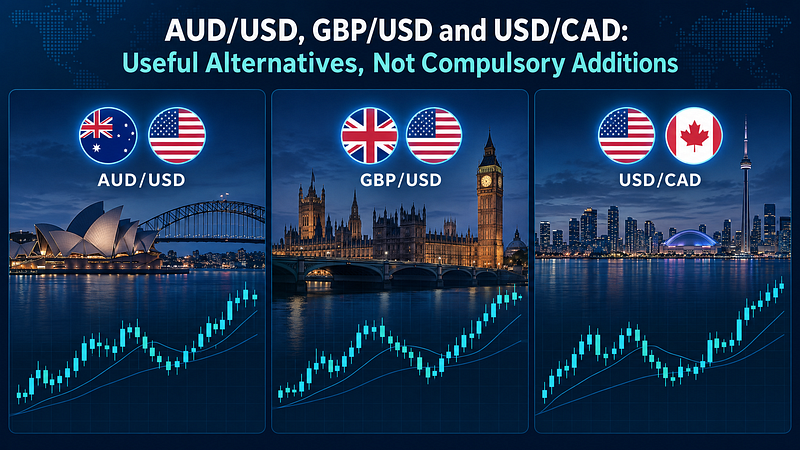
AUD/USD is worth observing during Asian hours, especially when Australian economic data or Chinese economic developments are in focus.
GBP/USD attracts attention during London trading. But its sometimes sharp price movements make it a less forgiving choice for beginners who have not yet developed a consistent approach to stop-loss placement.
USD/CAD is more closely aligned with North American hours. Canadian employment data, Bank of Canada decisions, and changes in oil prices can all affect the pair.
A Malaysian beginner does not need five currency pairs on a screen. One or two are sufficient for learning how trading hours, spreads, and price movements interact.
The Best Time to Trade Forex in Malaysia-May Be When You Trade Less

The busiest trading session is not necessarily the best one for a beginner. A predictable routine and manageable transaction costs can matter more than the number of price movements.
Established market practice favours periods when major financial centres overlap. More participants generally mean greater liquidity, which can help keep spreads competitive.
But liquidity and volatility are different things. A market can be highly liquid and still experience sudden price changes.
Consider two Malaysian traders:

Trader A: The morning commuter
Has one hour before work and follows USD/JPY during Tokyo trading. The routine allows time to review overnight developments and record observations, though the opening period may be volatile.

Trader B: The evening analyst
Has two hours after dinner and follows EUR/USD during the European-American overlap. Liquidity may be plentiful, but scheduled US data can make short-term movements difficult to manage.
Which trader has the better opportunity?
There is no reliable answer without knowing their strategies, costs, and ability to manage risk. Trader B may see more price movement, but Trader A may have a more consistent routine.
That leads to this article’s central judgment: for a beginner with a full-time job, the best currency pair is the one that can be monitored without disrupting work, sleep, or risk management.
A practical test: Does the movement justify the spread?
The difference between a good trading hour and an expensive one becomes clearer when transaction costs are expressed as a share of the expected price movement.
Suppose a trader is considering two hypothetical EUR/USD trading conditions.

The calculation is straightforward:
\[ \text{Spread-to-target ratio}=\frac{\text{Spread in pips}}{\text{Target in pips}}\times100 \]
In Window A, the spread consumes the equivalent of 4% of the intended price target. In Window B, it consumes 12.5%.
The second trade begins with a larger cost burden relative to its objective, even though the absolute spread difference is just 0.7 pips. Neither ratio predicts whether the trade will succeed, and a smaller target does not necessarily imply lower risk.
For beginners, this is a more useful question than asking which session moves the most: how much of the intended price movement would trading costs consume?
A sensible experiment is to record spreads, price ranges, and scheduled announcements for one currency pair over 20 trading days, using a demo account. The observations may reveal that a supposedly attractive hour offers little practical advantage once costs and sudden movements are considered.
How Malaysian Beginners Can Build a Trading Schedule Around Work?
A narrow, repeatable observation window is a better starting point than trying to follow the forex market throughout the day.
A beginner in Malaysia need not monitor every session. The following schedules offer three practical starting points.
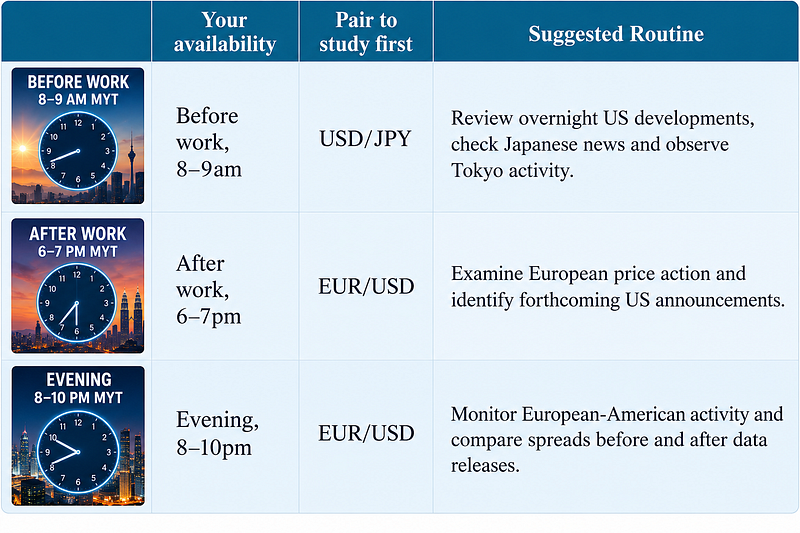
Someone who works from 9am to 6pm may find the evening EUR/USD window easiest to maintain. Someone with flexible mornings may prefer USD/JPY. And someone who cannot watch prices consistently may be better suited to longer-term chart analysis — or to avoid live trading altogether.
Three precautions deserve particular attention.
First, economic announcements can matter more than session labels. A US inflation release can transform an otherwise ordinary evening into a period of unusually rapid price changes. The relevant release time should always be converted to MYT.
Second, the spread displayed in an advertisement is not necessarily the spread available when an order is placed. Beginners should compare actual bid-ask prices during their intended trading hours, including commissions where applicable.
Third, the broker’s legal status matters more than the currency pair’s popularity. The Securities Commission Malaysia maintains a public register of licensed intermediaries and an Investor Alert List. The regulator warns that investors dealing with unauthorized entities may not receive protection under Malaysian securities laws.
Malaysian residents should check whether the particular entity and product they intend to use are authorized for the relevant activity, rather than relying on a broker’s overseas license or marketing claims.
The Bottom Line
Overall, Malaysian beginners should select a consistent observation window before choosing a currency pair. For a morning routine, USD/JPY is worth studying first. For an evening routine, EUR/USD is a reasonable option. The forex market offers Malaysian traders considerable choice. That is both its attraction and its difficulty. More trading hours do not necessarily produce better decisions.
For someone learning to trade alongside a day job, consistency is likely to be more useful than chasing every active session. The clock should help narrow the choices, not multiply them.
For more financial news and forex strategies, please visit: VG Markets.
Risk warning: Trading forex and CFDs involves significant risk and may result in losses that exceed expectations. Leverage magnifies both gains and losses. This article is for educational purposes only and does not constitute investment advice.
FAQs
What are the best forex pairs to trade in Malaysia?
EUR/USD, USD/JPY and AUD/USD are reasonable starting points for Malaysian beginners. USD/JPY and AUD/USD are relevant during Asian trading hours, while EUR/USD is often more active during the London and New York sessions. The best choice depends on your availability, trading costs, and risk tolerance.
What is the best time to trade forex in Malaysia?
The best time depends on the currency pair. For EUR/USD, the London–New York overlap, generally 8 pm–12 am or 9 pm–1 am MYT depending on the season, is often highly active. For USD/JPY, the Asian morning session, particularly 8 am–12 pm MYT, is worth observing.
Can I trade forex in Malaysia at night?
Yes. Forex trading generally operates 24 hours a day from Monday to Friday, with the trading week extending into early Saturday in Malaysia. Evening hours are particularly relevant for EUR/USD, GBP/USD, and USD/CAD because European and American financial markets are active. However, liquidity and spreads vary throughout the night.
Is USD/JPY better than EUR/USD for Malaysian beginners?
Neither pair is universally better. USD/JPY suits traders available during Malaysian mornings, whereas EUR/USD is often more convenient for those trading after work. Both are highly traded currency pairs, but their volatility, spreads, and reactions to economic news differ.