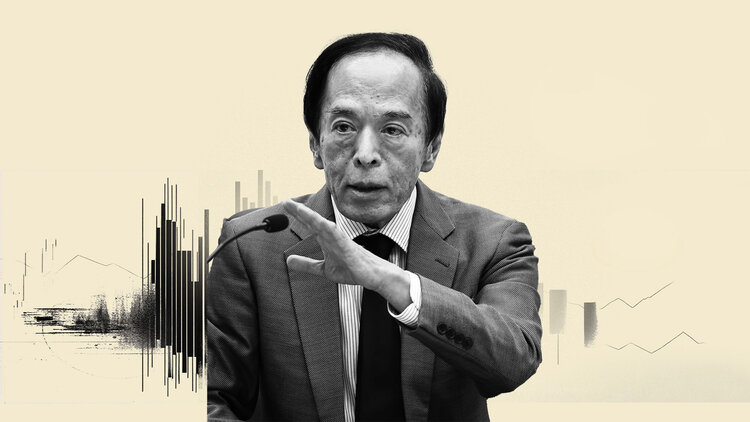
Bank of Japan (BoJ) Governor Kazuo Ueda said on Thursday that underlying inflation roughly aligns with the price target. He added that the central bank plans to continue raising interest rates as monetary conditions remain accommodative.
Key quotes
Japan's economy steady but showing some fragility.
Underlying inflation roughly aligns with price target.
Risk inflation could exceed central bank's target.
Plans to continue raising interest rates as monetary conditions remain accommodative.
Crucial to anchor core inflation near 2% to prevent risk of inflation overshoot.
Simulations indicate accelerated ETF sales won’t severely impact BoJ finances.
Rate hikes raise firms' funding costs but strong corporate earnings and rising wages also factor in economic impact.
Real interest rates stay low in short-term zones despite previous hikes with biggest effect on economy.
Financial conditions stay loose, backing economic activity.
Will closely examine impact of rate hikes on corporate and household activity.
July-September consumption decline in GDP data matches expectations.
Consumption steady overall as wages grow steadily amid tight labor market.
Consumption likely to resume moderate rise as nominal wages increase steadily, inflation expected to gradually ease.
Rising crude oil prices, weak yen may dent household real income, curb spending more than expected.
Pace and timing of rate increases will depend on our evaluation of probability of baseline projections materialising and associated risks.
Weak yen could cause inflation overshoot by driving up prices across many goods.
FX swings could affect inflation more as companies pass on costs more actively.
Difficult to determine response if weak domestic demand and yen decline coexist.
FX swings could influence price changes more than before, impacting long-term inflation expectations and core inflation.
Reduced presence in JGB market lets long-term rates reflect market views on economy, prices, fiscal and monetary policies.
BoJ’s Ueda flags inflation overshoot risks, keeping Yen sensitive to rate path
FXS Speechtracker’s 8/10 score versus the 7.5/10 historic average signals a modestly more hawkish tone, driven by Ueda’s emphasis on inflation overshoot risks and the intention to continue raising rates while financial conditions remain loose. The focus on anchoring core inflation near 2%, the acknowledgment that weak Yen and higher crude prices could push inflation above target, and the reduced BoJ presence in the JGB market all reinforce a shift toward allowing higher long-term yields and a more market-driven rate environment.
At the same time, Ueda highlights steady consumption supported by rising wages and low real rates, suggesting policy normalization will be gradual and data-dependent, with the pace and timing of hikes tied to the probability of baseline projections materialising. This mix of ongoing accommodation, concern about weak domestic demand, and heightened sensitivity to FX swings implies a cautiously hawkish stance that keeps Yen and Japanese rates highly responsive to incoming inflation and wage data.
Market reaction
At the time of writing, the USD/JPY pair is up 0.03% on the day at 159.35.
Bank of Japan FAQs
The Bank of Japan (BoJ) is the Japanese central bank, which sets monetary policy in the country. Its mandate is to issue banknotes and carry out currency and monetary control to ensure price stability, which means an inflation target of around 2%.
The Bank of Japan embarked in an ultra-loose monetary policy in 2013 in order to stimulate the economy and fuel inflation amid a low-inflationary environment. The bank’s policy is based on Quantitative and Qualitative Easing (QQE), or printing notes to buy assets such as government or corporate bonds to provide liquidity. In 2016, the bank doubled down on its strategy and further loosened policy by first introducing negative interest rates and then directly controlling the yield of its 10-year government bonds. In March 2024, the BoJ lifted interest rates, effectively retreating from the ultra-loose monetary policy stance.
The Bank’s massive stimulus caused the Yen to depreciate against its main currency peers. This process exacerbated in 2022 and 2023 due to an increasing policy divergence between the Bank of Japan and other main central banks, which opted to increase interest rates sharply to fight decades-high levels of inflation. The BoJ’s policy led to a widening differential with other currencies, dragging down the value of the Yen. This trend partly reversed in 2024, when the BoJ decided to abandon its ultra-loose policy stance.
A weaker Yen and the spike in global energy prices led to an increase in Japanese inflation, which exceeded the BoJ’s 2% target. The prospect of rising salaries in the country – a key element fuelling inflation – also contributed to the move.