
- Gold recovers as falling US Treasury yields and a softer US Dollar attract buyers.
- Hawkish Fed expectations remain a challenge for Gold as inflation risks persist.
- XAU/USD remains below the Bollinger Bands midline, keeping the near-term technical outlook bearish.
Gold (XAU/USD) attracts fresh buying on Thursday as weakness across global equities, driven by mounting concerns over AI-related investments, triggers a sharp pullback in US Treasury yields and drags the US Dollar (USD) lower from fresh year-to-date highs. At the time of writing, XAU/USD trades around $4,159, up 1.31% on the day.
The risk-averse mood drives investors toward safe-haven assets, including precious metals and government bonds, with traders largely shrugging off stronger-than-expected US economic data.
The benchmark 10-year US Treasury yield falls around 9 basis points (bps) to 5.06%, its lowest level in three weeks. Meanwhile, the US Dollar Index (DXY), which tracks the Greenback’s value against a basket of six major currencies, slips toward 102.00 after reaching 102.94 the previous day.
Data released on Thursday showed that the Producer Price Index (PPI) rose 1.3% MoM and 6.3% YoY in September, exceeding forecasts of 0.5% and 5.3%, respectively. Core PPI, which excludes food and energy, increased 0.7% MoM and 5% YoY, also beating estimates of 0.3% and 4.4%.
Retail Sales increased 0.8%, above the 0.3% forecast, following an upwardly revised 1.3% rise in August. Weekly Initial Jobless Claims came in at 199K, slightly below expectations of 200K and up from 198K the previous week.
The figures follow Wednesday’s Consumer Price Index (CPI) report, which showed headline inflation accelerating to 3.7%, above the 3.6% forecast, while core inflation rose to 2.6%, exceeding expectations of 2.5%.
Higher energy prices remain a major driver of headline inflation. With no sign of a near-term agreement between the US and Iran to reopen the Strait of Hormuz, and fighting between Saudi Arabia and Yemen’s Houthis adding to supply risks, energy-driven price pressure could persist for longer, complicating the Fed’s efforts to bring inflation back to its 2% target.
Against this backdrop, traders expect the Fed to deliver another interest rate hike before year-end, with the CME FedWatch Tool showing around a 90% probability of an increase in December. However, a hike at the October meeting remains less likely than a hold, as recent Fed comments suggest policymakers are cautious about raising rates at consecutive meetings.
San Francisco Fed President Mary Daly said on Wednesday “more rate hikes likely, timing still under consideration,” adding that “risks to above-target inflation remain high” and a “steady labor market allows focus on price stability.” New York Fed President John Williams and Fed Vice Chair Philip Jefferson also signalled earlier this month that officials could take time before raising rates again.
For Gold, the prospect of further Fed tightening could limit a stronger recovery by cushioning the downside in the US Dollar and Treasury yields. Higher interest rates also increase the opportunity cost of holding the non-yielding metal.
Technical analysis: XAU/USD needs a break above $4,200 to extend recovery
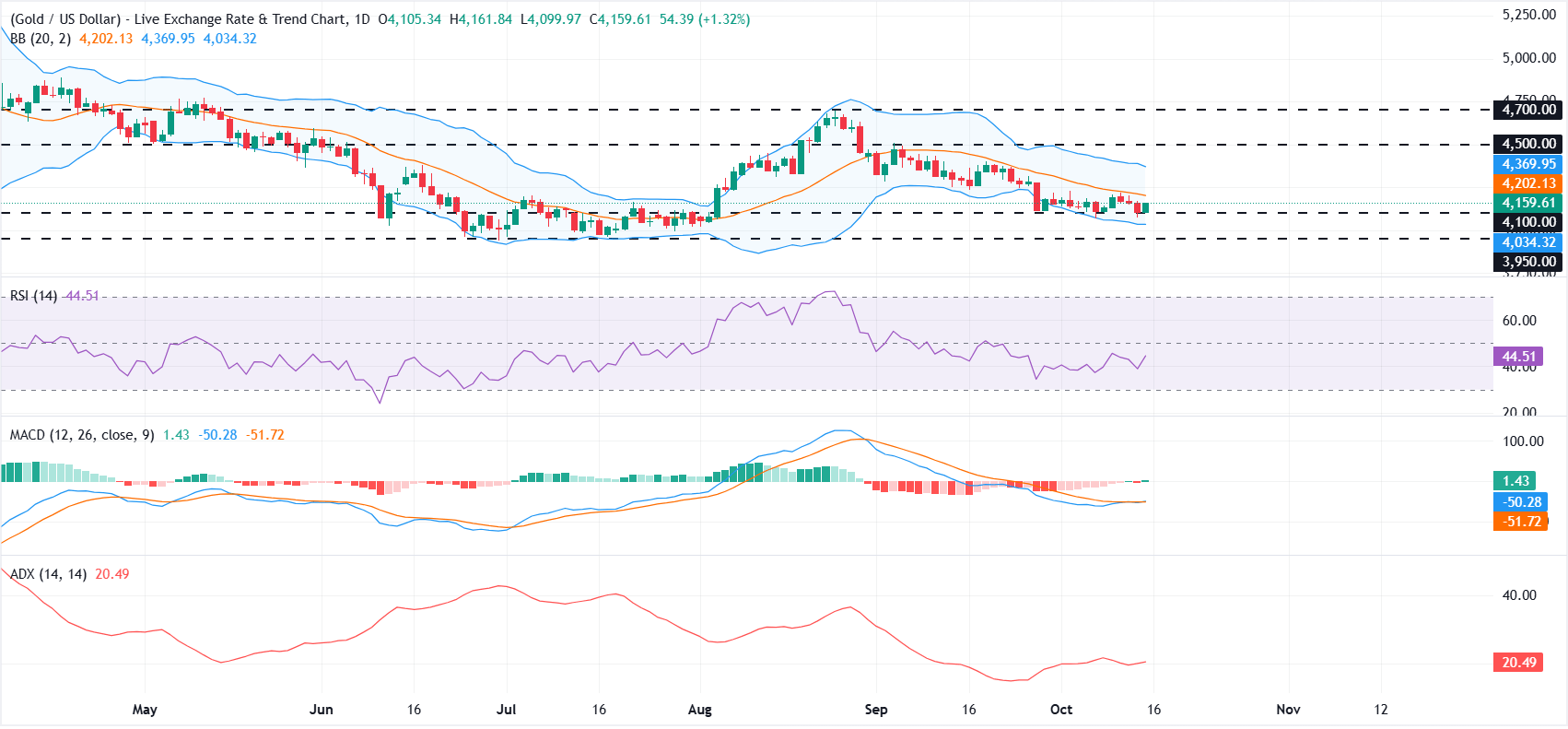
On the daily chart, XAU/USD maintains a pattern of lower highs and lower lows since peaking near $4,700 in late August, although prices remain largely trapped between $4,100 and $4,200 since the start of the month. The metal holds below the 20-day Simple Moving Average (SMA), which forms the Bollinger middle band around $4,202, keeping the near-term bias tilted to the downside.
The Relative Strength Index (RSI) near 44 leans slightly negative without signalling oversold conditions. The Moving Average Convergence Divergence (MACD) has turned marginally positive, suggesting fading downside momentum rather than a clear bullish reversal, while the Average Directional Index (ADX) near 20 points to a relatively weak underlying trend.
On the downside, initial support emerges near $4,100, followed by the lower Bollinger band around $4,034. A break below this level would expose the $4,000-$3,950 support zone.
On the topside, a first hurdle is seen at the Bollinger middle band at $4,202, with subsequent resistance aligning at the upper band near $4,369 and then the more strategic horizontal caps at $4,500 and $4,700, which would need to be reclaimed to ease the broader bearish pressure.
(The technical analysis of this story was written with the help of an AI tool. Know more.)
Gold FAQs
Gold has played a key role in human’s history as it has been widely used as a store of value and medium of exchange. Currently, apart from its shine and usage for jewelry, the precious metal is widely seen as a safe-haven asset, meaning that it is considered a good investment during turbulent times. Gold is also widely seen as a hedge against inflation and against depreciating currencies as it doesn’t rely on any specific issuer or government.
Central banks are the biggest Gold holders. In their aim to support their currencies in turbulent times, central banks tend to diversify their reserves and buy Gold to improve the perceived strength of the economy and the currency. High Gold reserves can be a source of trust for a country’s solvency. Central banks added 1,136 tonnes of Gold worth around $70 billion to their reserves in 2022, according to data from the World Gold Council. This is the highest yearly purchase since records began. Central banks from emerging economies such as China, India and Turkey are quickly increasing their Gold reserves.
Gold has an inverse correlation with the US Dollar and US Treasuries, which are both major reserve and safe-haven assets. When the Dollar depreciates, Gold tends to rise, enabling investors and central banks to diversify their assets in turbulent times. Gold is also inversely correlated with risk assets. A rally in the stock market tends to weaken Gold price, while sell-offs in riskier markets tend to favor the precious metal.
The price can move due to a wide range of factors. Geopolitical instability or fears of a deep recession can quickly make Gold price escalate due to its safe-haven status. As a yield-less asset, Gold tends to rise with lower interest rates, while higher cost of money usually weighs down on the yellow metal. Still, most moves depend on how the US Dollar (USD) behaves as the asset is priced in dollars (XAU/USD). A strong Dollar tends to keep the price of Gold controlled, whereas a weaker Dollar is likely to push Gold prices up.