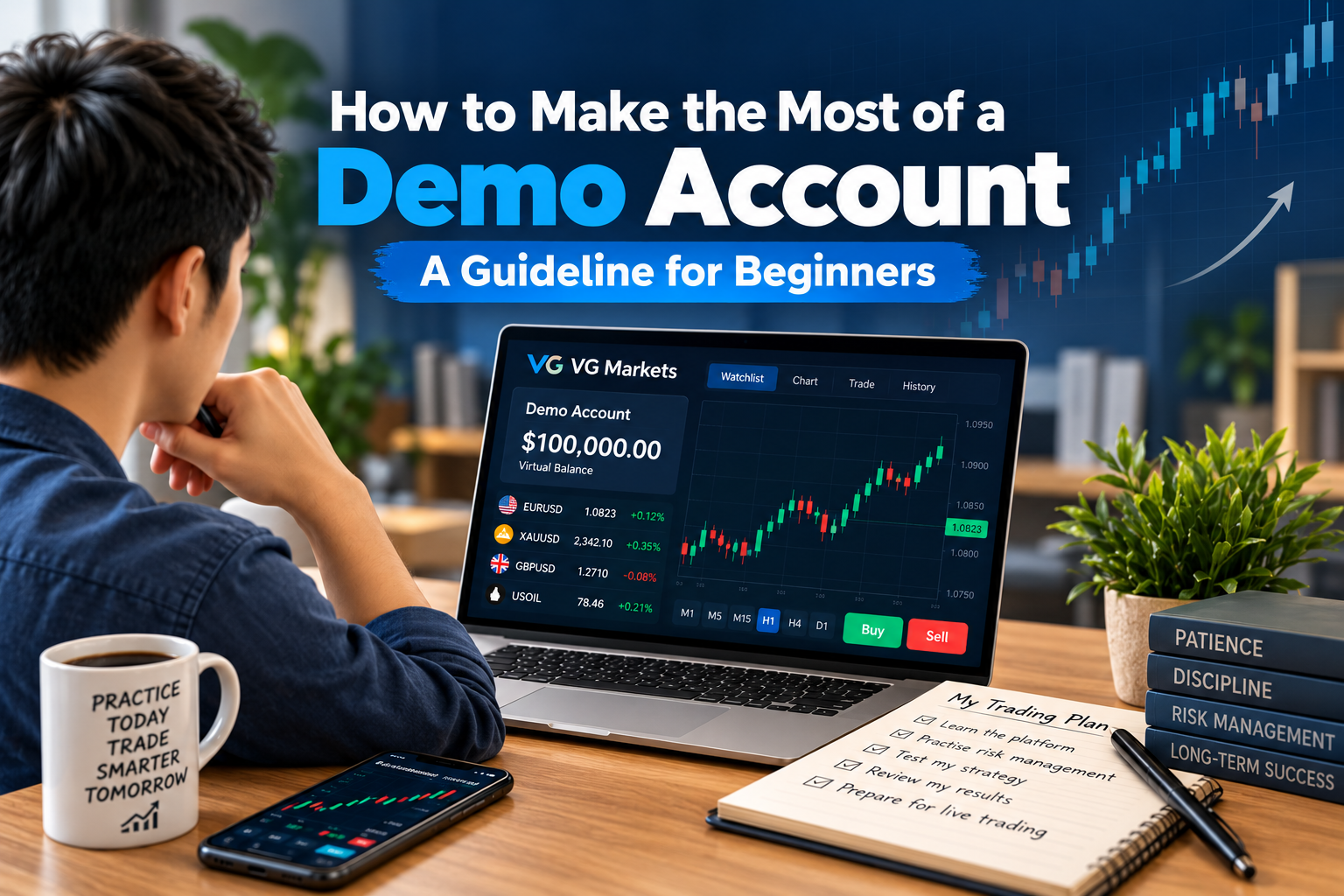
Opening a demo trading account takes only a few minutes. Learning how to use it properly can take considerably longer. Most forex and CFD brokers offer demo accounts that allow beginners to practice trading with virtual money. A demo account enables you to open positions, place stop-loss orders, test indicators, and follow market movements without risking your savings.
Yet many beginners make the same mistake: they treat a demo account like a trading game. They open oversized positions, chase quick profits, and celebrate impressive returns that would be difficult to repeat with real money.
The real purpose of a demo account is not to make the largest virtual profit. It is to find out whether your trading decisions make sense.
This guide explains how beginners can use demo trading to develop practical skills, test strategies, and recognize when they are ready—or not ready—to trade with real money.
What Is a Demo Trading Account?
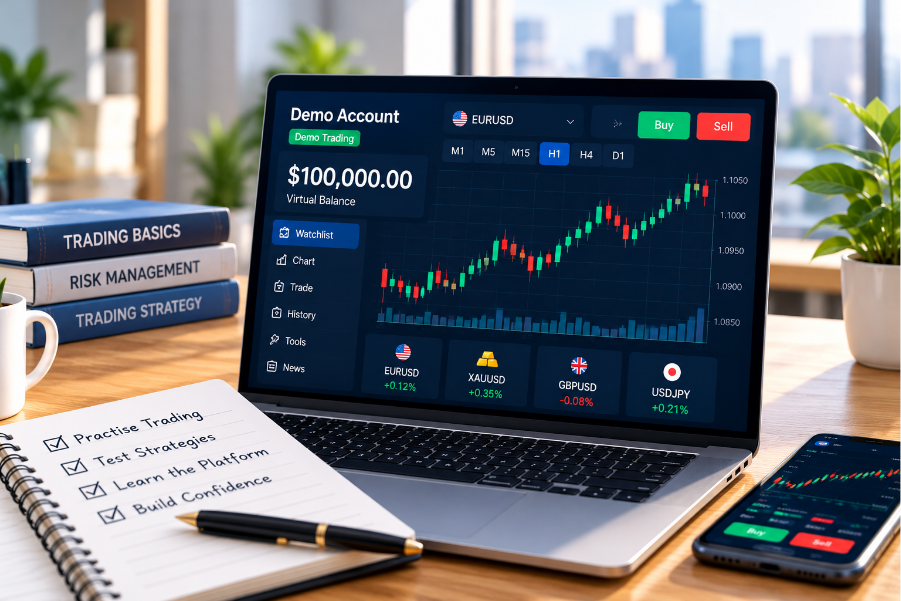
A demo account, literally, is not a real trading account. It is responsible for providing a simulated trading environment. A demo account is typically equipped with a large sum of virtual funds for beginners to place buy and sell orders and test technical charts and indicators.
A demo account is totally risk-free. For instance, if a beginner buys gold and the price rises, the account shows a virtual profit. If the price falls, the account records a virtual loss. No Actual money changes hands.
One important thing to note is that, however, demo execution is not fully the same as live-market conditions, particularly when low liquidity or sharp price movements occur. A demo account is best considered as a training environment rather than a reliable predication of future trading performance.
Why Should Beginners Use a Demo Account?
A demo account can help beginners answer three questions before depositing real money.
First, do I understand how the trading platform works?
Even simple mistakes can be expensive in live trading. A beginner may accidentally enter the wrong lot size, place a buy order instead of a sell order, or forget to set a stop-loss. Practicing these actions repeatedly can reduce avoidable operational errors.
Second, can I follow a trading plan?
Knowing what a trading strategy is and executing it consistently are two different skills. A demo account provides an opportunity to test whether you can wait for a setup, calculate position size, and close a trade according to predefined rules. You become more sensible and patient in your demo trading environment; then when it switches to a real trading model, perhaps you won't panic when encountering sudden changes.
Third, how does my strategy perform over multiple trades?
One profitable trade proves very little. A series of recorded trades provides more useful information about win rates, average losses, and trading costs.
The objective is to develop a repeatable process, not to prove that every trade can be profitable. A demo account plays a crucial role in fostering your trading strategy. More trading opportunities can make your trading strategy more mature.
How to Use a Demo Account: A Guideline for Beginners
A demo account is far more than a decorative feature. Instead, it is a foundational asset for beginners.
It provides an ideal test ground for beginners to test their trading strategies. More importantly, enabling them to get familiar with risk management, the most important component on the trading road. Overall, a demo account is a precious tool to develop execution maturity and psychological discipline before making real trades.
Set Your Demo Balance to Match Your Real Trading Budget
One of the most overlooked aspects of demo trading is the starting balance.
Imagine you plan to begin live trading with $200, but your demo account contains $50,000.
You might open positions that require several thousand dollars in margin, absorb large losses, and still have plenty of virtual money left.
That experience tells you little about managing a $200 account.
Consider the following example:
Trading Scenario | $50,000 Demo Account | $200 Live Account |
Account balance | $50,000 | $200 |
Loss on one trade | $20 | $20 |
Percentage of capital lost | 0.04% | 10% |
Remaining balance | $49,980 | $180 |
The same $20 loss has a completely different effect on each account.
This is why beginners should calculate risk as a percentage of their intended live capital, not simply as a dollar amount. Remember that a demo account with large virtual funds does not mean that you must invest so much in your real trading account.
Learn the Trading Platform Before Testing a Strategy
The first move before you make predictions about market direction would be spending time understanding the platform itself. This is a basic act, yet many beginners focus on chart patterns while neglecting how orders actually work.
Let's start with a simple exercise:
A beginner opens a chart of EUR/USD and identifies the current bid and ask prices. Then he begins a small buy order. After opening the position, practice setting a stop-loss and take-profit level.
The next step is to adjust both orders and close the trade manually.
Then he repeats the process using a sell order.
During this exercise, pay attention to five elements:
Order size: If I changed the lot size, would it affect market exposure?
Spread: The difference between buying and selling prices.
Margin: Is account equity required to open the position?
Stop-loss: What happens when the market reaches your exit level?
Trading history: Where can you locate the completed trade and its costs?
Don't be so rushed during this period. A beginner who truly understands the platform won't make expensive mistakes during their real trading stage.
Practice Risk Management Before Trying to Make Profits
Many beginners use demo accounts to test how much money they can make.
A more useful approach is to test how much they might lose.
Suppose you plan to start with $500 and choose a practice risk limit of 1% per trade.
Your maximum planned loss would be:
$500 × 1% = $5
Now imagine you want to trade EUR/USD with a stop-loss 25 pips away.
For a standard USD-denominated account, a 0.01-lot EUR/USD position has a pip value of approximately $0.10.
Your estimated loss at the stop-loss would be:
25 pips × $0.10 = $2.50
That represents 0.5% of your planned $500 account, excluding trading costs and any slippage.
The example illustrates an important principle: your position size and stop-loss distance should work together.
A wider stop-loss generally requires a smaller position if you want to maintain the same dollar risk.
What If the Broker's Minimum Lot Size Is Too Large?
This is a practical problem for beginners with small accounts.
Suppose your planned maximum risk is $2, but the smallest permitted position would lose approximately $6 at a reasonable stop-loss distance.
You have three choices: reduce your intended risk by using a smaller supported position, choose a different instrument or skip the trade.
Moving the stop-loss closer simply to fit the budget may change the strategy and cause otherwise avoidable exits.
A demo account helps you identify these limitations before committing real funds.
Test One Trading Strategy at a Time
A demo account gives you access to many possible strategies, but testing several at once makes it difficult to understand what works.
Start with one simple setup.
For example, a beginner wants to test a trend-following strategy on EUR/USD using the one-hour chart.
The rules could be:
- Identify the broader direction using the 50-period moving average.
- Consider buying only when the price is above that average.
- Wait for a pullback rather than entering after a large price movement.
- Place the stop-loss below a relevant recent swing low.
- Set a profit target based on a predefined reward-to-risk ratio.
These are hypothetical testing rules, not a recommendation to trade this strategy.
The important part is consistency.
If you change the entry rules after every losing trade, your results become difficult to interpret.
A useful demo experiment keeps the same rules long enough to reveal whether the approach has any repeatable characteristics.
Keep a Trading Journal: Your Most Useful Demo Tool
A trading journal may be more valuable than another technical indicator.
Without records, beginners tend to remember their largest wins and forget the many small losses that reduced their balance.
A journal forces you to examine what actually happened.
You do not need complicated software. A spreadsheet is enough.
Date | Instrument | Reason for Entry | Planned Risk | Result | Followed Rules? |
Monday | EUR/USD | Trend pullback | $5 | +$10 | Yes |
Tuesday | Gold | Breakout | $5 | -$5 | Yes |
Wednesday | EUR/USD | Impulsive entry | $5 | -$8 | No |
Thursday | GBP/USD | Support retest | $5 | +$7 | Yes |
The Wednesday trade deserves particular attention.
The trader planned to risk $5 but lost $8 after entering impulsively and failing to follow the original plan.
That mistake matters even if the overall demo account remains profitable.
After every ten trades, review your journal and ask:
- Which setups produced the most consistent results?
- Did I respect my planned risk?
- Were my losses caused by the strategy or by breaking its rules?
- Did trading costs materially reduce my returns?
These questions help distinguish a weak strategy from poor execution.
Measure More Than Your Win Rate
In most cases, beginners have a misunderstanding: a high win rate means a successful strategy.
This is not necessarily true.
Consider two traders, Joseph and Tom, who each complete ten trades.
Performance | Joseph | Tom |
Winning trades | 8 | 4 |
Losing trades | 2 | 6 |
Average win | $5 | $20 |
Average loss | $25 | $8 |
Net result | -$10 | +$32 |
From the table above, we can see clearly that Joseph wins 80% of the time but ends up losing money overall, while Tom wins only 40% of the time but reaches a profit.
The key lies in the relationship between average gains and average losses.
Here, expectancy plays a role: the average amount a strategy is expected to gain or lose per trade based on its observed results.
The basic formula is:
Expectancy = (Win Rate × Average Win) − (Loss Rate × Average Loss)
For Trader B:
(40% × $20) − (60% × $8) = +$3.20 per trade
Of course, this is not a guaranteed future win. A short sample can sometimes generate misleading results.
However, expectancy gives more information than win rate alone. When analyzing your demo performance, take spreads, commissions and financing charges into consideration wherever applicable.
Practise During the Hours You Would Actually Trade
A demo strategy that works at 3 a.m. may not be practical for someone with a full-time job.
This is particularly relevant for beginners in Malaysia who can only monitor markets after work.
Suppose you normally have time to trade between 8 p.m. and 10 p.m. Malaysia time.
Test your strategy during that window instead of placing demo trades throughout the day.
This allows you to evaluate whether your preferred instruments have suitable price movement and trading conditions when you are actually available.
It also helps you answer practical questions.
Can you identify setups without constantly watching the screen? Do you have enough time to manage open positions? Are you tempted to enter trades simply because you have a free evening?
Your trading schedule should be part of the experiment.
A strategy that requires continuous monitoring may be unsuitable for someone who can only check charts twice a day.
Understand Why Demo Trading Feels Easier Than Live Trading
One of the biggest limitations of demo trading has nothing to do with charts or technical indicators.
It is the absence of real financial pressure.
Losing $100 in virtual money is very different from losing $100 from your savings.
When trading with real money, beginners may experience fear, frustration, or the urge to recover losses immediately.
These emotions can change their behaviour.
A trader who calmly follows a stop-loss in a demo account might move that same stop-loss further away in live trading to avoid accepting a loss.
Similarly, a trader may close profitable positions too early because the prospect of losing an unrealised gain feels uncomfortable.
Demo trading cannot fully reproduce these psychological pressures.
There are also technical differences. Live orders frequently experience slippage, execution delays, and technical lags, whereas these rarely appear in a demo trading environment.
Therefore, perfect demo results do not necessarily stand for your live trading ability.
How Long Should You Use a Demo Account?
There is no universal number of days that makes someone ready for live trading.
Practising for 30 days may be useful, but the number of completed trades and the quality of your records matter more than the calendar.
A beginner who places only three trades in a month has learned less about a strategy's consistency than someone who has documented 40 trades under comparable conditions.
As a practical starting point, consider recording 30 to 50 trades using the same rules.
This is a training benchmark, not a statistically sufficient sample for proving profitability.
If your strategy trades infrequently, collecting that sample may take several months.
Before considering live trading, check whether you can:
- Place and modify orders without confusion.
- Calculate position size before entering a trade.
- Follow stop-loss rules consistently.
- Explain your entry and exit decisions.
- Review trading results after accounting for costs.
- Accept losing trades without immediately trying to recover the money.
If you are still frequently breaking your own rules, additional demo practice may be more useful than opening a live account.
When Should You Move From Demo to Live Trading?
Moving to a live account should not be viewed as a reward for reaching a particular virtual profit target.
Instead, it is a separate stage of learning.
You may be ready to consider that step when your demo results show a reasonably consistent process, your position sizing is suitable for your actual budget, and you understand the possibility of losing your deposited funds.
Even then, begin with a small amount of money you can afford to lose.
Keep your initial live positions small and compare the results with your demo experience.
Pay particular attention to differences in spreads, execution quality, financing costs, and your own decision-making.
If your behaviour changes significantly under real financial pressure, reducing exposure or returning to demo practice may be sensible.
The goal is not to move to live trading as quickly as possible. It is to understand what changes when virtual money becomes real.
The Bottom Line
A demo account is one of the most accessible learning tools available to beginner traders, but its value depends on how it is used.
Rather than trying to turn $50,000 in virtual funds into an impressive six-figure balance, beginners should practise realistic position sizes, test one strategy consistently, and maintain a detailed trading journal.
Focus on the quality of your decisions, not just the balance displayed on the screen.
A successful demo account is not necessarily one that makes the most money. It is one that helps you recognise your mistakes before those mistakes become expensive.
FAQs
Can beginners make money with a demo account?
No. Demo profits are virtual and cannot be withdrawn. A demo account is designed for practising trading skills without risking real money.
Is a $50,000 demo account suitable for beginners?
Yes, but beginners should practise with position sizes that reflect their intended live trading budget rather than using the entire virtual balance.
How many trades should I practise before trading live?
Recording 30 to 50 trades can provide an initial basis for reviewing your strategy and behaviour. It does not guarantee that you are ready or that the strategy will be profitable.
Can I lose more than my demo account balance?
Demo losses involve virtual funds, not real money. However, the treatment of negative balances depends on how the simulation is configured.