
- The Indian Rupee attracts significant bids against the US Dollar despite oil prices gaining sharply.
- TD Securities expects oil prices to retain a risk premium amid ongoing Middle East risks.
- Both the US Dollar and US Treasury Yields are seen regaining ground.
The Indian Rupee (INR) rebounds sharply against the US Dollar (USD) even as oil prices continue to boil due to Middle East risks. On Friday, the USD/INR pair slumps below 95.00 after failing to extend its gains above over two-week high of 95.38 posted the previous day.
As of writing, the MCX Crude Oil contract expiring on November 19 jumps to a fresh multi-month high near Rs. 9,900.
Theoretically, higher oil prices bode poorly for currencies from economies, such as India, given their significant reliance on oil imports to meet their energy needs.
Crude trades under headline pressure but risk premium keeps energy supported
According to TD Securities, a "deal headline barrage" ahead of the US midterm elections is exerting notable pressure on crude, with "persistent headlines of deal talks" weighing on the market. The bank expects this dynamic to persist into the vote, but adds that it does not anticipate that Iran would agree to a deal "just before the tense elections."
At the same time, TD Securities stresses that "on the ground, the fundamentals remain tight," pointing to tanker attacks and Houthi pressure, which "appear to have been successful in reducing Mideast flows, at least temporarily." The bank argues that "so long as continued attacks keep a risk premium in the market, energy prices should remain well-supported in this higher range."
US bond yields regain ground
A strong recovery move in US Treasury Yields has also failed to weaken the Indian Rupee. As of writing, 10-year US Treasury Yields are flat to near 4.93% after clawing back its entire early losses. Earlier in the day, 10-year US bond yields slid to a fresh seven-week low at 4.89%.
US bond yields came under pressure even though preliminary United States (US) Q3 Gross Domestic Product (GDP) growth remained stronger than expected and the core Personal Consumer Expenditures (PCE) Price Index, which is Federal Reserve’s (Fed) preferred inflation gauge, elevated further.
On Tuesday, the Bureau of Economic Analysis (BEA) reported that the economy expanded at an annualized pace of 3.4%, faster than estimates of 3.2% and the prior release of 2.2%.
The US core PCE Inflation rose by 3.1% Year-on-Year (YoY) in September, in line with expectations, and higher than the August reading of 3%. On a monthly basis, the growth was similar to estimates and the prior release of 0.3%.
Technical Analysis: USD/INR retreats below 95.00
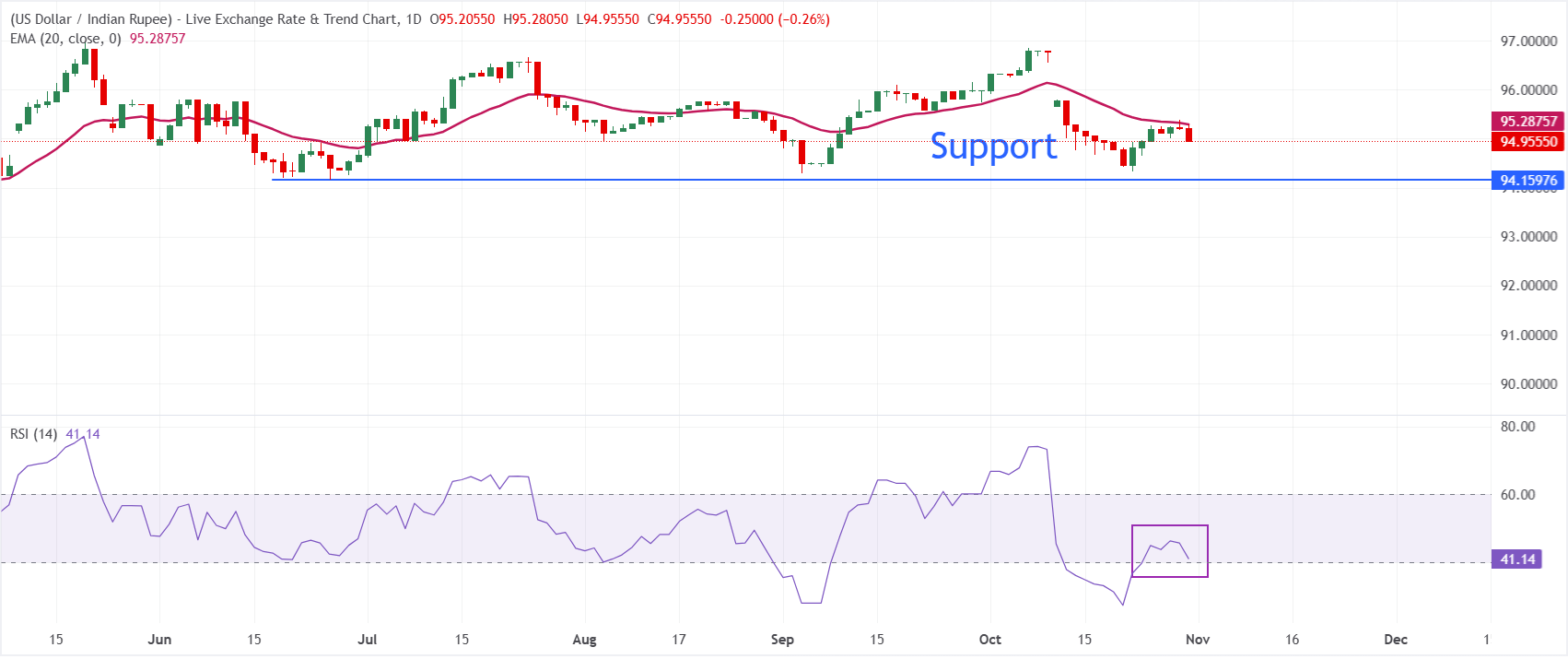
In the daily chart, USD/INR trades near 94.95, maintaining a mildly bearish near-term bias as spot holds below the 20-period exponential moving average (EMA) at 95.31. The pair has retreated from late-September highs and the loss of the short-term EMA suggests upside attempts are being capped, while the Relative Strength Index (RSI) at 45 hovers just below neutral, hinting at fading bullish momentum rather than outright oversold conditions.
On the topside, immediate resistance is located at the 20-day EMA near 95.31, followed by 96.00. Looking down, the June 25 low at 94.16 is the key support level.
(The technical analysis of this story was written with the help of an AI tool. Know more.)
Economic Indicator
Core Personal Consumption Expenditures - Price Index (YoY)
The Core Personal Consumption Expenditures (PCE), released by the US Bureau of Economic Analysis on a monthly basis, measures the changes in the prices of goods and services purchased by consumers in the United States (US). The PCE Price Index is also the Federal Reserve’s (Fed) preferred gauge of inflation. The YoY reading compares the prices of goods in the reference month to the same month a year earlier. The core reading excludes the so-called more volatile food and energy components to give a more accurate measurement of price pressures." Generally, a high reading is bullish for the US Dollar (USD), while a low reading is bearish.
Read more.Last release: Thu Oct 29, 2026 12:30
Frequency: Monthly
Actual: 3.1%
Consensus: 3.1%
Previous: 3%
Source: US Bureau of Economic Analysis
After publishing the GDP report, the US Bureau of Economic Analysis releases the Personal Consumption Expenditures (PCE) Price Index data alongside the monthly changes in Personal Spending and Personal Income. FOMC policymakers use the annual Core PCE Price Index, which excludes volatile food and energy prices, as their primary gauge of inflation. A stronger-than-expected reading could help the USD outperform its rivals as it would hint at a possible hawkish shift in the Fed’s forward guidance and vice versa.