
- USD/INR depreciates as the Indian Rupee gains on foreign and corporate inflows.
- Falling crude oil prices reduce petrodollar demand, offering key support to the Indian Rupee.
- Markets price in a 93.5% chance of a December Fed rate hike while awaiting Chairman Kevin Warsh's upcoming speech.
The Indian Rupee (INR) gains ground against the US Dollar (USD) during Monday's Asian trading hours, rebounding from two consecutive days of losses. This appreciation, which pushed the USD/INR pair lower, was primarily driven by steady corporate inflows and renewed foreign investment into Indian equities.
India’s wholesale inflation accelerated to 12.29% in October, up from 11.39% in September and exceeding market expectations of 12.1%. The uptick was primarily driven by a sharp surge in fuel prices, which outweighed a marginal easing in food inflation to 8.58% from 8.66% the previous month.
Indian equity markets stood out as top regional performers, diverging sharply from a broader decline in MSCI’s gauge of Asian stocks. While broader Asian markets, particularly in Taiwan and South Korea, struggled as investors grew cautious over crowded artificial intelligence (AI) trades, India's benchmark Nifty 50 index climbed on the back of returning foreign capital. Foreign purchases of Indian stocks have surged to a record monthly pace of $10 billion so far in November.
Bolstering this positive momentum, Goldman Sachs has joined several other global brokerages that have adopted a bullish stance on Indian equities over the past two weeks. Analysts at the firm noted that global macroeconomic conditions appear to be shifting in the rupee's favor, supported by cooling crude oil prices and an improving trajectory for foreign portfolio flows.
Indian Rupee receives support from foreign inflows
Societe Generale strategists describe the Indian Rupee as “the surprise star performer in EMs this month (total return +1.6% vs USD),” highlighting that the move has been “powered by FPI inflows topping $5bn already” as investors broaden market bets beyond AI-themed markets such as South Korea and Taiwan. They add that sentiment has also been supported by “optimism over Iran truce following US midterm election that has deflated Brent towards $90/b,” reinforcing the constructive backdrop for INR at a time when it is already trading near six‑month lows against the Dollar.
The INR also faces fewer headwinds as falling crude oil prices ease petrodollar demand for India. Oil prices lost ground as traders weighed signs of robust Middle Eastern supply alongside hints of geopolitical de-escalation, following signals from Tehran that a diplomatic resolution remains possible and statements from US President Donald Trump suggesting additional strikes against Iran may not be necessary.
India inflation seen breaching RBI ceiling as Societe Generale eyes December hike
Economists at Societe Generale expect October headline CPI to have “exceeded the RBI ceiling,” with SG Economics forecasting inflation at “6.3%.” In their view, such an outcome “should seal the deal for +25bp at the MPC meeting on 4th December,” reinforcing expectations that the Reserve Bank of India will respond to the latest upside surprise in prices with another rate increase.
However, the USD/INR pair may regain its ground as the US Dollar (USD) receives support amid growing expectations that the US Federal Reserve (Fed) will accelerate its pace of monetary tightening. Several Fed officials have signaled the possibility of further rate increases, with some policymakers suggesting a larger 50-basis-point hike could be on the table. According to the CME FedWatch tool, markets are currently pricing in nearly a 93.5% probability of a 25-basis-point hike next month, lifting the current 3.75% to 4.0% target range, followed by another increase in January.
Traders are awaiting remarks from Fed Chairman Kevin Warsh, who is scheduled to speak on Artificial Intelligence and Financial Stability at the 7th ACM International Conference on AI in Finance in Milan, Italy. Markets are also bracing for key economic releases later this week, including the US October Retail Sales report on Tuesday and the Federal Open Market Committee (FOMC) Meeting Minutes on Wednesday.
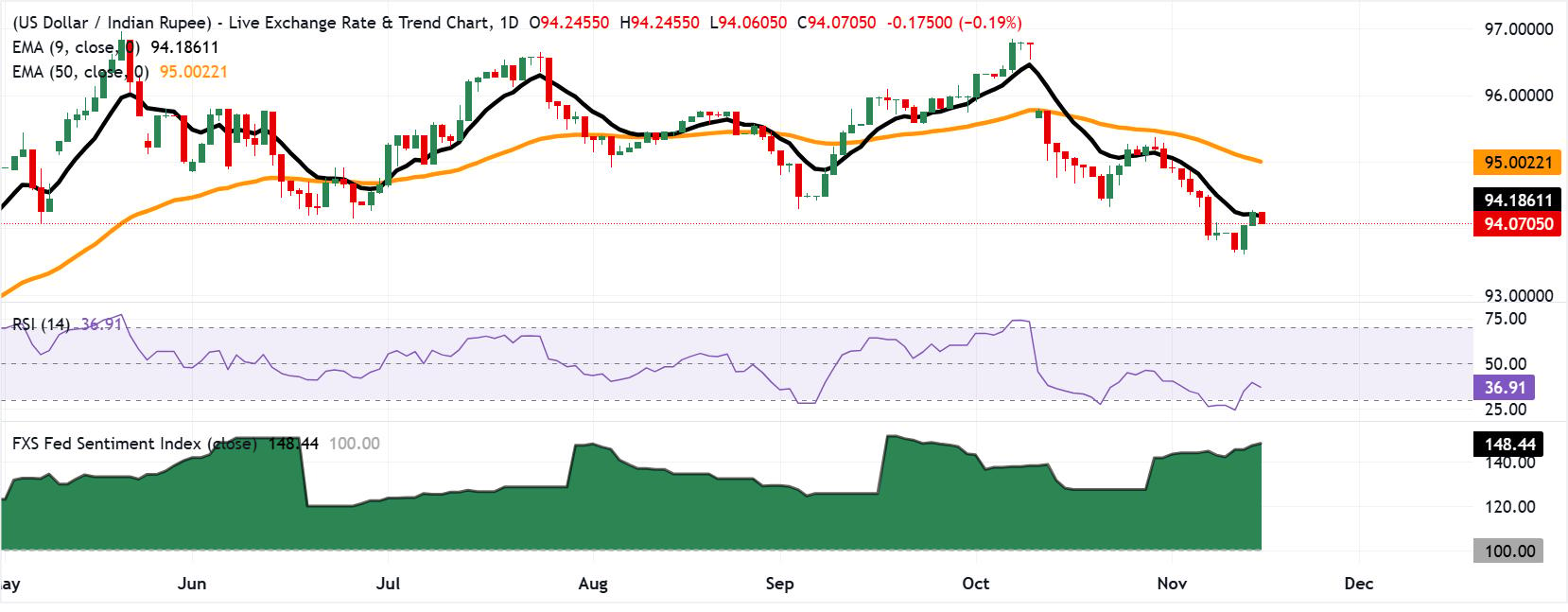
Technical Analysis: USD/INR holds around 94.00 after slipping below 94.00
In the daily chart, USD/INR trades at 94.10, keeping a bearish near-term tone as spot holds under the 50- and nine-day Exponential Moving Averages (EMAs), hinting at a bearish bias. The 14-day Relative Strength Index (RSI) at 39.59 remains below the neutral 50 line, suggesting that downside pressure persists even as selling momentum has eased from earlier oversold readings.
On the topside, immediate resistance is located at the nine-day EMA of 94.18, followed by the 50-day EMA around 95.00, and a daily close above these moving averages would be needed to weaken the current bearish bias. On the downside, further declines would navigate the region around the 93.00 level, while rebounding above the nine-day EMA could allow USD/INR to rise toward the 95.01 resistance area.
Schmid flags stubborn inflation, reinforcing hawkish Fed tone
Fed’s Schmid delivers a distinctly hawkish message, with a 7/10 FXS Speechtracker score marginally above the 6.9/10 historical average, underscoring that containing inflation has only become harder since Warsh’s Jackson Hole speech. The emphasis that inflation is “running too hot,” “moving in the wrong direction,” and would still be near 3% excluding energy, while the labor market is “largely in balance,” highlights a demand-side inflation narrative and a clear signal that the Fed “has some work to do on inflation.” By stressing that the Fed’s mandate is not to target any particular set of prices, including AI-related tech goods, but to use its tools to manage aggregate demand, the speech reinforces a broad-based commitment to bringing inflation back toward the 2% goal, a tone typically supportive of the Dollar.
The FXS Fed Sentiment Index rose by 1.00 points to 148.44, firmly in hawkish territory well above the neutral 100 mark, consistent with the slightly above-baseline 7/10 reading on the FXS Speechtracker. This incremental uptick in the FXS Fed Sentiment Index signals a modest but clear reinforcement of expectations for a persistently restrictive policy stance, a backdrop that tends to underpin the Dollar against the Euro and Yen.
(The technical analysis of this story was written with the help of an AI tool. Know more.)
US Dollar Price Today
The table below shows the percentage change of US Dollar (USD) against listed major currencies today. US Dollar was the weakest against the Indian Rupee.
| USD | EUR | GBP | JPY | CAD | AUD | NZD | INR | |
|---|---|---|---|---|---|---|---|---|
| USD | 0.07% | 0.05% | -0.22% | 0.09% | 0.27% | 0.12% | -0.31% | |
| EUR | -0.07% | -0.04% | -0.32% | 0.05% | 0.22% | 0.05% | -0.34% | |
| GBP | -0.05% | 0.04% | -0.27% | 0.08% | 0.24% | 0.08% | -0.35% | |
| JPY | 0.22% | 0.32% | 0.27% | 0.33% | 0.51% | 0.36% | -0.04% | |
| CAD | -0.09% | -0.05% | -0.08% | -0.33% | 0.17% | 0.03% | -0.37% | |
| AUD | -0.27% | -0.22% | -0.24% | -0.51% | -0.17% | -0.15% | -0.55% | |
| NZD | -0.12% | -0.05% | -0.08% | -0.36% | -0.03% | 0.15% | -0.43% | |
| INR | 0.31% | 0.34% | 0.35% | 0.04% | 0.37% | 0.55% | 0.43% |
The heat map shows percentage changes of major currencies against each other. The base currency is picked from the left column, while the quote currency is picked from the top row. For example, if you pick the US Dollar from the left column and move along the horizontal line to the Japanese Yen, the percentage change displayed in the box will represent USD (base)/JPY (quote).
Indian Rupee FAQs
The Indian Rupee (INR) is one of the most sensitive currencies to external factors. The price of Crude Oil (the country is highly dependent on imported Oil), the value of the US Dollar – most trade is conducted in USD – and the level of foreign investment, are all influential. Direct intervention by the Reserve Bank of India (RBI) in FX markets to keep the exchange rate stable, as well as the level of interest rates set by the RBI, are further major influencing factors on the Rupee.
The Reserve Bank of India (RBI) actively intervenes in forex markets to maintain a stable exchange rate, to help facilitate trade. In addition, the RBI tries to maintain the inflation rate at its 4% target by adjusting interest rates. Higher interest rates usually strengthen the Rupee. This is due to the role of the ‘carry trade’ in which investors borrow in countries with lower interest rates so as to place their money in countries’ offering relatively higher interest rates and profit from the difference.
Macroeconomic factors that influence the value of the Rupee include inflation, interest rates, the economic growth rate (GDP), the balance of trade, and inflows from foreign investment. A higher growth rate can lead to more overseas investment, pushing up demand for the Rupee. A less negative balance of trade will eventually lead to a stronger Rupee. Higher interest rates, especially real rates (interest rates less inflation) are also positive for the Rupee. A risk-on environment can lead to greater inflows of Foreign Direct and Indirect Investment (FDI and FII), which also benefit the Rupee.
Higher inflation, particularly, if it is comparatively higher than India’s peers, is generally negative for the currency as it reflects devaluation through oversupply. Inflation also increases the cost of exports, leading to more Rupees being sold to purchase foreign imports, which is Rupee-negative. At the same time, higher inflation usually leads to the Reserve Bank of India (RBI) raising interest rates and this can be positive for the Rupee, due to increased demand from international investors. The opposite effect is true of lower inflation.