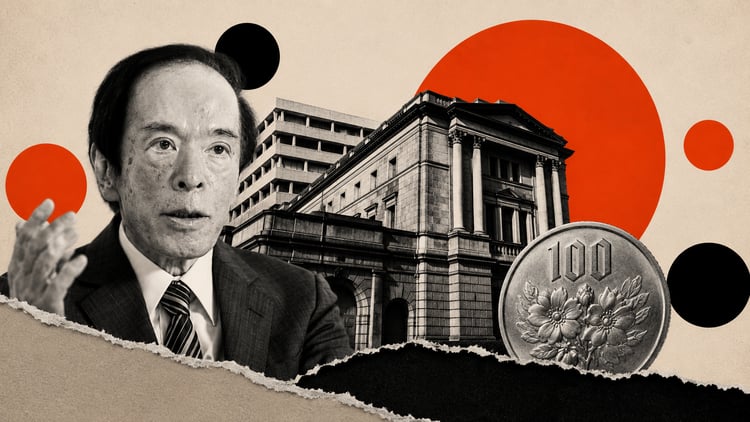
Bank of Japan (BoJ) Governor Kazuo Ueda is addressing the press conference, explaining the reason behind leaving the key interest rate unchanged at 1.25% in the October policy meeting.
BoJ press conference key highlights
Japan's economy expected to continue growing moderately.
Mid- to long-term inflation expectations are at around 2%.
Underlying CPI inflation at level generally consistent with 2% price stability target, expected to remain at around that level.
We need to watch impact of FX, AI and Middle East.
Japan's financial conditions are accommodative.
Various government measures stimulated economy to lead to 2% price target being met.
Government measures, easy monetary conditions seen to firmly support economy.
BoJ will continue to raise policy rate and adjust degree of monetary easing in response to economic actity, prices and financial condition developments.
Bank will consider adjustment of timing, pace on monetary policy while looking at likelihood of achieving economic, price outlook. Baseline scenario as well as risks to those outlook.
Stabilising underlying inflation at level around 2% is important.
All members agreed that underlying inflation has reached 2%.
More important than ever that underlying inflation is not allowed to overshoot 2% target.
Will monitor various data to gauge whether trend inflation has stabilised.
Will closely monitor whether mid- and long-term inflation expectations will be anchored around 2%.
Not yet to declare inflation target has been achieved as we think it is important for inflation to be stably, sustainably around 2%.
BoJ flags sustained 2% inflation, keeping Yen bulls cautiously engaged
FXS Speechtracker scores this press conference at 7.2/10, slightly below the historic 7.7/10 baseline, signaling a mildly less confident tone despite clear acknowledgement that underlying CPI inflation is now broadly consistent with the 2% target. The commitment to continue raising the policy rate and to adjust the degree of monetary easing as economic activity, prices and financial conditions evolve marks a modestly hawkish tilt, tempered by repeated emphasis on accommodative financial conditions and government support for growth.
By stressing that mid- to long-term inflation expectations are anchored around 2% and that all members agree underlying inflation has reached the target, the Bank of Japan reinforces a narrative of durable price stability that supports gradual Yen appreciation. However, the explicit caution against allowing inflation to overshoot 2%, and the focus on monitoring FX, AI and Middle East risks, suggests a carefully calibrated normalization path that may limit aggressive Yen upside in the near term.
The section below was published on October 30 at 3:00 GMT to cover the Bank of Japan's monetary policy announcements and the initial market reaction.
The Bank of Japan (BoJ) board members decided to leave the short-term interest rate unchanged at 1.25% following the conclusion of its two-day monetary policy review meeting on Friday.
The decision aligned with the market expectations.
Summary of the BoJ’s Monetary Policy Statement
Board's core CPI fiscal 2026 median projection at 2.5% vs 2.5% in July.
Underlying inflation has hit levels in line with price target.
BOJ board member Takata dissented on rate decision.
Board's core-core CPI fiscal 2027 median projection at 2.7% vs 2.6% in July.
Core inflation likely to stay near levels consistent with price target.
Risk underlying inflation could exceed price target.
Core inflation hits levels generally aligned with price target.
Must monitor risk of inflation rising unexpectedly, causing negative effects on economy later.
Risks to prices tilted toward upside.
Will keep raising interest rates amid economic, price and financial condition changes.
Will consider timing, pace of rate increases with focus on chances of economy, prices aligning with baseline scenario and risks.
Set sales pace at about 860 billion yen annually on book value basis.
Medium- to long-term inflation expectations near 2%.
Crucial to anchor core inflation near 2% target.
Companies’ conduct shifting more toward increasing wages, prices.
Will implement monetary policy as needed to sustainably and stably meet inflation goal.
Must prevent risk of inflation rising above target from materialising, exerting negative impact on economy later.
Risks to economic activity remain broadly balanced.
Real interest rates have risen recently but short-term rates stay low.
Interest rate burden is sufficiently low for firms compared to profits.
Demand for corporate funds is rising.
Financial institutions' lending stance stays active.
Middle East conflict, growth in AI demand, FX volatility and their economic, price impact warrant attention.
Unlike past focus on downside price risks, Japan now faces risk of inflation overshoot.
No major distortions observed in Japan's financial activity.
Long-term inflation expectations hover near 2%.
To speed up sales of ETF holdings to about 860 billion yen from previous about 330 billion yen.
Underlying inflation likely to stay at levels aligned with Bank of Japan target.
Proposed tax cut would reduce core CPI by 1.3 percentage points in fiscal 2027.
BoJ Report on Risks
Vigilance remains necessary over impact of higher crude oil procurement costs on economy and prices.
Price pass-through in B2B transactions from high crude oil costs, AI-driven demand, forex likely to push consumer prices higher.
If AI earnings don’t grow with investment, adjustment pressure could occur alongside asset price shifts.
Recent surge in grain prices amid geopolitical tensions in Middle East and global weather conditions warrants attention as potential concern.
Insufficient labor-to-capital substitution amid shortages may curb growth rate.
Market reaction to the BoJ policy announcements
The Japanese Yen (JPY) attracts some buyers following the Bank of Japan’s rate hike decision. At the press time, the USD/JPY pair is down 0.20% on the day to trade at 157.40.
Japanese Yen Price This week
The table below shows the percentage change of Japanese Yen (JPY) against listed major currencies this week. Japanese Yen was the strongest against the New Zealand Dollar.
| USD | EUR | GBP | JPY | CAD | AUD | NZD | CHF | |
|---|---|---|---|---|---|---|---|---|
| USD | 0.33% | -0.17% | 0.36% | -0.51% | 0.11% | 1.09% | -0.08% | |
| EUR | -0.33% | -0.52% | -0.02% | -0.88% | -0.29% | 0.70% | -0.47% | |
| GBP | 0.17% | 0.52% | 0.44% | -0.37% | 0.23% | 1.29% | 0.03% | |
| JPY | -0.36% | 0.02% | -0.44% | -0.81% | -0.30% | 0.77% | -0.53% | |
| CAD | 0.51% | 0.88% | 0.37% | 0.81% | 0.55% | 1.53% | 0.39% | |
| AUD | -0.11% | 0.29% | -0.23% | 0.30% | -0.55% | 1.00% | -0.38% | |
| NZD | -1.09% | -0.70% | -1.29% | -0.77% | -1.53% | -1.00% | -1.19% | |
| CHF | 0.08% | 0.47% | -0.03% | 0.53% | -0.39% | 0.38% | 1.19% |
The heat map shows percentage changes of major currencies against each other. The base currency is picked from the left column, while the quote currency is picked from the top row. For example, if you pick the Japanese Yen from the left column and move along the horizontal line to the US Dollar, the percentage change displayed in the box will represent JPY (base)/USD (quote).
This section below was published on October 29 at 22:00 GMT as a preview of the Bank of Japan Interest Rate Decision.
- The BoJ is expected to hold interest rates steady at 1.25% on Friday.
- The interest of investors will be on the BoJ’s future rate path..
- USD/JPY has been consolidating within 156-159 for the last six weeks.
The Bank of Japan (BoJ) is set to announce its monetary policy decision on Friday at around 02:30 GMT.
Like the Federal Reserve (Fed), financial markets are confident that the BoJ will leave interest rates unchanged, after raising them by 25 basis points (bps) to 1.25% in the September policy meeting. This is the highest interest rate level seen in 31 years in Japan. So far this year, the BoJ has delivered two quarter-to-a-percent interest rate hikes.
Commerzbank said in a note that markets anticipate “the overnight rate remaining steady, and none of the economists surveyed by Bloomberg expects a hike on Friday”. This consensus view leaves investors focusing more on the monetary policy statement, the central bank’s outlook report and Governor Kazuo Ueda’s press conference for the policy outlook into year-end.
Ueda leaned hawkish as AI demand and inflation near BoJ goals
BoJ Governor Ueda’s remarks after the September policy meeting have shown his concern about energy-driven inflationary risks. Ueda has also stressed the importance of anchoring core inflation near the 2% target. He has reiterated several times that the central bank will remain on the monetary tightening path.
Ueda’s speech on October 16 was scored at 8.2/10 versus by FXStreet’s Speechtracker, signaling a modest hawkish tilt compared to Ueda’s average 7.5 score. Ueda stressed that underlying inflation is “quite close” to 2% and that economic and price moves are roughly in line with forecasts. The commitment to “continue to raise interest rates” while financial conditions remain accommodative, and the plan to discuss whether to tweak the assessment of inflation approaching 2%, reinforced a gradual normalization bias that supports a firmer Yen backdrop.
Ueda’s remark that there is “no big gap” between the Bank of Japan’s view on AI-driven inflationary pressure and that of global policymakers, alongside noting some counterparts are more bullish on AI demand, underscores upside risks to prices that justify keeping a tightening path on the table. By explicitly tying the timing and pace of future rate hikes to FX, AI demand and Middle East developments, the speech framed a data- and risk-sensitive reaction function that is incrementally supportive for the Japanese Yen, especially if AI-related demand and external shocks sustain inflation around the 2% target.
These comments suggest that BoJ’s Ueda will remain hawkish on the monetary policy outlook and will highlight the importance of keeping price pressures anchored near the central bank’s 2% target.
What are expectations for December’s policy meeting?
According to the October 13-19 Reuters’ poll, nearly 70% of economists, 54 of 78, expected the BoJ to raise its policy rate to 1.5% this quarter, almost double the share in the previous poll, Reuters reported. The consensus is for another hike before the year end.
How can USD/JPY react to the BoJ’s decision?
The BoJ’s interest rate decision itself appears to be a non-event for the USD/JPY pair, given that market participants are highly confident about policy rates remaining steady. What will be impactful would be the tone in the BoJ’s monetary policy outlook and any cues on where they see the terminal rate.
Any indication from the BoJ that it could approach the terminal rate faster would be favorable for the Japanese Yen (JPY). On the contrary, signs from the Japanese central bank that it would pursue a gradual monetary tightening path could have little impact on the Japanese currency. Therefore, risks are moderately tilted to the downside for USD/JPY.
USD/JPY Technical Outlook: Trading within range, volatility contracted
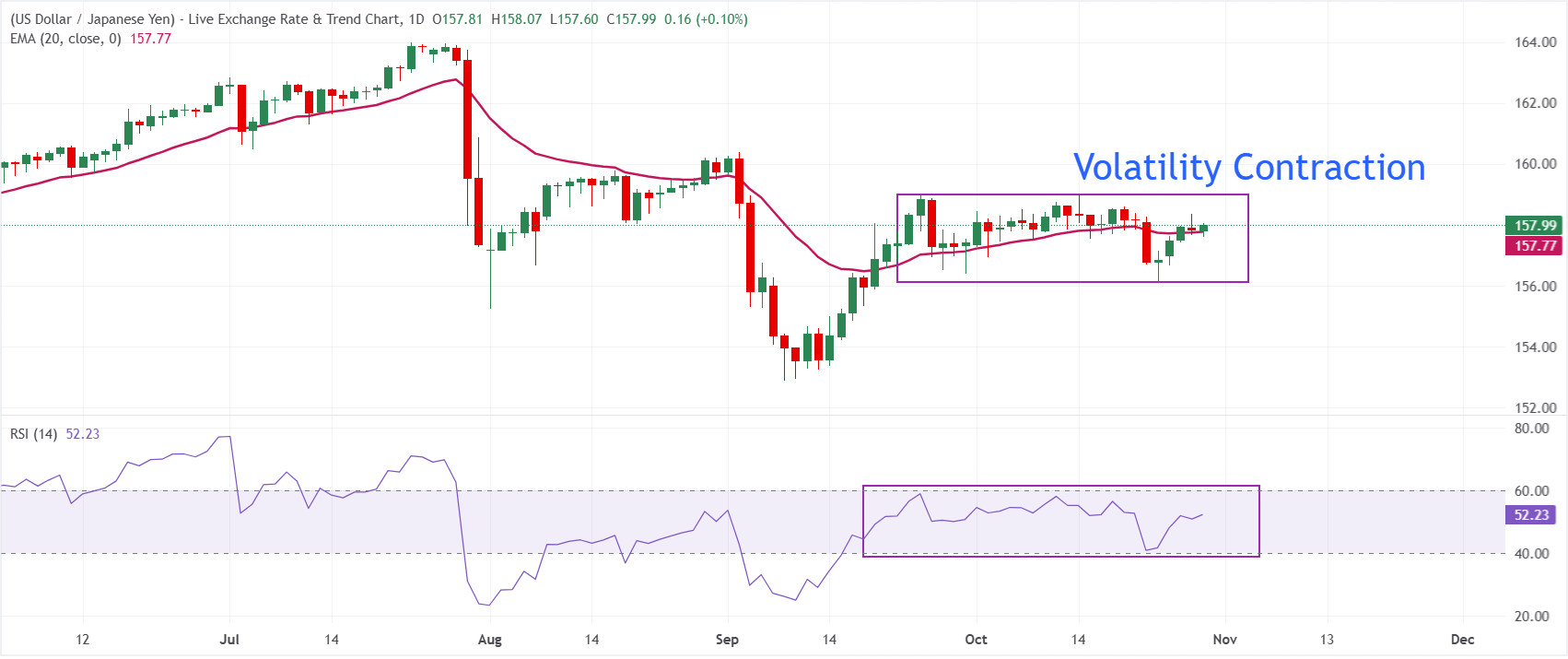
Trend: At the time of writing, USD/JPY trades at around 157.80. The USD/JPY pair has remained in a limited range between 156.08 and 159.04 for over a month. The 20-day exponential moving average (EMA) at 157.77 is flat-lined, reflecting that the overall trend is sideways.
Momentum: The Relative Strength Index (RSI) has been inside the 40.00-60.00 range for a month, indicating a sharp volatility contraction and reinforcing the current consolidation.
Support: On the downside ,the lower-end of the above-mentioned range at 156.08 is the immediate support. The pair would get exposed to the September 14 high at 155.00 if it fails to hold 156.08.
Resistance: Looking up, the immediate hurdle for the pair is the upper-end of the consolidation near 159.04; a decisive break above that would increase the likelihood of further upside towards 160.00, followed by the September high near 160.40.
(The technical analysis of this story was written with the help of an AI tool. Know more.)
Japanese Yen FAQs
The Japanese Yen (JPY) is one of the world’s most traded currencies. Its value is broadly determined by the performance of the Japanese economy, but more specifically by the Bank of Japan’s policy, the differential between Japanese and US bond yields, or risk sentiment among traders, among other factors.
One of the Bank of Japan’s mandates is currency control, so its moves are key for the Yen. The BoJ has directly intervened in currency markets sometimes, generally to lower the value of the Yen, although it refrains from doing it often due to political concerns of its main trading partners. The BoJ ultra-loose monetary policy between 2013 and 2024 caused the Yen to depreciate against its main currency peers due to an increasing policy divergence between the Bank of Japan and other main central banks. More recently, the gradually unwinding of this ultra-loose policy has given some support to the Yen.
Over the last decade, the BoJ’s stance of sticking to ultra-loose monetary policy has led to a widening policy divergence with other central banks, particularly with the US Federal Reserve. This supported a widening of the differential between the 10-year US and Japanese bonds, which favored the US Dollar against the Japanese Yen. The BoJ decision in 2024 to gradually abandon the ultra-loose policy, coupled with interest-rate cuts in other major central banks, is narrowing this differential.
The Japanese Yen is often seen as a safe-haven investment. This means that in times of market stress, investors are more likely to put their money in the Japanese currency due to its supposed reliability and stability. Turbulent times are likely to strengthen the Yen’s value against other currencies seen as more risky to invest in.
Economic Indicator
BoJ Press Conference
The Bank of Japan (BoJ) holds a press conference at the end of each one of its eight scheduled policy meetings. At the press conference the Governor of the BoJ communicates with media representatives and investors regarding monetary policy. The Governor talks about the factors that affect the most recent interest rate decision, the overall economic outlook, inflation, and clues regarding future monetary policy. Hawkish comments tend to boost the Japanese Yen (JPY), while a dovish message tends to weaken it.
Read more.Next release: Fri Oct 30, 2026 06:30
Frequency: Irregular
Consensus: -
Previous: -
Source: Bank of Japan