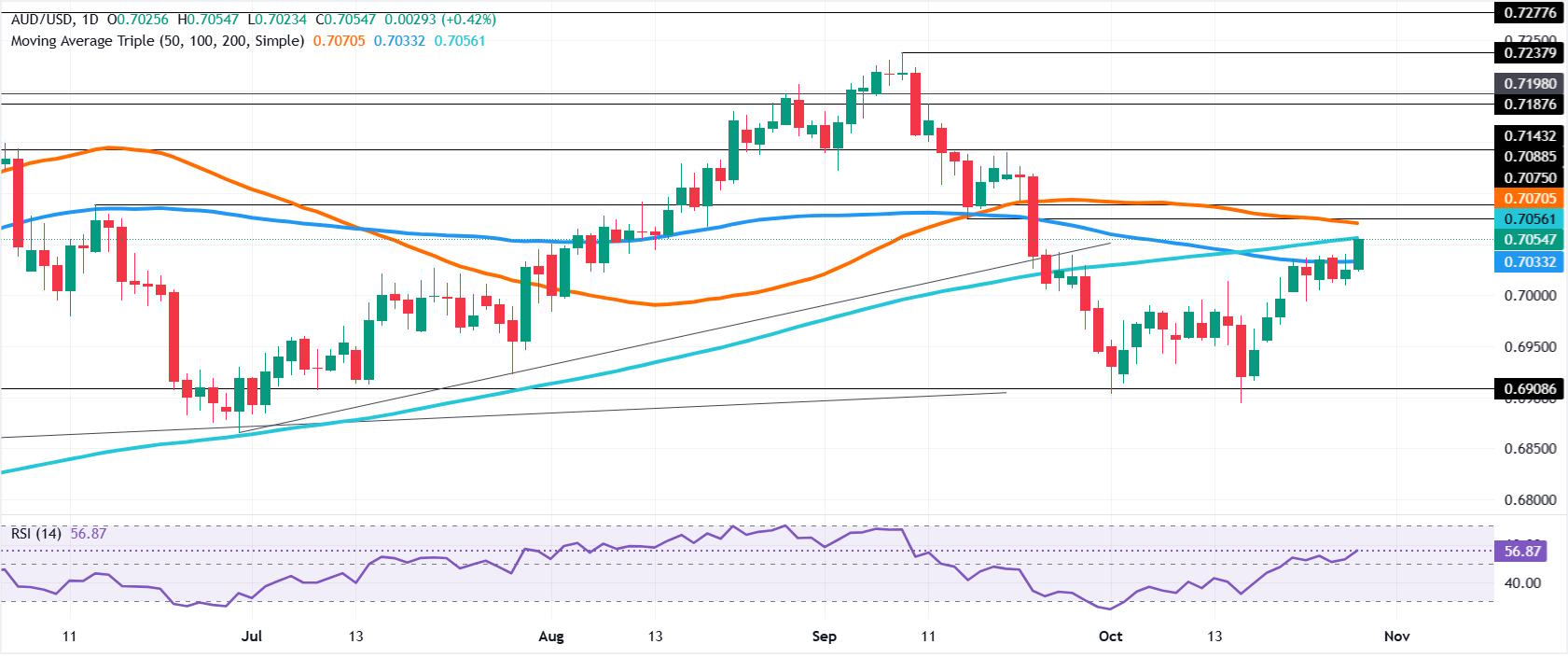
- AUD/USD jumps 0.52% to 0.7054 following Warsh's press conference.
- Fed holds rates at 3.75%-4%, with two officials favoring a hike.
- Warsh reaffirms 2% inflation target while acknowledging tightening is working.
The Australian Dollar (AUD) surges 0.52% against the US Dollar (USD) on Wednesday after Federal Reserve (Fed) Chair Kevin Warsh press conference, sending the Aussie Dollar to a one-month high, even though he emphasized the Fed’s commitment to attain 2% inflation. The AUD/USD trades at 0.7054, its highest level since September 23.
AUD/USD rallies despite Warsh's inflation warnings as the Fed pauses tightening following a divided vote
Fed Chair Kevin Warsh said the economy is strong and the FOMC will deliver price stability. The Fed will hold eight meetings next year, though one will not include a vote, and six policy-setting meetings in 2028. He said tightening appears to be working, inflation is not “soft,” and that the price stability target is 2% as measured by PCE.
Before Warsh’s conference, the Fed held rates at 3.75%–4%, with two dissenters: Fed Governor Lisa Cook and Cleveland Fed President Beth Hammack, who voted for a 25-basis-point rate hike.
The Fed acknowledged that economic activity is expanding, domestic spending “has been resilient, that productivity growth is strong and that capital investment is robust,” and that productivity growth is strong. Regarding its employment mandate, the Fed noted that “Job gains have kept pace with the workforce, and the unemployment rate has changed little.”
On inflation, the central bank said it remains elevated but chose to hold off on rate hikes while gathering more information and assessing the appropriate policy stance.
AUD/USD Price Chart – Daily
Fed FAQs
Monetary policy in the US is shaped by the Federal Reserve (Fed). The Fed has two mandates: to achieve price stability and foster full employment. Its primary tool to achieve these goals is by adjusting interest rates. When prices are rising too quickly and inflation is above the Fed’s 2% target, it raises interest rates, increasing borrowing costs throughout the economy. This results in a stronger US Dollar (USD) as it makes the US a more attractive place for international investors to park their money. When inflation falls below 2% or the Unemployment Rate is too high, the Fed may lower interest rates to encourage borrowing, which weighs on the Greenback.
The Federal Reserve (Fed) holds eight policy meetings a year, where the Federal Open Market Committee (FOMC) assesses economic conditions and makes monetary policy decisions. The FOMC is attended by twelve Fed officials – the seven members of the Board of Governors, the president of the Federal Reserve Bank of New York, and four of the remaining eleven regional Reserve Bank presidents, who serve one-year terms on a rotating basis.
In extreme situations, the Federal Reserve may resort to a policy named Quantitative Easing (QE). QE is the process by which the Fed substantially increases the flow of credit in a stuck financial system. It is a non-standard policy measure used during crises or when inflation is extremely low. It was the Fed’s weapon of choice during the Great Financial Crisis in 2008. It involves the Fed printing more Dollars and using them to buy high grade bonds from financial institutions. QE usually weakens the US Dollar.
Quantitative tightening (QT) is the reverse process of QE, whereby the Federal Reserve stops buying bonds from financial institutions and does not reinvest the principal from the bonds it holds maturing, to purchase new bonds. It is usually positive for the value of the US Dollar.