
- Gold rallies over 2% to $3,954 as US Dollar weakness accelerates.
- US 10-year Treasury yields drop nearly six basis points to 4.871%.
- December Fed hike odds hold near 75% amid stronger US manufacturing.
Gold (XAU/USD) rebounds and gains over 2% on Monday as crude prices drift lower, dragging the US Dollar (USD) lower due to its positive correlation, as elevated energy prices exert pressure on inflation. XAU/USD trades at $3,954 at the time of writing.
XAU/USD surges as falling energy prices and Treasury yields revive bullion demand
Oil prices are collapsing amid growing speculation for a diplomatic exit from the US-Iran conflict. Reports say that Iran’s supreme leader granted “certain authorities” regarding peace talks to President Masoud Pezeshkian. News that US President Donald Trump wants a peaceful resolution improved risk appetite, a headwind for the Greenback, which usually fares well amid high interest-rate scenarios and on its safe-haven appeal.
The US Dollar Index (DXY), which measures the buck’s performance against six currencies, is down 0.27% at 101.68. US Treasury yields also edged lower, with the 10-year yield losing nearly 6 basis points to 4.871%.
In the US, the Institute for Supply Management (ISM) Purchasing Managers’ Index (PMI) improved from 54.5 to 55.5 in October, exceeding forecasts of 54.6. The report showed that the Prices Paid sub-component fell from 77.9 to 75.2, while an employment measure cooled during the month.
Even though business activity reached its second-highest reading in more than four years, an indication that the economy is expanding solidly, traders trimmed hawkish bets from a week ago. Money markets see a 75% chance of a rate hike in December, down from 80% a week ago, according to the CME FedWatch Tool.
What is on the US calendar
Traders' focus is on Tuesday’s US midterm elections, Factory Orders, the Job Openings and Labor Turnover Survey (JOLTS) and speeches by Federal Reserve officials.
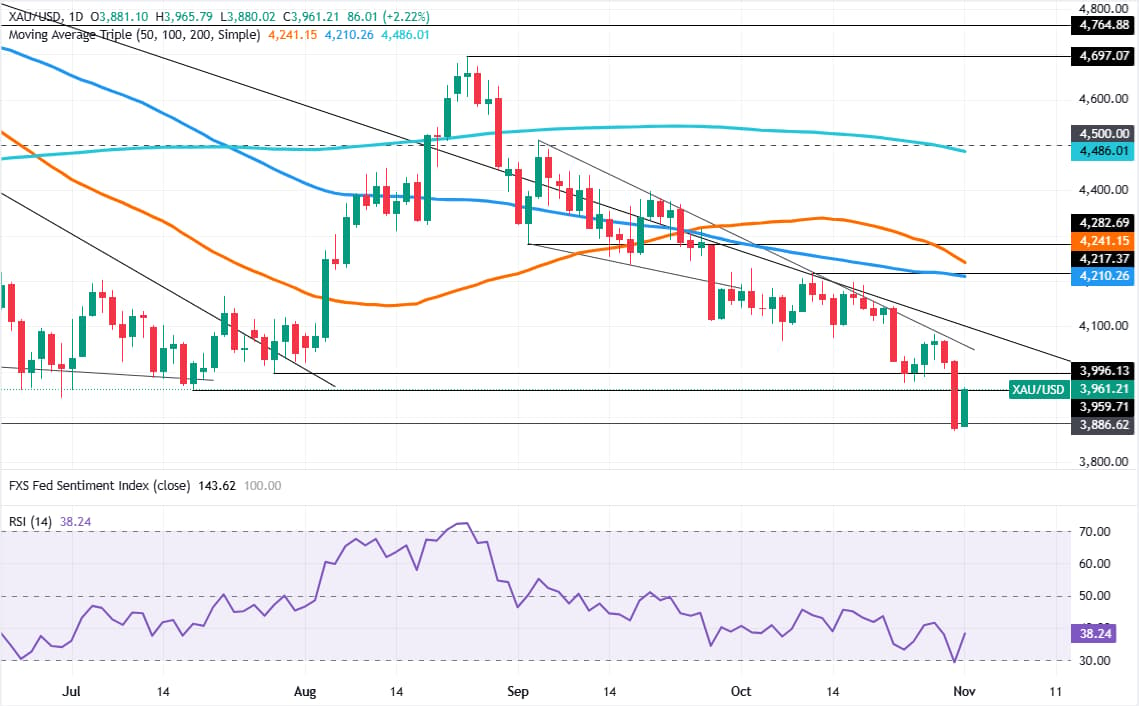
XAU/USD technical outlook: Recovery incomplete, but reclaims $3,900
Despite bouncing off yearly lows, Gold’s trend remains up, even though the Relative Strength Index (RSI) shows buyers are gaining momentum. The XAU/USD pair bounced from below $3,900 to current spot prices, but it remains below the latest cycle low at $3,975, the October 23 low of the day (LOD), which has turned into resistance.
To complete a bullish reversal, buyers must surpass the October 23 LOD followed by the $4,000 psychological level. A breach of the latter will see Gold face a key resistance trendline near $4,050-$4,070, ahead of $4,100.
For a bearish continuation, Gold needs to fall below $3,900. This will expose the October 30 yearly low of $3,870, followed by the April 22, 2025, daily high, turned into support at $3,500.
US midterm elections FAQs
The US midterm elections are the federal elections held halfway through a president's four-year term. Voters choose all 435 members of the House of Representatives, about one-third of the Senate, and, in many states, governors and other state and local officials.
Election Day is Tuesday, November 3, 2026. Federal law sets it as the Tuesday after the first Monday in November. Early voting and mail voting are already under way in many states.
They decide which party controls each chamber of Congress for the last two years of President Donald Trump's term. The majority party sets the legislative agenda, chooses committee leaders and, in the Senate, controls confirmations of judges and senior officials.
No. The president is elected every four years; the next presidential election is in November 2028. Midterms are often seen as a referendum on the sitting president's party, which historically tends to lose House seats.
Most analysts expect a modest, short-lived reaction in the US Dollar rather than a lasting trend. A divided Congress is widely seen as the base case and is partly priced in. Treasury yields may react more noticeably to the results. Outcomes that raise expectations of fiscal stimulus tend to lift yields and the US Dollar, while gridlock that limits new spending can pull both lower. Political friction, such as funding or debt-ceiling standoffs, can also briefly lift the Dollar as a safe haven. Over six to twelve months, growth and Federal Reserve policy matter more than the vote.
US stocks have historically been weak before midterms and strong after them. Since 1950, the S&P 500 has been higher 12 months after every midterm election, 19 out of 19, with an average gain of about 15%. Analysts link the pattern to uncertainty fading once results are known. Past performance does not guarantee future returns, and some strategists note that high valuations in 2026 could test the streak.
Markets have often welcomed a divided government because gridlock makes sweeping changes to taxes, spending and regulation less likely. Under a Republican president, the S&P 500 has historically done well in years following midterms that split control of Congress. The risks are funding deadlines, debt-ceiling fights and congressional investigations, which can add short-term volatility.