
- Gold rebounded after hitting a fresh nearly 14-month low of $3,693 on Thursday.
- Non-yielding Gold faces challenges as Fed officials expect more rate hikes.
- Markets price in a 10% probability of a 50 bps Fed hike in December.
Gold price (XAU/USD) remains close to a fresh nearly 14-month low of $3,693 recorded on Thursday after The New York Times (NYT) reported that United States (US) President Donald Trump is weighing plans for another round of extensive military strikes on Iran, taking into account new intelligence about Iranian capabilities and intensifying pressure from Israel to move quickly and aggressively. The report shows that US President Trump has yet to make a decision, but he has been considering warnings from Israel about Iran’s success in rebuilding its missile and drone arsenals and advancing its chemical and biological weapons programs.
Moreover, the precious metal could face further challenges as hawkish Federal Reserve (Fed) signals raised expectations of higher interest rates. According to Fed meeting minutes released Wednesday, officials said in October that additional interest rate increases would be needed to combat inflation, but decided to hold off while gathering more data.
The Federal Open Market Committee (FOMC) held the Federal Funds Rate steady at 3.75%–4.00% at its October policy meeting by a 10–2 vote. This followed a 25 basis points (bps) rate hike in September.
Fed Governor Christopher Waller reiterated his belief that the FOMC should consider a half-point hike in December. Meanwhile, Fed officials John Williams and Alberto Musalem also signaled further rate hikes may be needed to curb inflation.
"Gold won't find much relief from the Fed minutes as the overwhelming majority sees further hikes, with a couple broaching a 50bps move if inflation disappoints. Fed will hike until inflation turns, but it's not an emergency. Barring a quick reversal, today's damage suggests a probe of 3350-3450 in the coming weeks," independent analyst Tai Wong said.
Markets are now pricing in nearly a 90% chance of a 25-basis-point Fed rate hike in December, while there is a 10% odds of a larger 50-basis-point increase, according to the CME FedWatch tool. Higher rates are typically negative for gold, which doesn’t pay interest.
Mixed US data leave growth expectations broadly intact
According to Deutsche Bank, the latest run of US data “painted a mixed picture of economic performance.” On the positive side, the bank highlights that “retail sales grew by 0.2% in October (vs. +0.1% expected),” suggesting consumer demand remains resilient. However, this was offset by softer activity indicators, with “industrial production unexpectedly fell 0.4% (vs. +0.1% expected), while the NAHB’s housing market index also fell unexpectedly to 25 in November (vs. 29 expected).” Deutsche Bank underscores that this housing gauge marked “the lowest print for the housing market index since 2012, when the economy was still recovering from the aftermath of the GFC.” Even so, they note that “with all that in hand, the Atlanta Fed’s GDPNow estimate was little changed, with the Q4 estimate moving down very slightly from an annualised 3.5% to 3.4%,” indicating that near-term growth expectations remain broadly stable despite the mixed signals.
Technical Analysis: Gold amid prevailing bearish bias
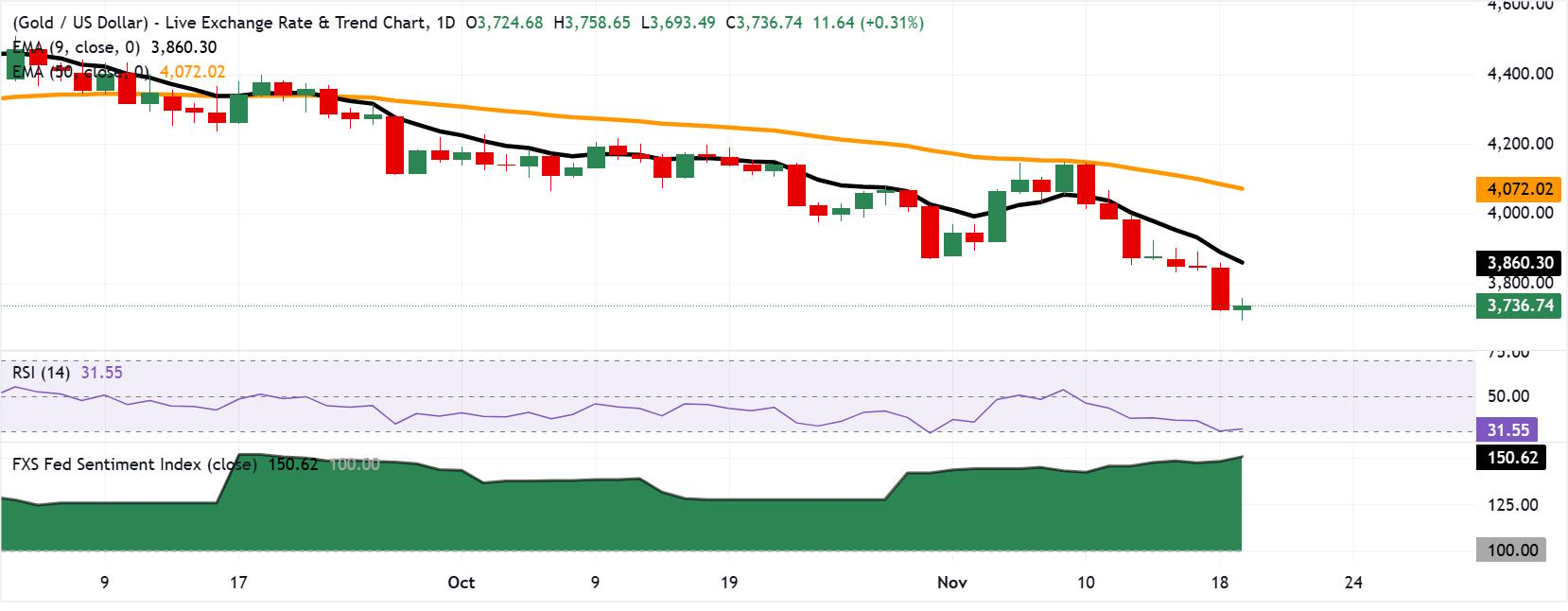
In the daily chart, XAU/USD trades at $3,740, remaining below both the short-term and medium-term Exponential Moving Averages (EMAs), which keeps the near-term bias bearish. Both the nine- and 50-day EMAs sit overhead as dynamic resistance, suggesting rallies are likely to be capped while price holds beneath these levels. The 14-day Relative Strength Index (RSI) at 31.55 flirts with oversold territory, hinting at stretched downside momentum even as the broader structure remains pressured.
On the topside, initial resistance emerges at the nine-period EMA near $3,860, followed by a more significant barrier at the 50-period EMA around $4,072, where a recovery would need to gain traction to ease the current bearish tone. With no nearby technical support identified below the market in this dataset, the metal remains vulnerable to further downside, and any corrective bounce toward the clustered moving average resistance is likely to attract selling interest unless sentiment, as tracked by the FXS Fed Sentiment Index at 150.62, shifts decisively in favor of bullion.
Kashkari flags inflation miss and resilient demand, keeping Dollar bulls on alert
Fed’s Kashkari delivered a slightly more hawkish-than-usual tone, with the FXS Speechtracker score at 7/10 versus a 6.8/10 historical average, underscoring concern that elevated inflation stems from repeated supply shocks and must not be allowed to unanchor expectations. The acknowledgment that interest rates “absolutely can impact investment levels,” combined with surprise at strong demand and a resilient job market, reinforces the case for keeping policy restrictive even as Kashkari concedes the Fed is “clearly missing on the inflation side” of its mandate. Markets’ belief that the Fed may need to hike more than officials currently project adds a hawkish risk premium that is broadly supportive for the Dollar.
The FXS Fed Sentiment Index slipped by 0.11 points to 150.62, a modest pullback that still leaves the gauge deep in hawkish territory relative to the neutral 100 mark. Despite the slight decline, the elevated index level confirms that Fed communication, as captured by the FXS Speechtracker, continues to lean firmly toward tighter policy expectations, a backdrop that should keep Dollar downside limited unless incoming data decisively cools inflation and demand.
(The technical analysis of this story was written with the help of an AI tool. Know more.)
Gold FAQs
Gold has played a key role in human’s history as it has been widely used as a store of value and medium of exchange. Currently, apart from its shine and usage for jewelry, the precious metal is widely seen as a safe-haven asset, meaning that it is considered a good investment during turbulent times. Gold is also widely seen as a hedge against inflation and against depreciating currencies as it doesn’t rely on any specific issuer or government.
Central banks are the biggest Gold holders. In their aim to support their currencies in turbulent times, central banks tend to diversify their reserves and buy Gold to improve the perceived strength of the economy and the currency. High Gold reserves can be a source of trust for a country’s solvency. Central banks added 1,136 tonnes of Gold worth around $70 billion to their reserves in 2022, according to data from the World Gold Council. This is the highest yearly purchase since records began. Central banks from emerging economies such as China, India and Turkey are quickly increasing their Gold reserves.
Gold has an inverse correlation with the US Dollar and US Treasuries, which are both major reserve and safe-haven assets. When the Dollar depreciates, Gold tends to rise, enabling investors and central banks to diversify their assets in turbulent times. Gold is also inversely correlated with risk assets. A rally in the stock market tends to weaken Gold price, while sell-offs in riskier markets tend to favor the precious metal.
The price can move due to a wide range of factors. Geopolitical instability or fears of a deep recession can quickly make Gold price escalate due to its safe-haven status. As a yield-less asset, Gold tends to rise with lower interest rates, while higher cost of money usually weighs down on the yellow metal. Still, most moves depend on how the US Dollar (USD) behaves as the asset is priced in dollars (XAU/USD). A strong Dollar tends to keep the price of Gold controlled, whereas a weaker Dollar is likely to push Gold prices up.