
- Gold retreats after briefly rising above $4,200 following softer US inflation data.
- Softer PCE data and less hawkish Fed remarks reduce expectations of an October rate hike.
- The technical outlook remains bearish as XAU/USD trades below its key daily moving averages.
Gold (XAU/USD) reverses its earlier gains on Wednesday after briefly climbing above $4,200 in reaction to softer-than-expected US Personal Consumption Expenditures (PCE) inflation data. The initial move fades as the US Dollar (USD) trims its losses and US Treasury yields resume their advance. At the time of writing, XAU/USD trades around $4,166, although it remains above the seven-week low of $4,110 touched on Monday.
Data released by the US Bureau of Economic Analysis (BEA) showed that the core PCE Price Index rose 0.2% MoM in August, below the 0.3% forecast but above July’s 0.1% increase. Headline PCE inflation climbed 0.3% MoM, also below the 0.4% expected and up from 0.1% previously. On an annual basis, core and headline inflation held steady at 3.0% and 3.4%, respectively, both below market expectations.
However, stronger growth and employment figures overshadow the softer inflation readings. The US economy expanded at an annualized rate of 2.2% in the second quarter, above the 1.5% forecast and previous estimate. Meanwhile, ADP Employment Change rose by 90K in September, beating expectations of 70K and accelerating from 36K previously.
The US Dollar Index (DXY), which tracks the Greenback’s value against a basket of six major currencies, trades around 101.27 after rebounding from 101.03. The benchmark 10-year US Treasury yield climbs back to around 5.27%, near the previous day’s peak of 5.29%, its highest level since 2007.
The data points to continued resilience in the US economy, giving the Federal Reserve (Fed) room to keep interest rates elevated as it works to bring inflation back to its 2% target. Still, the softer inflation figures reduce the likelihood of an immediate rate increase. Markets now see around a 37% chance of an October hike, down from 70% earlier this week, according to the CME FedWatch Tool.
Less hawkish remarks from New York Fed President John Williams on Tuesday also encouraged traders to scale back expectations of a rate increase as soon as next month.
“With the policy action we took at our September meeting, there is no need for urgency,” Williams said. He added that “if the economy evolves in a manner broadly consistent with my forecast, one further upward adjustment of the federal funds target range may be appropriate late this year to support a timelier return of inflation to target.”
The median projection released after the September meeting placed the policy rate at 4.1% for 2026, suggesting that officials still expect to raise rates once more this year. The prospect of further tightening remains a key headwind for Gold, leaving the metal on track to end September in negative territory.
Energy-driven inflation risks could ease as Middle East crude supplies show signs of recovery. Reuters reported that Saudi Arabia resumed tanker loadings at Yanbu after restarting its East-West pipeline, while Goldman Sachs estimated that Gulf Oil exports returned to their 2025 average over the past week. The US also announced that it would offer up to 40 million barrels from its Strategic Petroleum Reserve.
Attention now turns to Friday’s US Nonfarm Payrolls (NFP) report for further clues about the strength of the labour market and the Fed’s policy path.
Technical Analysis: XAU/USD remains vulnerable while below major SMAs
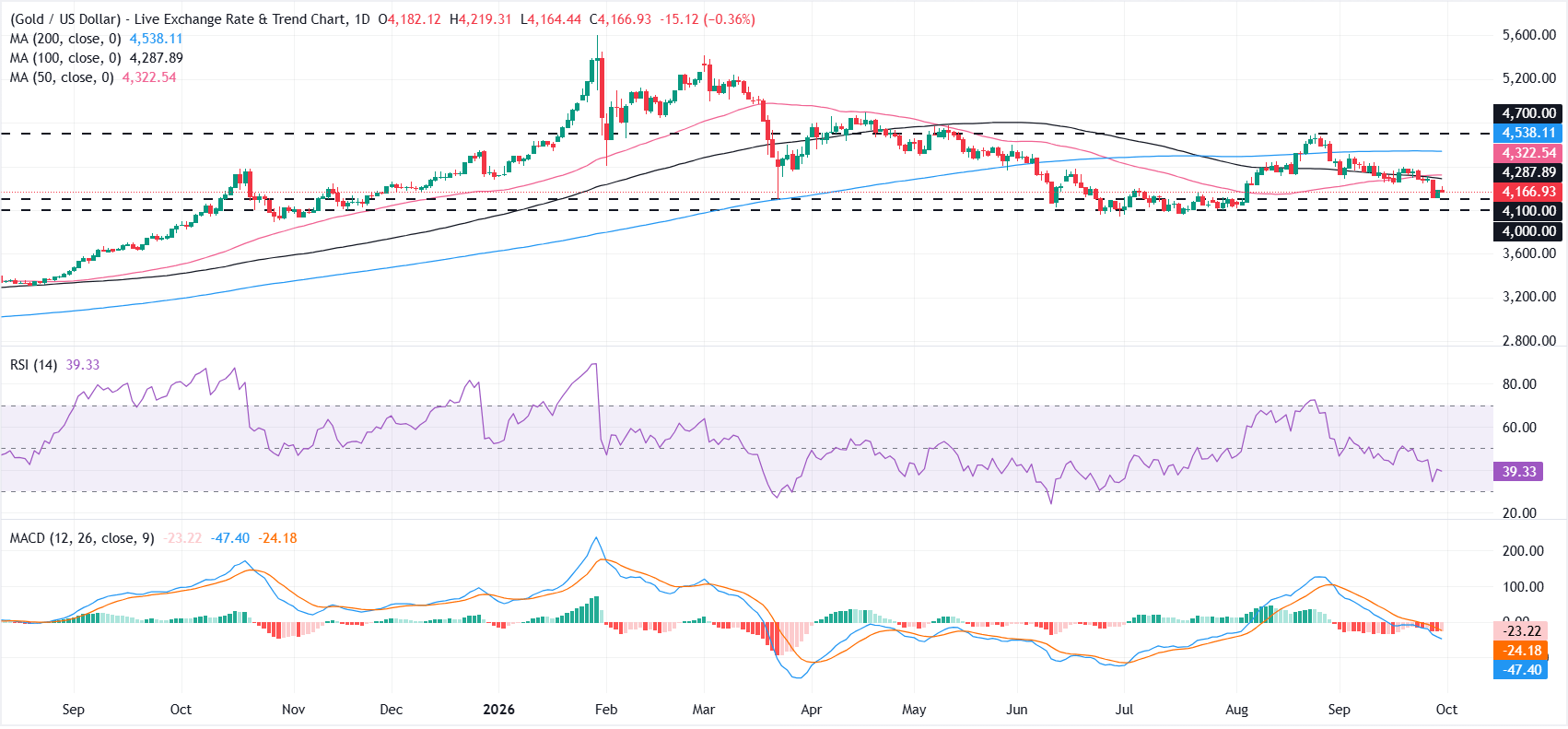
On the daily chart, XAU/USD keeps a bearish near-term bias as spot holds beneath the 50-day, 100-day and 200-day Simple Moving Averages (SMAs) clustered between roughly $4,287 and $4,538. The relative strength index (RSI) at 39 sits below its midline, while the Moving Average Convergence Divergence (MACD) indicator remains in negative territory, both hinting that downside momentum still outweighs recovery attempts despite the recent stabilization off the $4,100 region.
On the topside, initial resistance emerges at the 100-day SMA at $4,287, followed by the 50-day SMA at $4,322, with the broader bearish structure reinforced by the 200-day SMA near $4,538 and a horizontal barrier at $4,700. On the downside, immediate support is seen at the horizontal level of $4,100, ahead of a deeper floor around $4,000, where a break would open the way for an extension of the prevailing corrective phase.
(The technical analysis of this story was written with the help of an AI tool. Know more.)
Gold FAQs
Gold has played a key role in human’s history as it has been widely used as a store of value and medium of exchange. Currently, apart from its shine and usage for jewelry, the precious metal is widely seen as a safe-haven asset, meaning that it is considered a good investment during turbulent times. Gold is also widely seen as a hedge against inflation and against depreciating currencies as it doesn’t rely on any specific issuer or government.
Central banks are the biggest Gold holders. In their aim to support their currencies in turbulent times, central banks tend to diversify their reserves and buy Gold to improve the perceived strength of the economy and the currency. High Gold reserves can be a source of trust for a country’s solvency. Central banks added 1,136 tonnes of Gold worth around $70 billion to their reserves in 2022, according to data from the World Gold Council. This is the highest yearly purchase since records began. Central banks from emerging economies such as China, India and Turkey are quickly increasing their Gold reserves.
Gold has an inverse correlation with the US Dollar and US Treasuries, which are both major reserve and safe-haven assets. When the Dollar depreciates, Gold tends to rise, enabling investors and central banks to diversify their assets in turbulent times. Gold is also inversely correlated with risk assets. A rally in the stock market tends to weaken Gold price, while sell-offs in riskier markets tend to favor the precious metal.
The price can move due to a wide range of factors. Geopolitical instability or fears of a deep recession can quickly make Gold price escalate due to its safe-haven status. As a yield-less asset, Gold tends to rise with lower interest rates, while higher cost of money usually weighs down on the yellow metal. Still, most moves depend on how the US Dollar (USD) behaves as the asset is priced in dollars (XAU/USD). A strong Dollar tends to keep the price of Gold controlled, whereas a weaker Dollar is likely to push Gold prices up.