
- Gold falls for a third straight day as hawkish Fed expectations continue to dominate market sentiment.
- Markets now fully price in a December Fed rate hike following stronger US inflation and hawkish Fed remarks.
- XAU/USD remains bearish below the 20-day SMA, while the RSI near 41 points to weak buying momentum.
Gold (XAU/USD) slides to a fresh year-to-date low on Thursday as bets on more aggressive Federal Reserve (Fed) rate hikes lift the US Dollar (USD). At the time of writing, XAU/USD trades around $3,853, down more than 3% on the day. The US Dollar Index (DXY), which tracks the Greenback against a basket of six major currencies, trades near 103.10, its highest level since April 2025.
Selling pressure on Gold intensified as US equities fell following reports that Nvidia CEO Jensen Huang had resigned. The stock sell-off may have prompted some investors to sell Gold to cover losses elsewhere or meet margin calls.
Cleveland Fed President Beth Hammack said on Thursday that policy needs to become restrictive and that she is seeing higher energy costs feed through to other prices. She said smaller moves are less disruptive to the economy, though a larger hike could be needed if the Fed falls behind.
Fed Governor Christopher Waller put a 50-basis-point (bps) hike in December on traders’ radar before Tuesday’s US inflation report. Waller said a half-point hike could be needed if October core Consumer Price Index (CPI) came in “around 0.3% or higher.” And that’s what happened. Core CPI rose 0.3% on the month, above the 0.2% forecast, while headline CPI rose 0.4%, beating the 0.3% estimate.
Markets fully price in December Fed hike
Analysts at MUFG/BTMU note that "there are currently around 28bps of hikes priced by December, and 43bps of hikes priced by the following meeting in January," which "indicat[es] that even if the Fed hikes by 25bps in December, it is now expected to quickly follow up with another 25bps hike at the start of next year."
ING strategists add that "the combination of hawkish Fed speak and a US CPI beat earlier this week continues to pay dividends for the Dollar," with DXY now "back at Liberation Day (April 2025) levels." They stress that "real front-end rate differentials [are] continuing to fuel strong Dollar momentum" and that "this remains a rates-driven move, with contained excessive USD strength relative to short-term fair value currently built in."
The prospect of higher borrowing costs takes some shine off Gold as investors favour assets that pay interest. Traders now turn to the Producer Price Index (PPI) due on Friday, with several Fed officials also set to speak over the rest of the week.
US-Iran developments are also in focus. US President Donald Trump wrote on Truth Social, “We don’t need a deal with Iran. Those days have long since passed.” If tensions escalate, Oil prices could climb again and keep inflation elevated for longer.
Technical analysis: Weak RSI keeps downside risks in focus
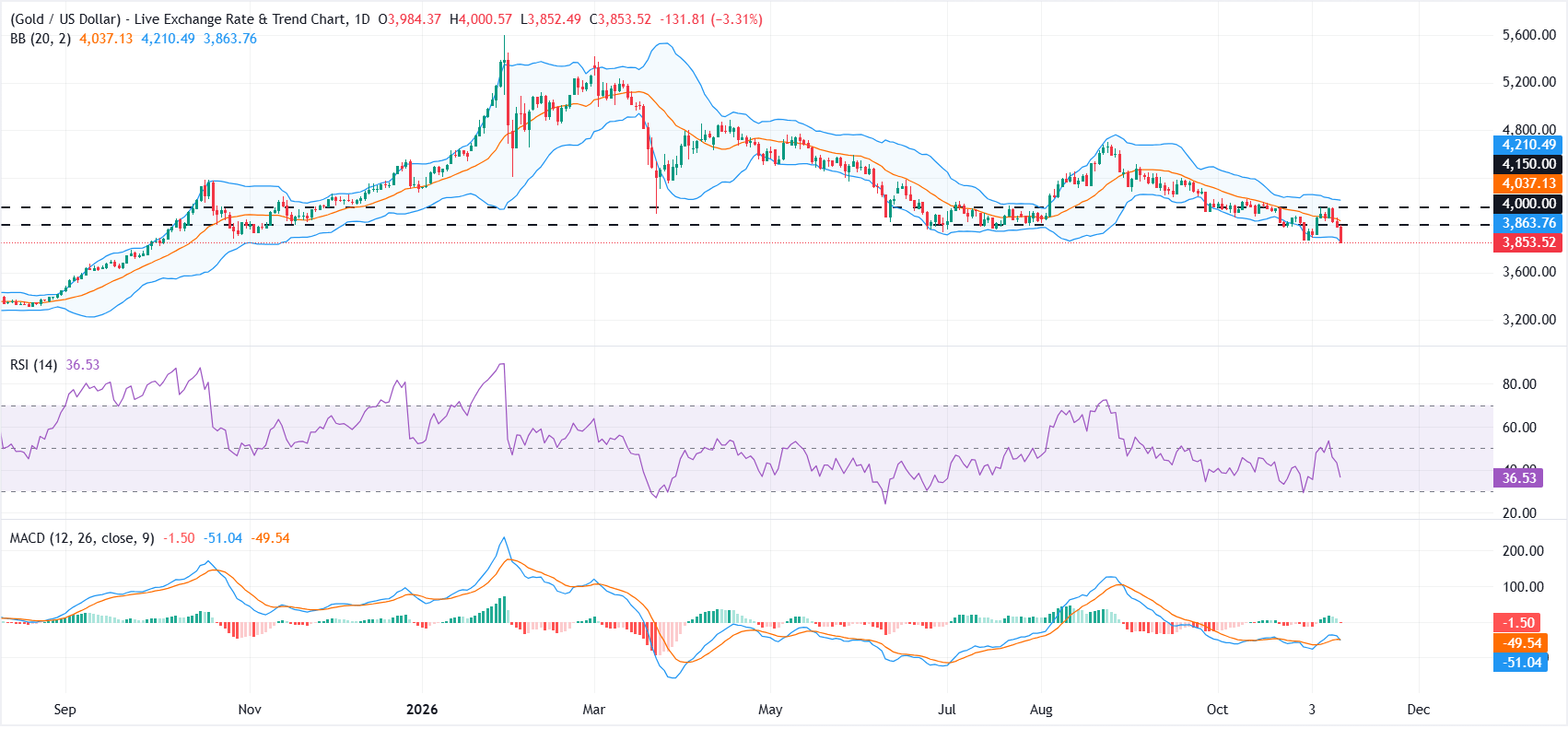
On the daily chart, XAU/USD trades below the lower Bollinger Band (20,2), which now acts as immediate resistance near $3,865. The Relative Strength Index (RSI) sits at 36, below the neutral 50 level and still above oversold territory. The Moving Average Convergence Divergence (MACD) has turned slightly negative, pointing to a pickup in bearish momentum.
On the topside, initial resistance appears at the lower Bollinger band near $3,865, followed by the psychological horizontal barrier at $4,000. Above that, the Bollinger middle band around $4,037 and a prior horizontal level at $4,150 form a broader cap before the upper Bollinger band near $4,209.
On the downside, initial support sits near $3,850. A break below that level would bring the psychological $3,800 mark into focus.
(The technical analysis of this story was written with the help of an AI tool. Know more.)
Gold FAQs
Gold has played a key role in human’s history as it has been widely used as a store of value and medium of exchange. Currently, apart from its shine and usage for jewelry, the precious metal is widely seen as a safe-haven asset, meaning that it is considered a good investment during turbulent times. Gold is also widely seen as a hedge against inflation and against depreciating currencies as it doesn’t rely on any specific issuer or government.
Central banks are the biggest Gold holders. In their aim to support their currencies in turbulent times, central banks tend to diversify their reserves and buy Gold to improve the perceived strength of the economy and the currency. High Gold reserves can be a source of trust for a country’s solvency. Central banks added 1,136 tonnes of Gold worth around $70 billion to their reserves in 2022, according to data from the World Gold Council. This is the highest yearly purchase since records began. Central banks from emerging economies such as China, India and Turkey are quickly increasing their Gold reserves.
Gold has an inverse correlation with the US Dollar and US Treasuries, which are both major reserve and safe-haven assets. When the Dollar depreciates, Gold tends to rise, enabling investors and central banks to diversify their assets in turbulent times. Gold is also inversely correlated with risk assets. A rally in the stock market tends to weaken Gold price, while sell-offs in riskier markets tend to favor the precious metal.
The price can move due to a wide range of factors. Geopolitical instability or fears of a deep recession can quickly make Gold price escalate due to its safe-haven status. As a yield-less asset, Gold tends to rise with lower interest rates, while higher cost of money usually weighs down on the yellow metal. Still, most moves depend on how the US Dollar (USD) behaves as the asset is priced in dollars (XAU/USD). A strong Dollar tends to keep the price of Gold controlled, whereas a weaker Dollar is likely to push Gold prices up.