Gold trading attracts much market participation in Malaysia at all times. There are three common types of gold trading, including spot gold (XAU/USD), Gold CFDs, and physical gold investing. Spot gold and physical gold trading are quite different from how gold CFDs are traded. Specifically, spot and physical gold trading entail purchasing bullion for immediate settlement or direct ownership. In contrast, gold CFDs enable traders to speculate on price movements via leveraged contracts—capturing exposure without taking delivery of the underlying asset. Both gold CFDs and spot gold trading can be started with a very small amount. The key difference lies in that the former is determined by the chosen broker, and the latter is determined by the product, purchase quantity, and trading provider
Both gold CFDs and spot/physical gold allow traders to start with small capital, but their entry requirements differ fundamentally. The starting deposit for a gold CFD is determined by the chosen broker's leverage and deposit rules, whereas spot gold minimums are driven by product, purchase quantity, and trading providers.
In Malaysia, trading Gold CFDs (typically as XAU/USD) through online brokers is popular among short-to-medium-term and active traders. However, for complete beginners with no prior trading experience, Gold CFDs are far too risky to be a starting point.
Despite attractive features like low capital requirements and flexible 24/5 trading, CFDs are highly leveraged and volatile derivatives. Without strict risk management and a proven trading system, beginners can easily face severe losses or wipe out their entire account balance in a short time.
Key Features of Gold CFD Trading in Malaysia
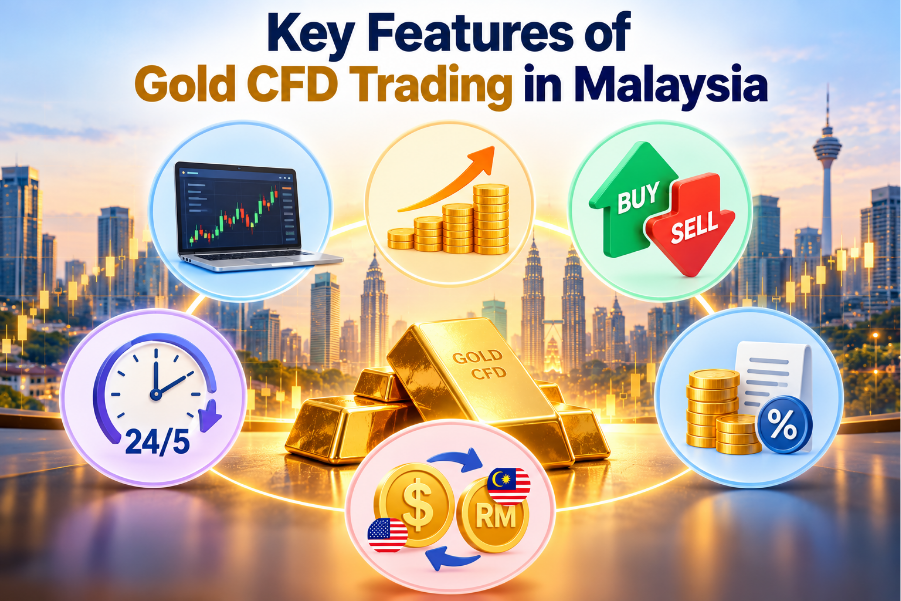
Platform Selection Is the Key
Typically, international brokers—operating under tier-1 regulators like Australia’s ASIC, the UK’s FCA, or Cyprus’s CySEC—are the primary providers of Gold CFDs. Local authorities—the Securities Commission (SC) and Bank Negara Malaysia (BNM)—maintain strict rules on leveraged retail trading. Most platforms accept local bank transfers (for easy deposits and withdrawals). Still, traders must choose top-tier regulated brokers to guarantee client fund segregation (and overall account safety).
High Leverage & Margin Applied
Gold CFDs operate on a margin trading model, with brokers typically offering leverage ranging from 1:20 up to 1:500 (or even higher on offshore-regulated platforms). Investors only need to put down a fraction of the total contract value (e.g., 0.2% to 5%) as margin to control a large position. However, leverage is a double-edged sword—it magnifies potential profits just as quickly as it amplifies losses.
Flexible Two-Way Trading (Going Long or Short)
Unlike physical gold or bank gold savings accounts—which only profit when buying low and selling high—Gold CFDs allow traders to take both long (Buy) and short (Sell) positions. This enables investors to profit in both rising and falling markets or even use CFDs to hedge against depreciation risks on their physical gold holdings before liquidating them.
24/5 Market Access & T+0 Execution
Gold CFDs track spot gold (XAU/USD) closely. Markets run continuously from Monday morning to Friday night (allowing nearly 24/5 trading). With T+0 instant execution, positions can open or close in milliseconds—bypassing physical delivery steps and liquidity delays.
Unique Cost Structure
Most CFD brokers charge no fixed commission, earning instead through the bid-ask spread. Spreads float dynamically based on market liquidity (narrowing during peak overlapping trading hours). Holding positions overnight incurs (or earns) swap fees. To serve Malaysia's Muslim population, nearly all major brokers offer Islamic accounts (waiving overnight interest to maintain Shariah compliance).
Dual-Currency Exposure (USD & MYR)
Spot Gold CFDs are denominated in US Dollars (USD). Fortunately, most international brokers serving Malaysia support local bank transfers (FPX/DuitNow). Deposits in Malaysian Ringgit (MYR) are automatically converted to USD at live rates. Traders, as a result, must monitor both XAU/USD price action and USD/MYR exchange rates.
Can I Get Swap-Free Gold CFD Trading in Malaysia?
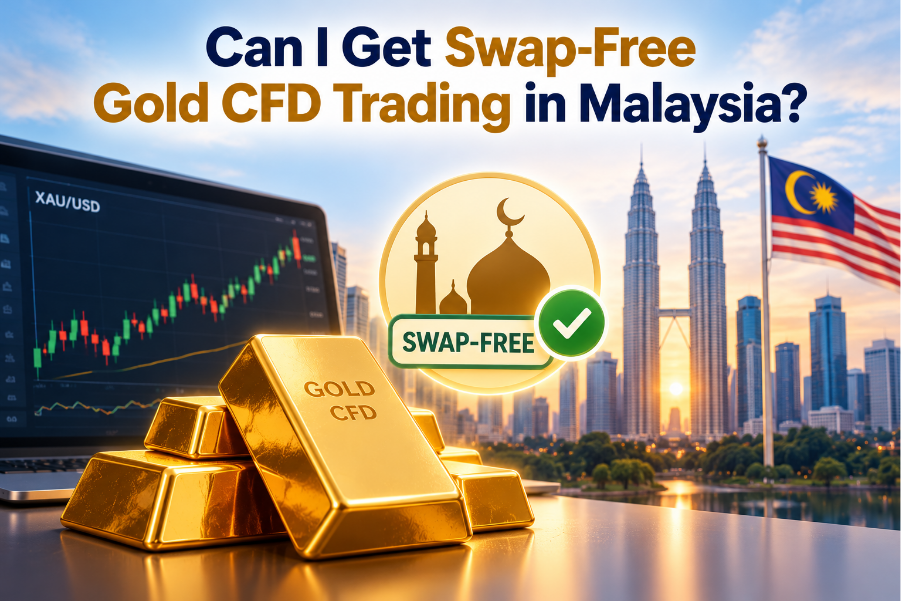
Yes, but it is not automatically waived for every platform or account type. In Malaysia, whether you can trade Gold CFDs (XAU/USD) swap-free mainly depends on the online broker you choose and the specific account type you open.
6 Practical Tips for Trading Gold CFDs in Malaysia
Gold CFDs allow Malaysian traders to speculate on movements in gold prices without buying or storing physical gold. However, leverage, trading costs, and sudden price fluctuations can make these instruments particularly risky for beginners. The following six tips focus on practical decisions that traders can control, from choosing a broker to managing positions around major economic announcements.
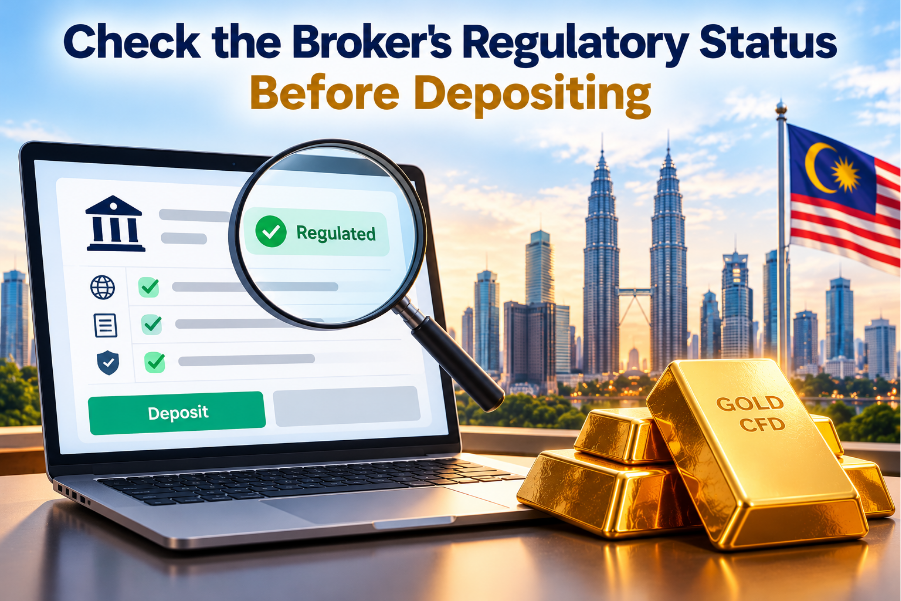
Check the Broker's Regulatory Status Before Depositing
Before opening a gold CFD account, verify the legal entity providing the service and the regulator responsible for supervising it.
A broker may advertise an international license, but this does not mean it is authorized to provide services in Malaysia. So, it is necessary for traders there to check the Securities Commission Malaysia's public registers and Investor Alert List rather than rely solely on claims made on a broker's website.
Another important step is to check the broker's withdrawal rules, client-fund arrangements, and negative balance protection, where applicable. A low minimum deposit is of limited value if the account lacks adequate safeguards.
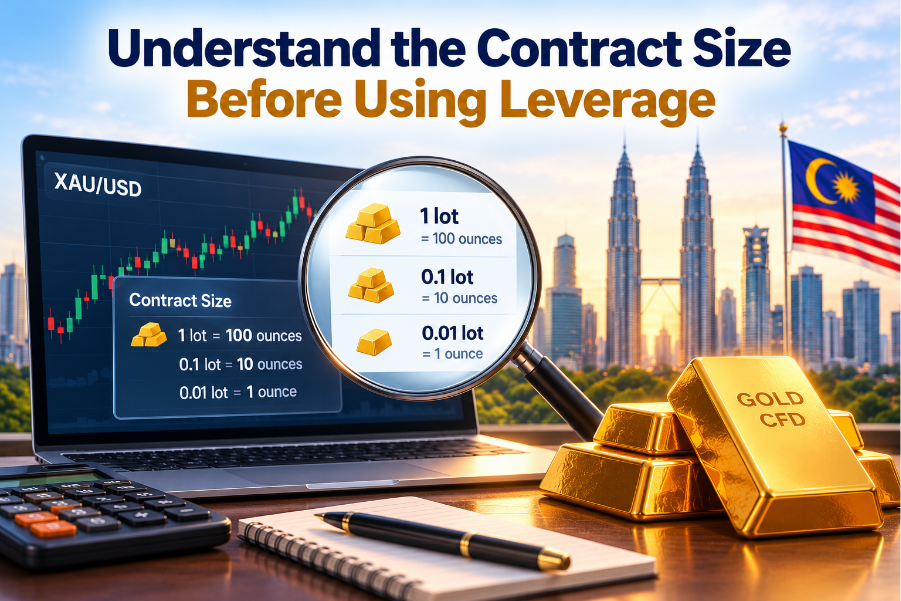
Understand the Contract Size Before Using Leverage
Gold CFDs are commonly quoted as XAU/USD, representing the price of gold in US dollars per troy ounce. However, the contract size and minimum trading volume depend on the broker.
For illustration, assume a broker defines one standard lot as 100 troy ounces.
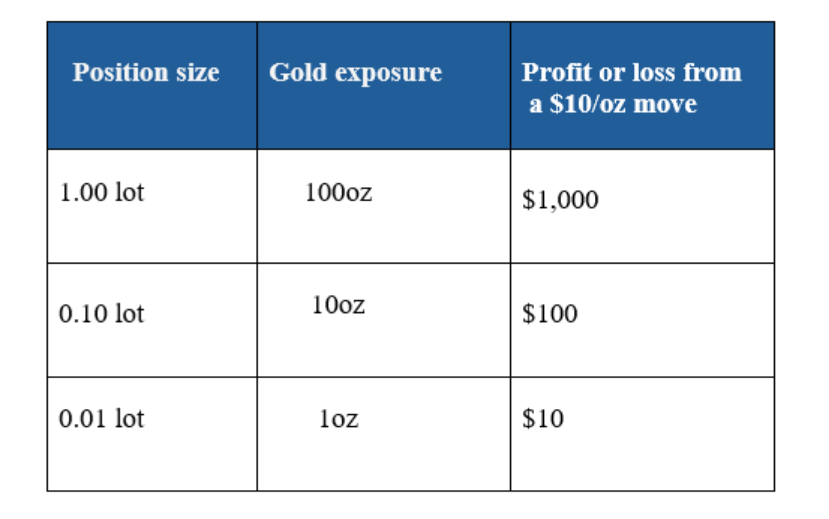
A trader opening 0.01 lot under these specifications would gain or lose approximately $10 for every $10 movement in gold's price, before trading costs.
Leverage reduces the margin required to open a position, but it does not reduce the profit or loss generated by a given price movement. Beginners should calculate their dollar exposure before placing a trade, rather than choosing a position size based on available leverage.
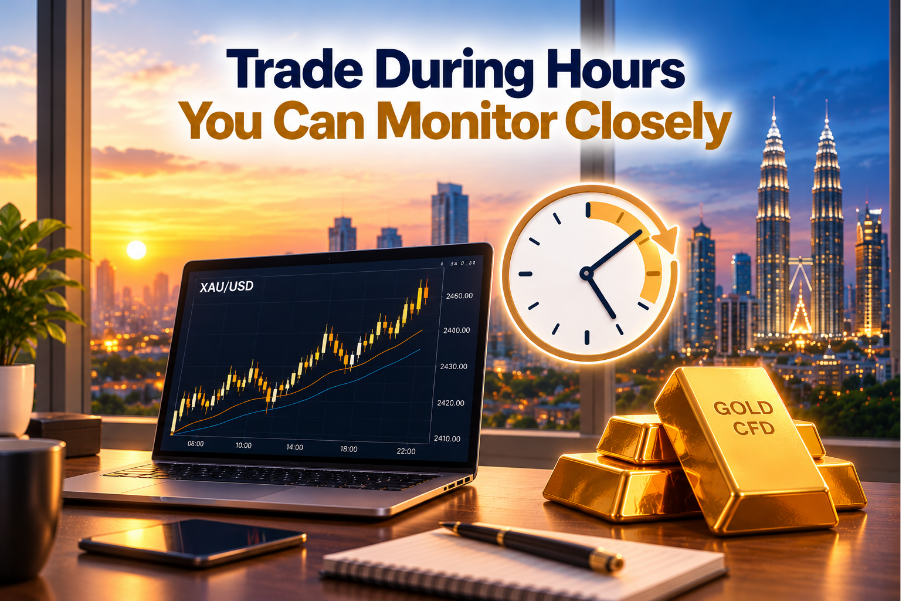
Trade During Hours You Can Monitor Closely
Gold CFDs may be available for trading for much of the working week, subject to the broker's trading schedule. Yet market activity is not equally distributed throughout the day.
For Malaysian traders, the London and New York sessions are particularly useful periods to observe because both can bring substantial participation to global gold markets.
The London session typically begins at 3pm MYT during British summer time and 4pm MYT during winter. The New York session generally becomes more active later in the Malaysian evening.
Higher activity can create trading opportunities, but it can also produce rapid price movements. Beginners should choose a manageable observation window rather than assume that the most volatile hours are necessarily the most profitable.
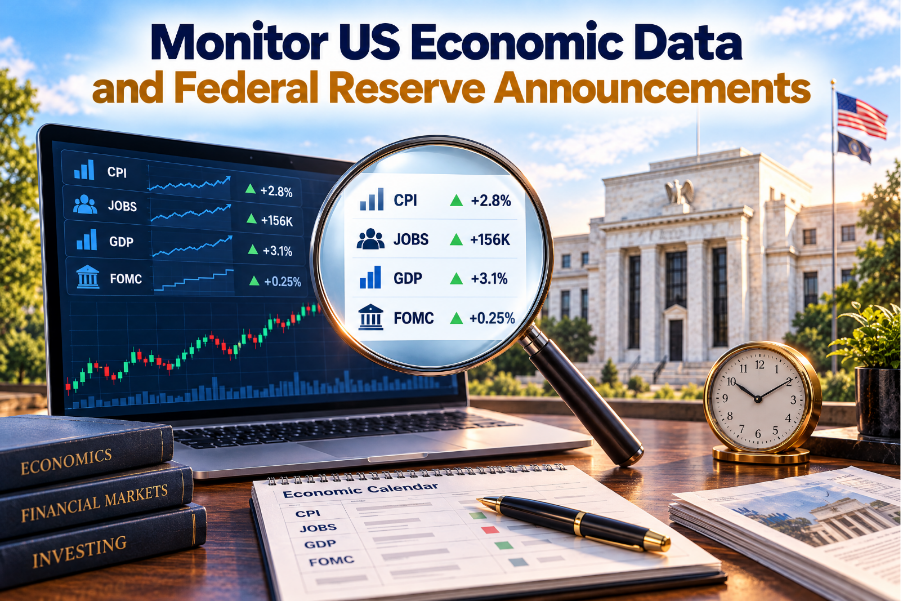
Monitor US Economic Data and Federal Reserve Announcements
Since Gold is traded globally in U.S. dollars, any sudden moves in Treasury yields, interest rate forecasts, or the dollar itself will instantly impact XAU/USD price action.
Key economic releases to watch include U.S. inflation data (CPI), non-farm payrolls (NFP), and Federal Reserve interest rate decisions. Stronger-than-expected economic data often drives Treasury yields and the dollar higher, putting downward pressure on gold prices. However, this relationship is far from automatic. Geopolitical uncertainty and safe-haven demand frequently override dollar strength, while recent market reactions demonstrate just how violently inflation surprises can move gold prices.
For example, a Malaysian trader planning to buy XAU/USD shortly before a US inflation release should consider whether the expected price movement justifies the risk of wider spreads and slippage. Waiting until the initial reaction settles may be more manageable than attempting to predict the announcement.
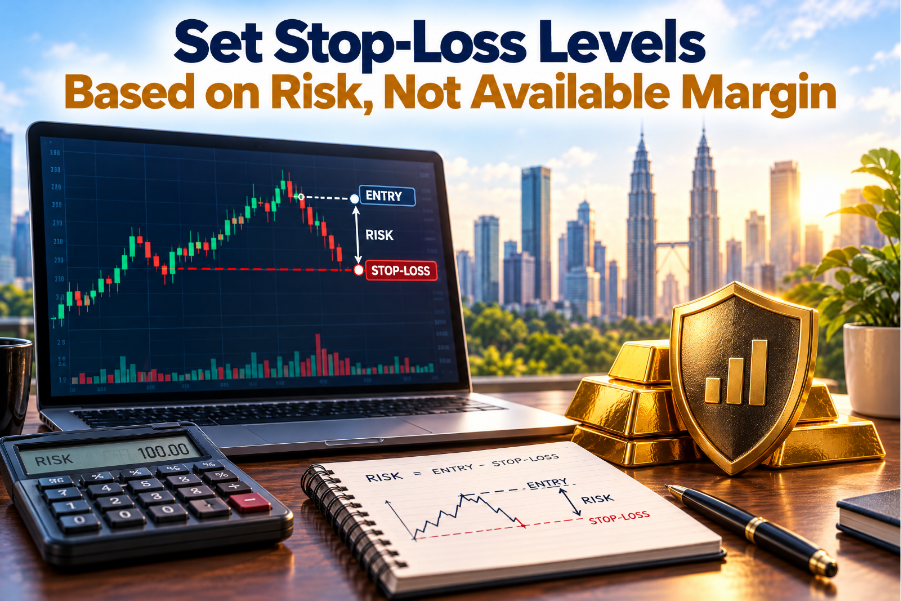
Set Stop-Loss Levels Based on Risk, Not Available Margin
A stop-loss should reflect the trading setup and the amount the trader can afford to lose, rather than the maximum position permitted by the broker.
Consider a trader with a $500 account who decides to risk 1%, or $5, on a gold CFD trade.
Assume the broker's contract specifications are 100 ounces per standard lot, and the trader's proposed stop-loss is $10 per ounce away from the entry price.
At 0.01 lot, the position represents one ounce of gold, so the planned price-movement loss would be $10—twice the intended risk allowance.
To remain within $5, the trader would need a smaller position, a different setup or to skip the trade. Tightening the stop-loss arbitrarily simply to make the calculation fit may expose the position to ordinary market fluctuations.
A stop-loss also cannot guarantee execution at the exact specified price during fast markets.
Compare Spreads, Commissions and Overnight Financing Costs
Gold CFD trading costs extend beyond the difference between the buying and selling prices.
Traders should consider the spread, any commission charged by the broker, currency-conversion charges, and overnight financing when a leveraged position remains open beyond the broker's rollover time.
For example, suppose a trader opens a one-ounce gold CFD position with a $2-per-ounce spread. The spread represents approximately $2 of trading cost for that exposure, before any additional charges.
A trader who opens and closes ten similar positions would incur approximately $20 in spread costs alone, assuming the spread remains unchanged.
For positions held overnight, financing charges may further affect the result. Some brokers offer swap-free accounts, but these may have alternative fees or eligibility restrictions. A swap-free label should not be interpreted as a guarantee that holding positions is cost-free.

Best Forex Brokers to Trade Gold CFDs in Malaysia?
Like mentioned previously, success in Gold (XAU/USD) CFD trading relies heavily on selecting a proper broker which can give easy and flexible trading experience on gold CFDs. We find out three brokers fit trades in Malaysia compared with other brokers, and here Let's explore why they are on the list.
XM at a Glance:
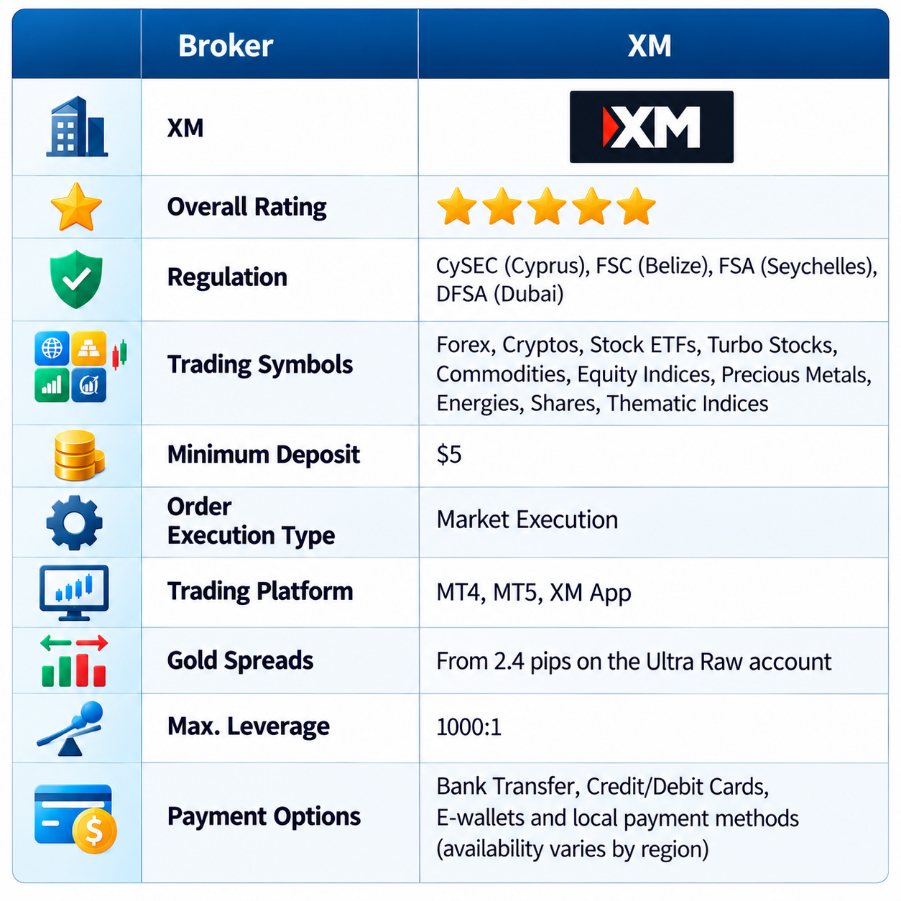
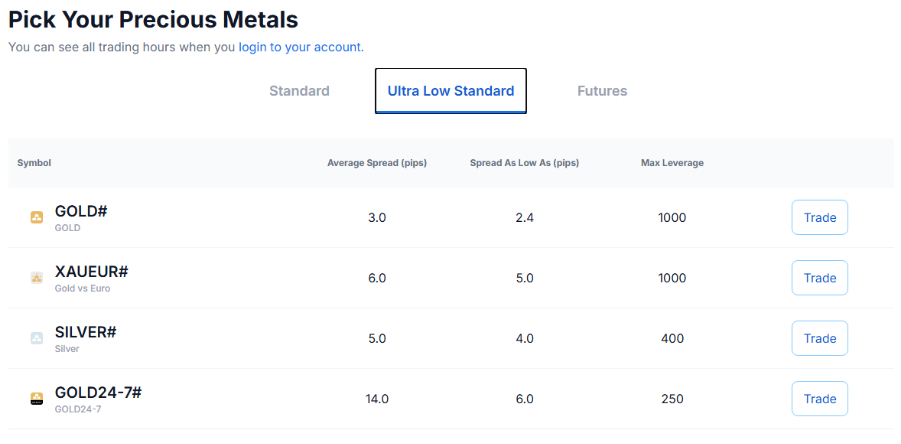
XM remains a popular choice among Malaysian traders thanks to its tailored local deposit methods, consistent execution speeds, and user incentives. Its Ultra Low Account is well-suited for gold trading, featuring zero commissions and average spreads of 3.0 pips, which is a reasonable price compared with its peers in the industry. Besides, automatic swap-free functionality is applied for Shariah compliance. In addition, it offers flexible leverage up to 1:1000 for gold trading. This gives active traders a huge attraction.
HFM (Hotforex) at a Glance:
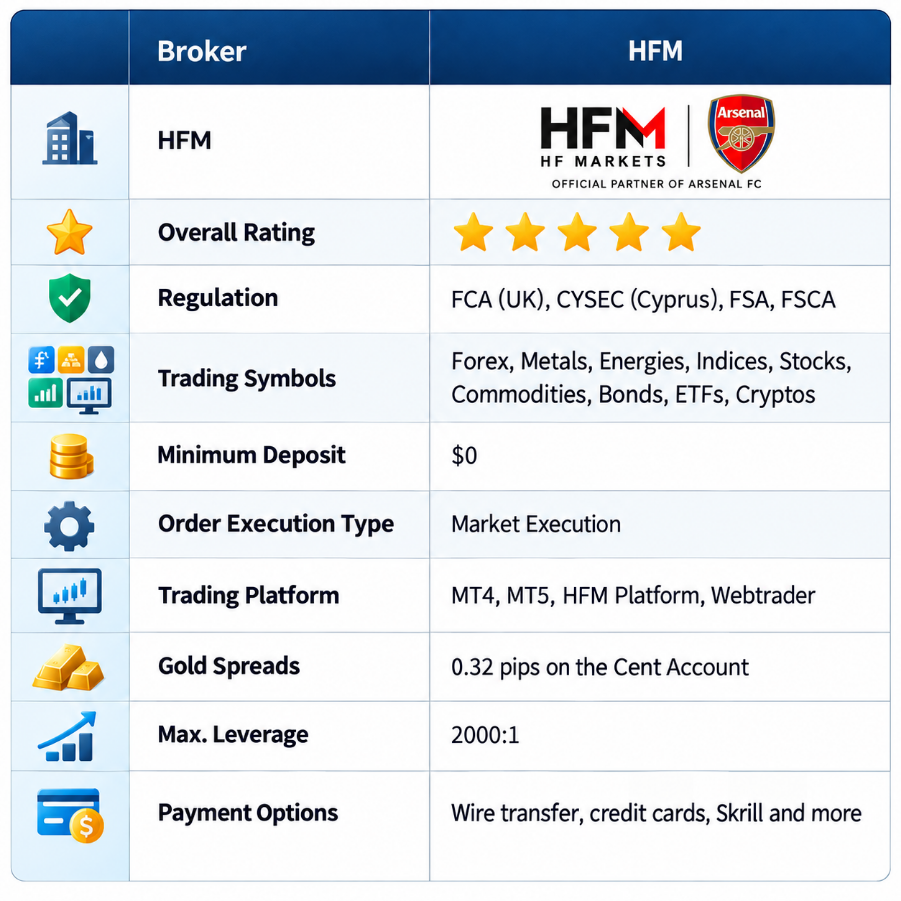
HFM, a heavily regulated CFD broker, is a solid choice to trade Gold CFDs among Malaysian traders. Gold trading fees on this platform are competitive, with raw spreads starting as low as 0.32 pips on XAU/USD and 0.38 pips on XAU/EUR. Notably, backed by multi-jurisdictional licensing, HFM leverage options extend up to 1:2000, and it also provides automatic swap-free Islamic accounts and integrated MYR payment channels.

VG Markets at a Glance:
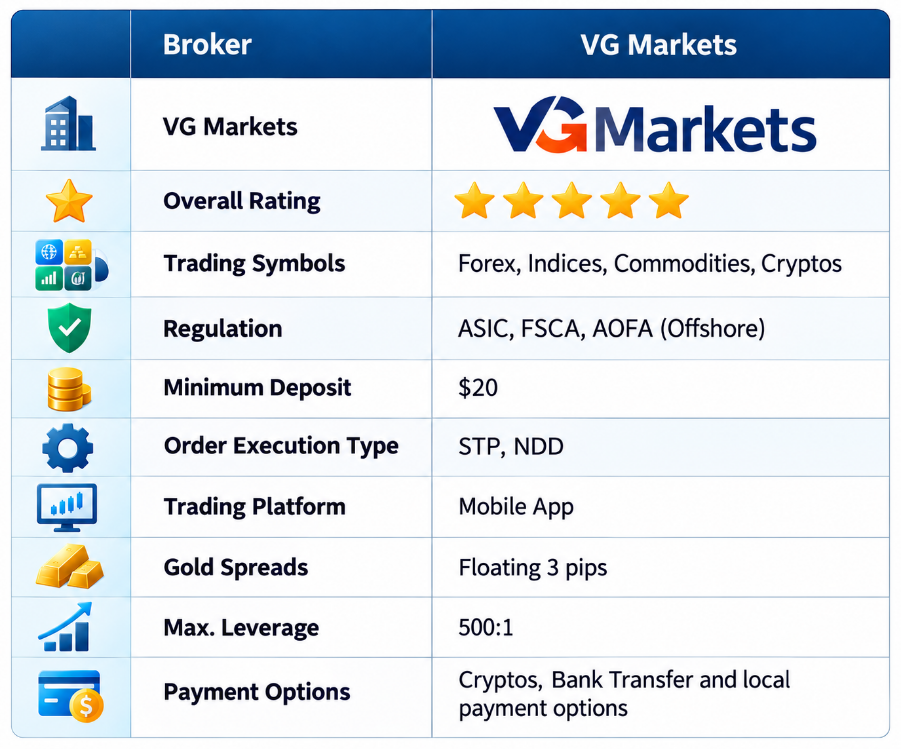
VG Markets shines through its mobile gold trading app, fast execution, and flexible trading experience. In testing, floating gold spreads averaged 3 pips alongside a conservative maximum leverage ratio of 1:20 to reduce emotional trading. It is also important to note that VG Markets is proud of its fast withdrawal process time, averaging a 3-day withdrawal turnaround verified by at least 90% of clients.
The Bottom Line
Like any derivative market, trading gold CFDs is not as easy as expected. Trading itself contains huge risks, and besides, traders themselves also play a vital role in trading. Choosing a solid broker softens the trouble, but it won't do all the work for you. Building strong habits and setting your trading goals on your end is the key.
Risk warning: Trading forex and CFDs involves significant risk and may result in losses that exceed expectations. Leverage magnifies both gains and losses. This article is for educational purposes only and does not constitute investment advice.
FAQs
Can I make a profit by trading gold CFDs?
It is hard to say. How well you do ultimately comes down to two main things: the platform you choose and the strategy you run. But if there’s one rule worth sticking to, it’s avoiding overstayed welcomes. Secure your gain, close the position, and leave the platform.
How much can I start to trade gold CFDs?
You can actually start quite small—provided you pick a broker that offers micro or standard accounts tailored for low minimums, such as XM, HFM, or VG Markets.
Should I employ high leverage when trading gold CFDs?
Using high leverage when trading gold is generally not a good idea. Gold is volatile on its own, and excessive leverage simply amplifies that risk—turning small market movements into major losses.