
- The Indian Rupee gains against the US Dollar on the outcome of US midterm elections.
- Democrats win majority in both US Houses.
- ING doesn’t see a structural weakness in the US Dollar due to Democrats' victory.
The Indian Rupee (INR) gains against the US Dollar (USD) on a volatile Wednesday as Democrats have registered victory in United States (US) midterm elections.
As of writing, the USD/INR pair is slightly lower to near 94.65 despite the outcome of US elections weighing on the US Dollar. The US Dollar Index (DXY), which gauges the Greenback’s value against six major currencies, trades 0.45% lower to near 101.42.
Democrats take control of both Houses
According to Decison Desk HQ, Democrats have won majority seats in both the House of Senate, and the House of Representatives. The scenario of Democrats winning both the House of Representatives and the Senate is expected to have a significant impact on the US Dollar.
ING warned earlier that “fears of tougher regulation could weigh on Artificial Intelligence (AI) stocks (we’ve recently seen how that can hit the greenback), while markets could price in greater risks of decision-making gridlock around issues such as government funding and the debt ceiling.”
However, ING ruled out fears of a structural directional shift in the Dollar, explaining that the greenback “continues to respond predominantly to the Fed story, which shouldn’t face an immediate and direct impact from the midterm result”.
Key US economic releases
This week, investors will pay close attention to key US economic releases, notably Nonfarm Payrolls (NFP) data for October, which will be released on Friday. The NFP data will likely influence Federal Reserve’s (Fed) interest rate expectations significantly.
Ahead of the official US employment data release, financial markets will focus on the US ADP Employment Change data for October, which will be published later in the day at 13:15 GMT. The data is expected to show that the private sector created 69K fresh jobs lower than 90K in September.
Technical Analysis: USD/INR stays below 20-day EMA
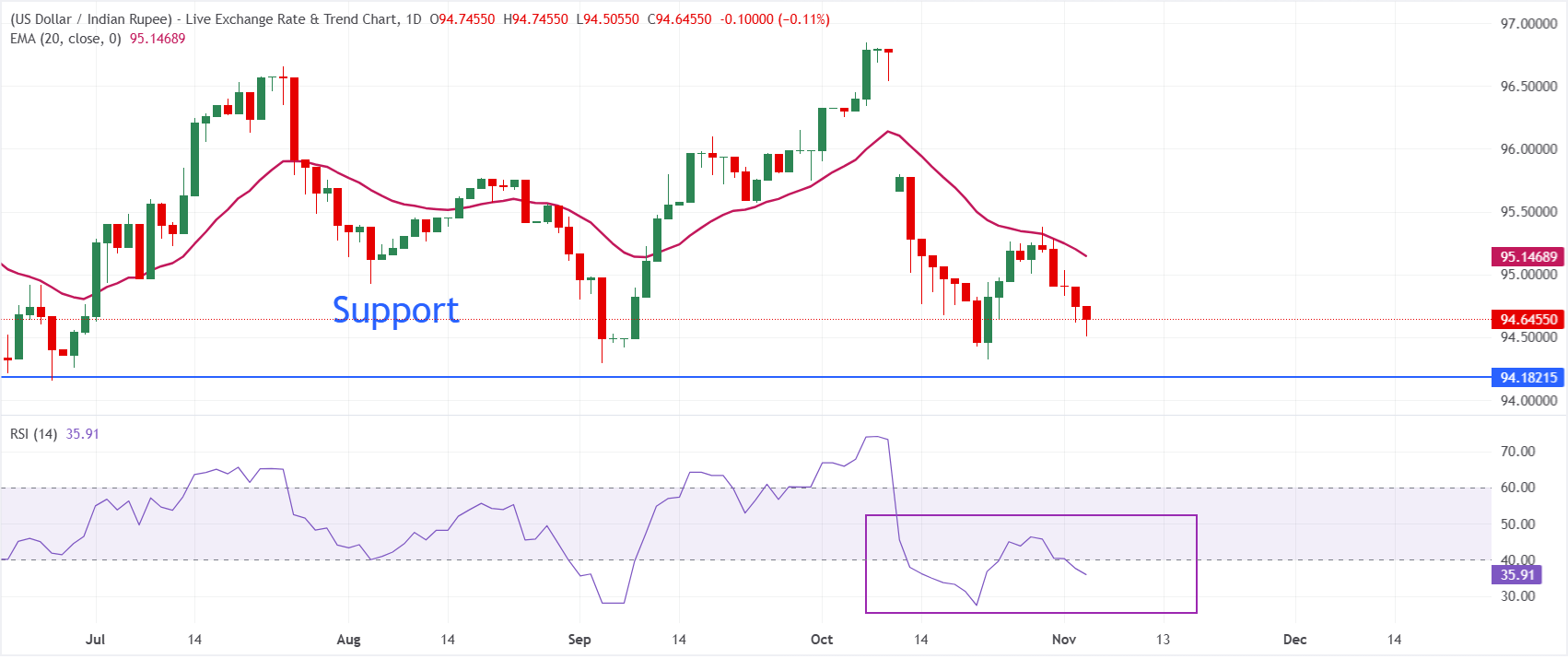
In the daily chart, USD/INR trades at 94.65, maintaining a bearish near-term bias as spot holds beneath the 20-day exponential moving average (EMA) at 95.16. The pair has retreated from recent highs and remains capped by this dynamic resistance, while the Relative Strength Index (RSI) around 37 suggests lingering downside pressure, though not yet in oversold territory.
On the topside, immediate resistance is seen at the 20-day EMA near 95.16, and a daily close above this barrier would be needed to ease the current downside bias and allow for a recovery phase. Looking down, the June low at 94.16 is the key support level.
(The technical analysis of this story was written with the help of an AI tool. Know more.)
Economic Indicator
ADP Employment Change
The ADP Employment Change is a gauge of employment in the private sector released by the largest payroll processor in the US, Automatic Data Processing Inc. It measures the change in the number of people privately employed in the US. Generally speaking, a rise in the indicator has positive implications for consumer spending and is stimulative of economic growth. So a high reading is traditionally seen as bullish for the US Dollar (USD), while a low reading is seen as bearish.
Read more.Next release: Wed Nov 04, 2026 13:15
Frequency: Monthly
Consensus: 69K
Previous: 90K
Source: ADP Research Institute
Traders often consider employment figures from ADP, America’s largest payrolls provider, report as the harbinger of the Bureau of Labor Statistics release on Nonfarm Payrolls (usually published two days later), because of the correlation between the two. The overlaying of both series is quite high, but on individual months, the discrepancy can be substantial. Another reason FX traders follow this report is the same as with the NFP – a persistent vigorous growth in employment figures increases inflationary pressures, and with it, the likelihood that the Fed will raise interest rates. Actual figures beating consensus tend to be USD bullish.