
- The Indian Rupee gains significantly against the US Dollar due to multiple tailwinds.
- Lower oil prices and AI unwinding have underpinned the Indian currency.
- The Fed is expected to deliver three back-to-back interest rate hikes.
The Indian Rupee (INR) opens sharply higher against the US Dollar (USD) on Tuesday, with the USD/INR pair posting a fresh almost seven-month low near 93.40. The pair is under pressure as the Indian currency strengthens due to lower oil prices, a consistent inflows of foreign funds due to the unwinding of Artificial Intelligence (AI) trade globally.
Why are oil prices falling?
Rising exports of energy products from the Middle East despite attacks on tankers in the region have improved hopes of supply surplus. The International Energy Agency (IEA) said last week that the global oil market will return to a surplus in the fourth quarter of this year, as Middle East exports recover faster than global oil demand despite attacks on shipping, Reuters reported.
In the opening trade, the MCX Crude Oil contract expiring on November 19 is down 1.53% to near Rs. 7,955. The oil price is close to its almost 11-week low of Rs. 7,861. Lower oil prices bode well for currencies from economies, such as India, which rely heavily on oil imports to meet their energy needs.
FIIs continue to pour money into the Indian stock market
Indian stock markets continue to attract investment from Foreign Institutional Investors (FIIs), with the entire world is facing the rapid unwinding of AI trade, following the victory of United States (US) Democrats in midterm elections and the resignation of Nvidia CEO Jensen Huang
India’s Chief Economic Advisor (CEA) V Anantha Nageswaran also said in an interview with Indian Express newspaper published on Monday, “India’s status as a non-AI play is definitely weighing positively on the Indian market sentiment and also drawing in foreign institutional investors in the near term.”
So far in November, FIIs have remained net buyers on all trading days, except for the Diwali Muhurat trading session, and bought stake worth Rs. 84,167.40 crore.
US Dollar outperforms on hawkish Fed rhetoric
The US Dollar Index (DXY) retreats after posting a fresh 19-month high at 103.70 in the early trade on Tuesday, but is likely to regain strength again as market experts bet on consecutive interest rate hikes from the Federal Reserve (Fed).
Analysts at MUFG/BTMU highlight that the sharp hawkish repricing of Fed policy has filtered directly into the US rates market, which is now "assigning a higher probability to three consecutive hikes in December, January and March, which would lift the effective Fed funds rate towards 4.6%."
Technical Analysis: USD/INR sees more downside towards 93.00
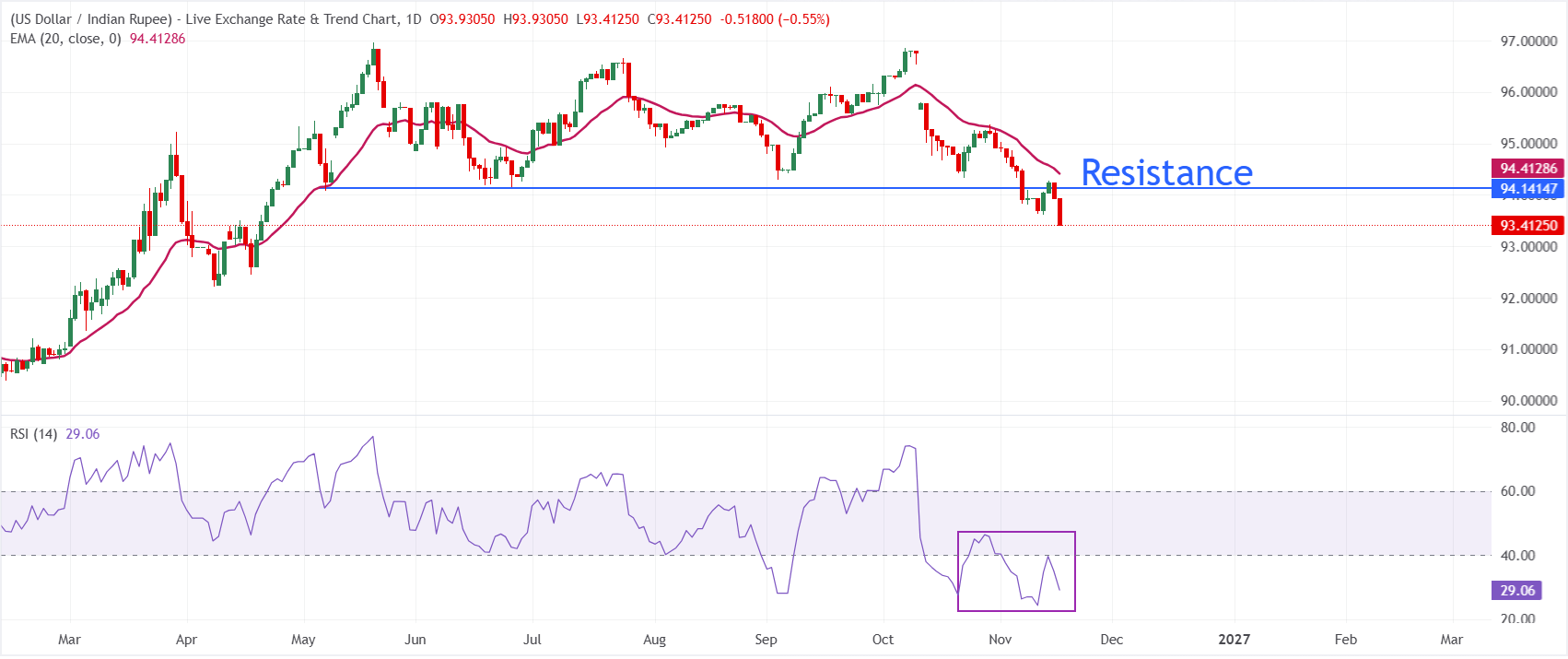
In the daily chart, USD/INR trades near 93.40, maintaining a bearish near-term bias as spot holds beneath the 20-day exponential moving average (EMA) at 94.41. The pair’s slide below this short-term average suggests that rallies are being capped by immediate overhead supply, while the Relative Strength Index (RSI) at 29.06 hovers just above oversold territory, hinting at persistent but not yet exhausted downside pressure.
On the topside, initial resistance is located at the 20-day EMA around 94.41, and a sustained recovery above this barrier would be needed to ease the current bearish tone and open the way for a broader corrective bounce. Looking down, the 93.00 level would act as key support for the pair.
(The technical analysis of this story was written with the help of an AI tool. Know more.)
Indian economy FAQs
The Indian economy has averaged a growth rate of 6.13% between 2006 and 2023, which makes it one of the fastest growing in the world. India’s high growth has attracted a lot of foreign investment. This includes Foreign Direct Investment (FDI) into physical projects and Foreign Indirect Investment (FII) by foreign funds into Indian financial markets. The greater the level of investment, the higher the demand for the Rupee (INR). Fluctuations in Dollar-demand from Indian importers also impact INR.
India has to import a great deal of its Oil and gasoline so the price of Oil can have a direct impact on the Rupee. Oil is mostly traded in US Dollars (USD) on international markets so if the price of Oil rises, aggregate demand for USD increases and Indian importers have to sell more Rupees to meet that demand, which is depreciative for the Rupee.
Inflation has a complex effect on the Rupee. Ultimately it indicates an increase in money supply which reduces the Rupee’s overall value. Yet if it rises above the Reserve Bank of India’s (RBI) 4% target, the RBI will raise interest rates to bring it down by reducing credit. Higher interest rates, especially real rates (the difference between interest rates and inflation) strengthen the Rupee. They make India a more profitable place for international investors to park their money. A fall in inflation can be supportive of the Rupee. At the same time lower interest rates can have a depreciatory effect on the Rupee.
India has run a trade deficit for most of its recent history, indicating its imports outweigh its exports. Since the majority of international trade takes place in US Dollars, there are times – due to seasonal demand or order glut – where the high volume of imports leads to significant US Dollar- demand. During these periods the Rupee can weaken as it is heavily sold to meet the demand for Dollars. When markets experience increased volatility, the demand for US Dollars can also shoot up with a similarly negative effect on the Rupee.