
- The Indian Rupee gains against the US Dollar on multiple tailwinds.
- Consistent RBI intervention, lower oil prices, and receding hawkish Fed bets lend support to the Indian currency.
- Easing hopes of US-Iran diplomacy could stage a recovery for oil prices.
The Indian Rupee (INR) gains against the US Dollar (USD) after a flat opening on Wednesday. The USD/INR pair falls to near 95.84 as the Indian currency has drawn temporary support from consistent Reserve Bank of India’s (RBI) intervention through spot and Non-Deliverable Forwards (NDFs) markets, a drop in oil prices, and the dovish revision of the Federal Reserve's (Fed) interest rate expectations.
At press time, the MCX Crude Oil contract expiring on October 19 is down 0.82% to near Rs. 8,600.
Currencies from economies, such as India, which rely heavily on oil imports to meet their energy needs, get some relief when oil prices start correcting.
Oil prices drop amid an increase in flows from Saudi Arabia
Analysts at Deutsche Bank note that the earlier surge in Brent was tempered after “Saudi Arabia has restored about half the flows through its East-West pipeline.” Goldman Sachs also said in a note that it estimates Persian Gulf oil exports, including dark exports, to have recovered to their 2025 average after doubling in September.
However, experts also question the correction in oil prices and warn of upside risks even beyond 2026, citing dashed hopes of near-term United States (US)-Iran diplomacy.
Deutsche Bank argues that persistent “scepticism about the Strait of Hormuz reopening any time soon has led investors to price a longer period of high prices into next year.”
Meanwhile, a report from Axios has shown that efforts this week by Qatari mediators to broker a diplomatic breakthrough between the US and Iran have made little progress, with neither side willing to budge. Such a scenario could allow oil prices to resume their upside.
Highest single-day FIIs selling in four months
On Tuesday, overseas investors sold shares worth 99.8 billion rupees ($1.04 billion) on a net basis, marking their biggest outflow in about four months, Reuters reports. Selling pressure by Foreign Institutional Investors (FIIs) in the Indian equity market could renew concerns over Foreign Exchange (Forex) reserves even after the RBI has buffed up Forex receipts significantly through the Foreign Currency Non-Residents (FCNR) window.
US PCE Inflation data awaited
Later in the day, investors will pay close attention to the US Personal Consumption Expenditures (PCE) Price Index data for August, which will be published at 12:30 GMT. The core PCE inflation, the Federal Reserve’s (Fed) preferred inflation gauge, is expected to have remained steady at 3.3% Year-on-Year (YoY), with monthly figures growing at a faster pace of 0.3% against the previous reading of 0.2%. The data is expected to have a significant influence on the Fed’s interest rate expectations.
Meanwhile, financial markets have trimmed hawkish Fed bets as New York Fed President John Williams has ruled out the urgency of another interest rate hike. The CME FedWatch tool shows that the odds of the central bank delivering an interest rate hike in October have diminished to 44.8% from 70.9% seen on Monday.
Williams tempers post-hike urgency but keeps Fed firmly hawkish
Fed’s John Williams has delivered a moderately hawkish message, with an FXS Speechtracker score of 6.4 slightly above the 6.2 historical average, signaling a tone that is firm but not escalating. The emphasis on “no need for urgency” after the latest rate hike, coupled with data-dependent guidance and the conditional prospect of one further hike this year, points to a cautious continuation of tightening rather than an aggressive push. Strong US economic momentum, persistent inflation risks including AI-related investment pressures, and a long glide path back to the 2% target reinforce a narrative of sustained restrictive policy relative to the established baseline.
The FXS Fed Sentiment Index fell by 1.43 points to 144.29, indicating a modest pullback in perceived hawkishness following the speech. Despite the decline, the index remains deep in hawkish territory above 100, underscoring that the bank's stance is still clearly restrictive even as the immediate urgency for additional rapid tightening is toned down in the FXS Speechtracker.
In the September policy meeting, the Fed raised key rates by 25 basis points (bps) to the 3.75%-4.00% range.
This week, the major trigger for the Fed’s interest rate projections will be the Nonfarm Payrolls (NFP) data for September, which will be released on Friday.
Technical Analysis: USD/INR holds key 20-day EMA
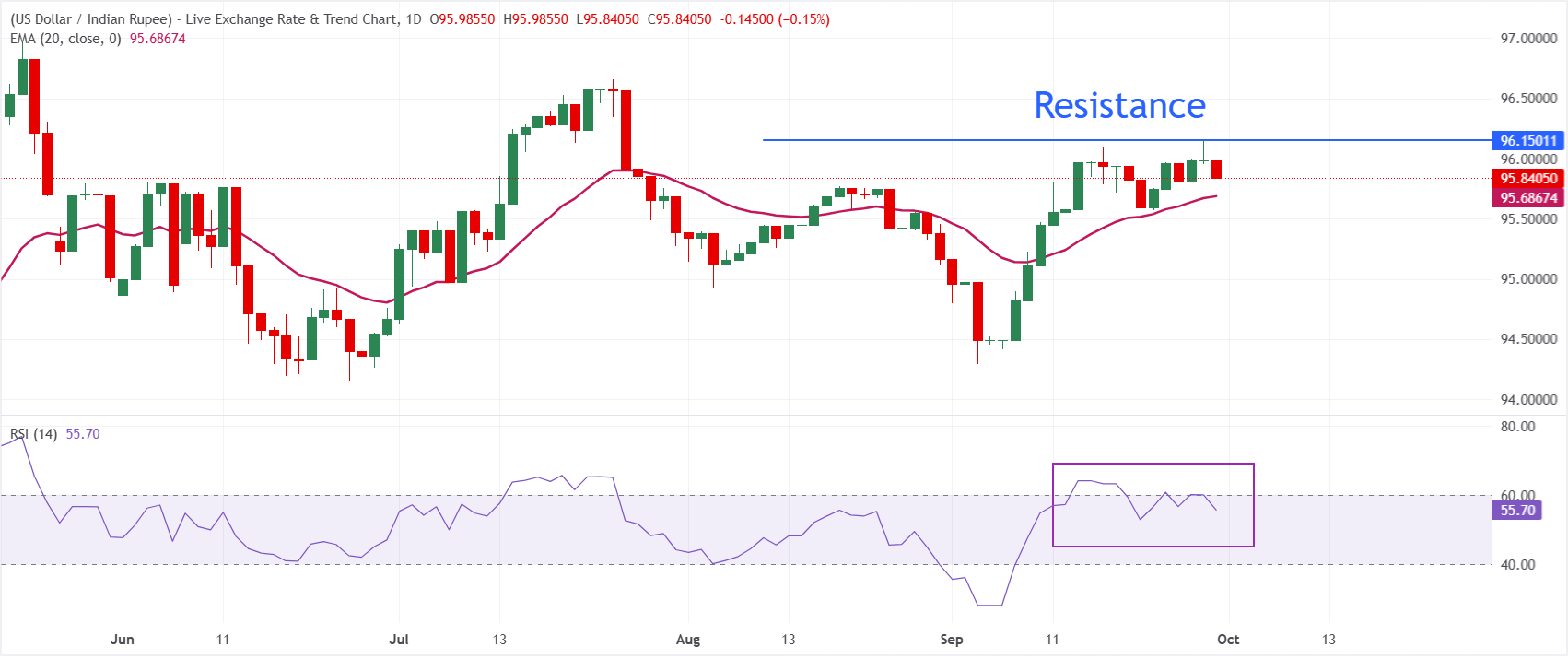
On the daily chart, USD/INR trades at 95.84, holding above the 20-period Exponential Moving Average (EMA) at 95.68, which underpins a mildly bullish near-term bias. The pair has been grinding higher over recent sessions, and the Relative Strength Index (RSI) at 55.7 stays in neutral-to-positive territory, suggesting room for the uptrend to extend while dips remain supported by the nearby EMA.
On the downside, initial support is located at the 20-period EMA around 95.70, where buyers are likely to defend the prevailing uptrend on any pullback. Looking up, the September 29 high at 96.15 is the immediate hurdle for the pair; above that, the USD/INR could attempt to revisit the all-time high near 97.00.
(The technical analysis of this story was written with the help of an AI tool. Know more.)
Economic Indicator
Core Personal Consumption Expenditures - Price Index (YoY)
The Core Personal Consumption Expenditures (PCE), released by the US Bureau of Economic Analysis on a monthly basis, measures the changes in the prices of goods and services purchased by consumers in the United States (US). The PCE Price Index is also the Federal Reserve’s (Fed) preferred gauge of inflation. The YoY reading compares the prices of goods in the reference month to the same month a year earlier. The core reading excludes the so-called more volatile food and energy components to give a more accurate measurement of price pressures." Generally, a high reading is bullish for the US Dollar (USD), while a low reading is bearish.
Read more.Next release: Wed Sep 30, 2026 12:30
Frequency: Monthly
Consensus: 3.3%
Previous: 3.3%
Source: US Bureau of Economic Analysis
After publishing the GDP report, the US Bureau of Economic Analysis releases the Personal Consumption Expenditures (PCE) Price Index data alongside the monthly changes in Personal Spending and Personal Income. FOMC policymakers use the annual Core PCE Price Index, which excludes volatile food and energy prices, as their primary gauge of inflation. A stronger-than-expected reading could help the USD outperform its rivals as it would hint at a possible hawkish shift in the Fed’s forward guidance and vice versa.