Investing is about growing wealth over time. When you buy an asset, your return typically comes from three main sources: capital gains as the value rises, steady cash flow like interest or dividends, or a combination of both.
Trading focuses on capturing profit from market fluctuations over short horizons. Depending on the strategy, a trader might hold a position for just a few minutes, several hours, or a couple of weeks before taking profit or cutting a loss.
Value Investing and Speculative Investing: Know the Difference
Value investing isn't just a strategy—it's a commitment to a business you believe in. When you hold shares for years or decades, you aren't playing the market; you're betting on a company's long-term worth to steadily compound over time. Value investing demands real homework. For instance, in stock trading, you have to thoroughly research the financial health, revenue trends, and long-term potential of the company behind.
Speculative trading works completely differently—and unfortunately, it's where most beginners start. Speculators aren't betting on a company's underlying strength. Instead, speculators buy and sell based primarily on shifting market sentiment, breaking news, and short-term industry trends without devoting much time to analyzing the company itself.
Trading Equipped with Margin, Leverage and Risks
Trading grants traders access to huge global markets. Via broker–hosted CFD derivatives, retail traders can speculate on various assets across forex, stocks, commodities, cryptos, and more. Trading features flexible leverage and margin to increase your principals 10 times, 100 times, or even 1000 times. This is exciting yet scary. Trading markets are filled with those who want to make a large fortune overnight.
$100 to start investing or trading?
If a beginner has only $100 to start to build a financial plan, then, what should him to do get a better result?
Investing or trading, that is the question.
Actually, $100 is enough to enter both markets, but it does not give beginners the same flexibility to manage risk.
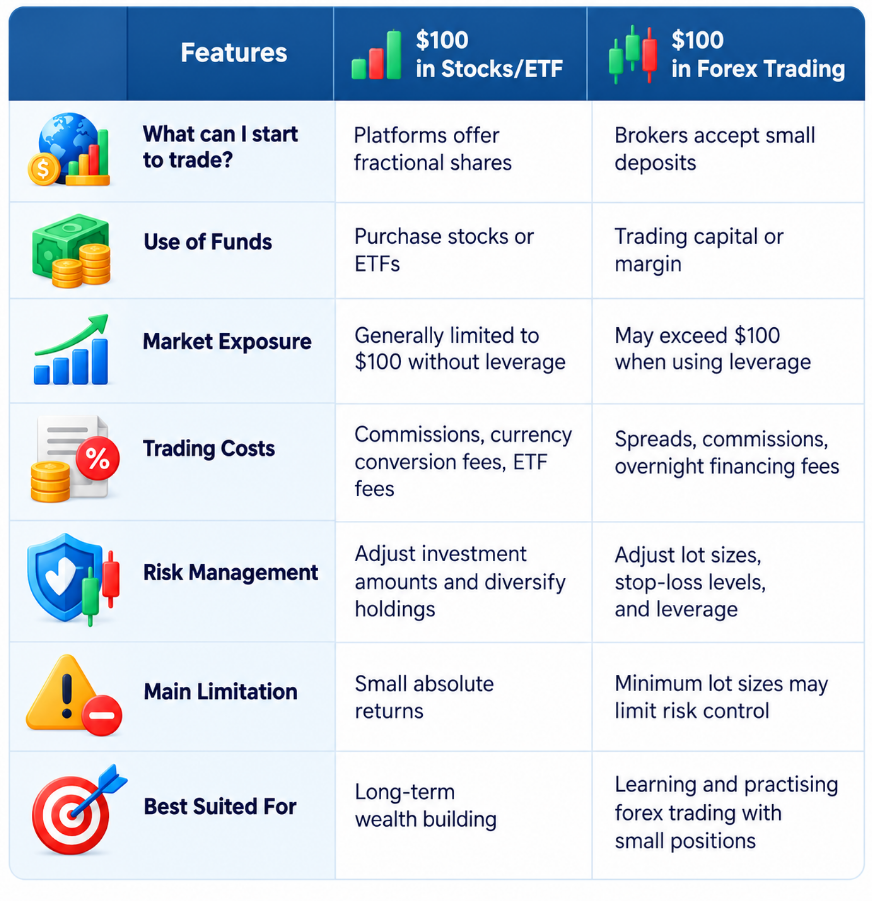
For investing, many platforms now support fractional shares and ETFs. For instance, putting $100 into an unleveraged ETF gives you exactly $100 in market exposure. If that fund drops 2%, your position falls by roughly $2 (minus any minor fees). This setup also lets beginners build a portfolio steadily over time by adding small, regular amounts rather than needing a massive upfront deposit.
Forex trading works differently. A $100 account often supports a position much larger than the deposited capital when leverage is used. At 10:1 leverage, for example, $100 could provide exposure to $1,000 worth of currency. A 2% adverse exchange-rate movement would then produce a loss of approximately $20, or 20% of the starting account, before trading costs.
Position size creates another limitation. On EUR/USD, a standard 0.01-lot position has an approximate pip value of $0.10 in a USD-denominated account. A 20-pip stop-loss would therefore represent a planned loss of $2, or 2% of a $100 account, before fees and possible slippage. If the broker does not support smaller positions, reducing that risk without changing the stop-loss distance may be difficult.
Trading costs also deserve attention. Suppose a trader completes 20 round-trip trades in a month, paying an average of $0.50 per trade. The total cost would be $10, equivalent to 10% of the original account balance.
For beginners focused on building wealth, $100 seems more useful as the first contribution to a long-term investment plan. For those interested in learning forex trading, a demo account or a suitable account requiring under $100 can provide a more manageable introduction, provided the contract sizes and costs are understood.
The question is that $100 may be enough to enter either market, but it is not enough to trade every strategy responsibly.
Is Trading More Profitable Than Investing?
Trading can generate faster profits than long-term investing, but the evidence does not suggest that frequent trading consistently delivers better returns for ordinary investors. The distinction becomes clearer when comparing historical stock-market performance with the actual results of active traders.
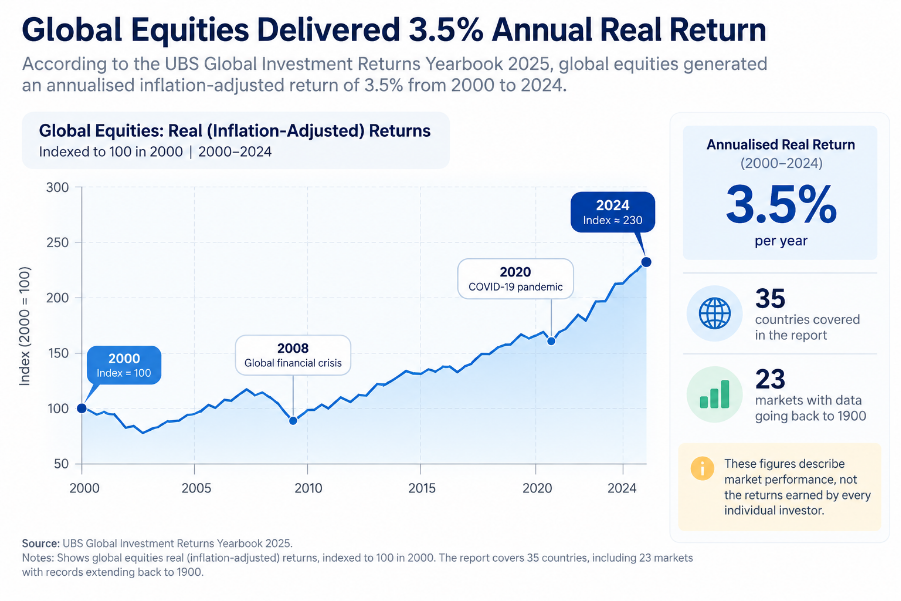
According to the UBS Global Investment Returns Yearbook 2025, global equities delivered an annualised inflation-adjusted return of 3.5% from 2000 to 2024. The report draws on historical financial-market data from 35 countries, including 23 markets with records extending back to 1900. These figures describe market performance, not the returns earned by every individual investor. You can learn more details here: Global Investment Returns Yearbook 2025
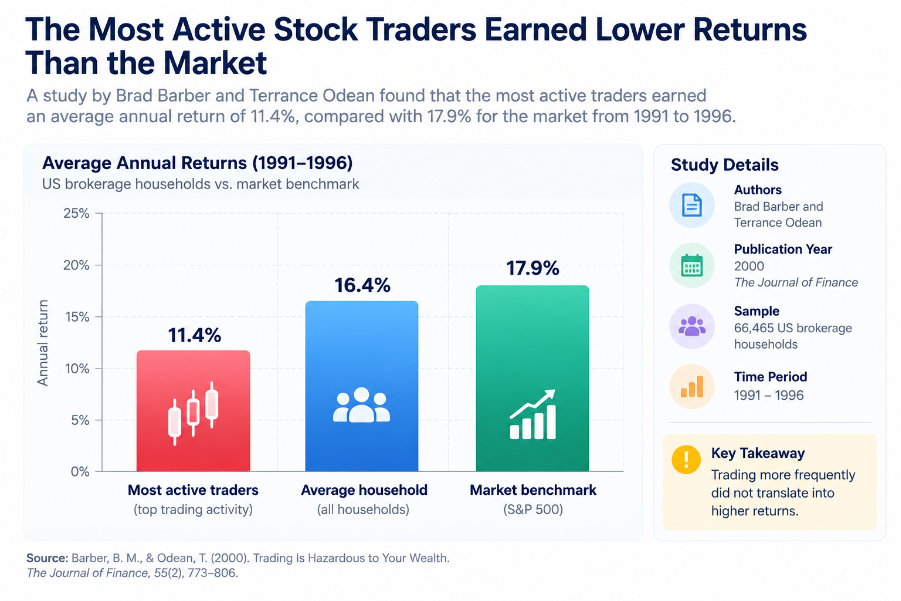
Active trading tells a different story. In a 2000 study published in The Journal of Finance, Brad Barber and Terrance Odean examined 66,465 US brokerage households between 1991 and 1996. The most active stock traders earned an average annual return of 11.4%, compared with 17.9% for the market over the same period. Trading more frequently did not translate into higher returns.
The evidence is also sobering for leveraged trading. In 2018, the European Securities and Markets Authority (ESMA) reported that 74%–89% of retail CFD accounts lost money across the European jurisdictions it examined. The figures cover CFDs on several asset classes, including currencies, rather than forex trading alone.
Why does this matter for beginners? Stocks offer a path to long-term wealth through underlying business growth and dividend payouts. Forex trading, meanwhile, depends entirely on short-term exchange-rate fluctuations and interest-rate differentials. For a beginner, understanding how high leverage, trading costs, and structural differences separate long-term investing from active currency trading is essential for managing risk and protecting your capital.
Consider two people starting with $1,000. A stock investor earning a hypothetical 8% annual return would make $80 before costs. A forex trader using 10:1 leverage would control $10,000 in currency exposure. A favourable 1% exchange-rate movement could produce approximately $100, while an unfavourable 1% movement could erase the same amount—10% of the trader's initial capital—before costs.
The forex trader has greater short-term exposure, not necessarily a better chance of earning a profit.
These studies cover different markets and historical periods, so they cannot establish a universal winner. For beginners, the more useful comparison is the return they can reasonably pursue after costs, relative to the risk required to achieve it.
The Bottom Line
To conclude, for most beginners, investing is a better starting point than trading. It generally requires fewer decisions, allows greater flexibility over time, and does not depend on predicting short-term price movements. Trading can produce faster profits, but it also requires more frequent decisions, closer market monitoring, and tighter risk control.
Risk warning: Trading forex and CFDs involves significant risk and may result in losses that exceed expectations. Leverage magnifies both gains and losses. This article is for educational purposes only and does not constitute investment advice.
FAQs
Is investing better for beginners?
Yes, it requires less time and few decisions, which can help beginners to build a long-term wealth plan.
Can I invest and trade at the same time?
Yes. You can invest for long-term goals while using a smaller, separate amount to practise trading.
Can beginners make a living on trading?
Definitely not. Trading is an activity that involves huge risks and unpredictable income. It cannot be considered a living method.