


- GBP/USD skids back under 1.3400, a 0.68% fall on the Fed.
- American rate passes Bank Rate, which the Bank of England has not moved.
- Bank of England votes at 11:00 GMT Thursday, forecast to hold at 3.75%.
The Pound trades just under 1.3400, 91 pips lower and down 0.68%. The Fed took its rate to 3.75-4.00% and, measured at the midpoint of the new range, American money now pays more than British money for the first time this year. The Bank of England gets seventeen hours to respond to that, and is forecast not to.
Seventeen hours to answer
Bank Rate has been 3.75% since December 2025 and the committee that sets it has held five meetings running. Thursday's vote is forecast at six to hold and three to raise, the same split as July, when the three wanted an immediate move to 4%. British inflation reached 3.1% in August, exactly the forecast, and the rise came from motor fuel rather than from anything the Bank can reach with a rate. The three will have their case again. The forecast says they will lose it again.
Guidance from the committee that abolished guidance
The chair put a condition on the next move: the committee has to see underlying inflation heading to 2% clearly and quickly, and he does not think the summer's readings show it. He also confirmed he had not submitted a projection of his own to the dot plot, as he did not in June. The projections that came without him put the American rate at 4.1% at the end of this year and 4.1% again a year later. A committee that publishes no guidance has just told the Pound more about the next twelve months than its own central bank will offer tomorrow.
Levels and bias
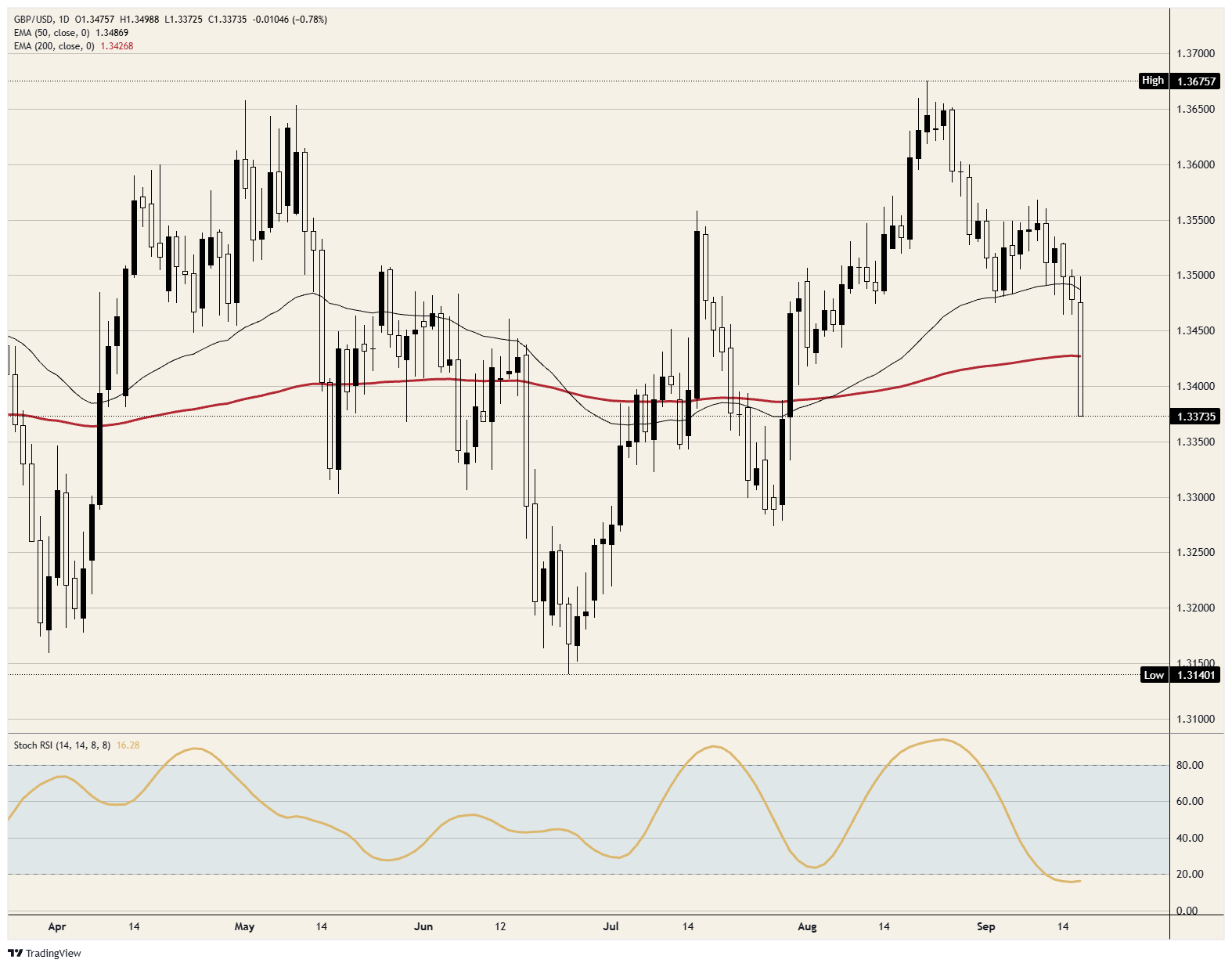
Resistance: 1.3400 is the first thing overhead now that the pair has traded through it, and the 200-day Exponential Moving Average (EMA) sits roughly 40 pips above the market, an average the pair has been above since early August.
Support: Today's low sits a few pips under where the pair now trades. Beneath it, 1.3350 and then 1.3300.
Bias: Bearish while 1.3400 caps, with 1.3350 the first objective and 1.3300 behind it. The Stochastic Relative Strength Index (Stoch RSI) on the daily chart, a momentum gauge, has gone flat near 16 at the bottom of its range, so the selling is stretched without being done. A daily close back above 1.3450 voids the case.
GBP/USD daily chart
Interest rates FAQs
Interest rates are charged by financial institutions on loans to borrowers and are paid as interest to savers and depositors. They are influenced by base lending rates, which are set by central banks in response to changes in the economy. Central banks normally have a mandate to ensure price stability, which in most cases means targeting a core inflation rate of around 2%. If inflation falls below target the central bank may cut base lending rates, with a view to stimulating lending and boosting the economy. If inflation rises substantially above 2% it normally results in the central bank raising base lending rates in an attempt to lower inflation.
Higher interest rates generally help strengthen a country’s currency as they make it a more attractive place for global investors to park their money.
Higher interest rates overall weigh on the price of Gold because they increase the opportunity cost of holding Gold instead of investing in an interest-bearing asset or placing cash in the bank. If interest rates are high that usually pushes up the price of the US Dollar (USD), and since Gold is priced in Dollars, this has the effect of lowering the price of Gold.
The Fed funds rate is the overnight rate at which US banks lend to each other. It is the oft-quoted headline rate set by the Federal Reserve at its FOMC meetings. It is set as a range, for example 4.75%-5.00%, though the upper limit (in that case 5.00%) is the quoted figure. Market expectations for future Fed funds rate are tracked by the CME FedWatch tool, which shapes how many financial markets behave in anticipation of future Federal Reserve monetary policy decisions.


