


.png)
Among global financial markets, CFD, short for “contract for difference,” stands as a special type of derivative. The core point lies in its not requiring the physical ownership of the underlying assets such as stocks, commodities, and crude oil. All you need to do is simply enter into a contract with your CFD broker to speculate on the price rises or falls afterwards.
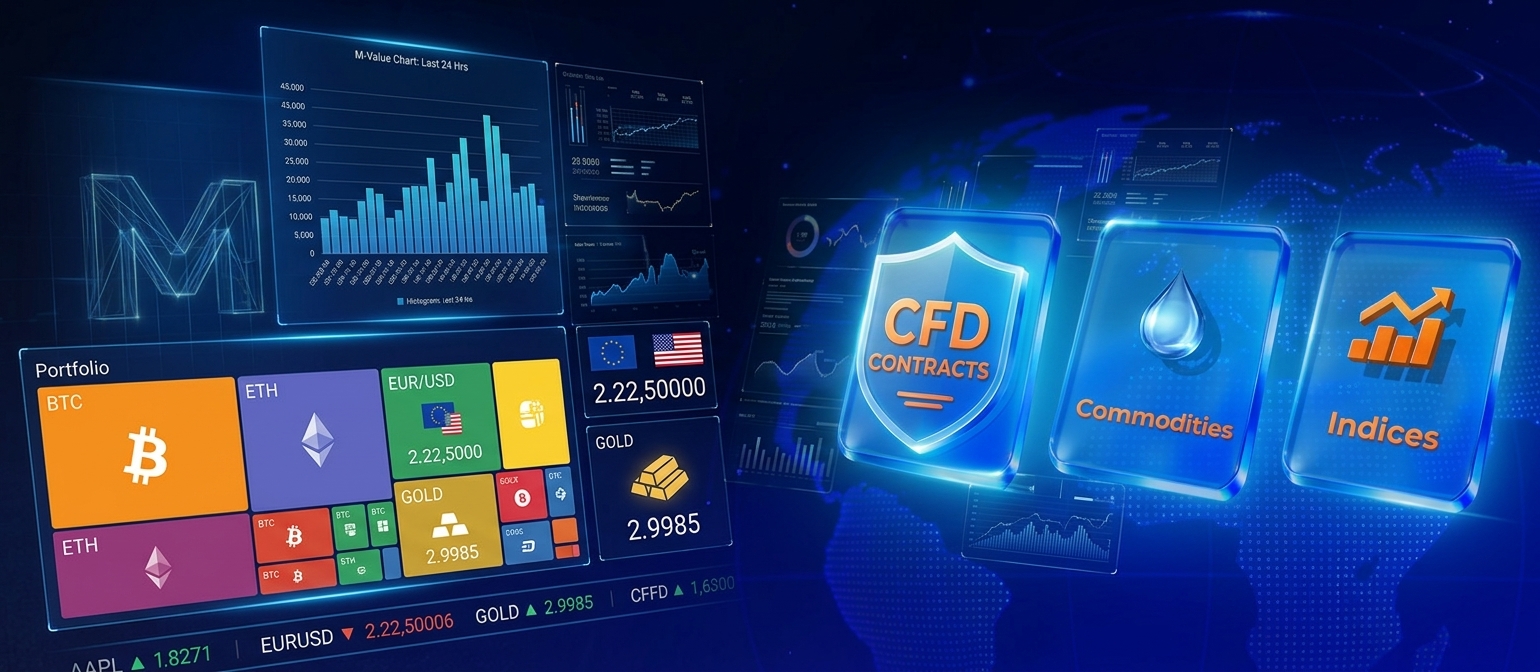
VG Markets offers access to more than 100 selected global instruments, including popular forex pairs, commodities (energy and metals), indices, and more.
Some Characteristics of CFD Trading to Explore
Leveraged CFD Trading: High and Flexible Leverage
Unlike traditional stock trading, where leverage is typically limited and capped at 5X, CFD trading allows traders with small capital to gain larger market exposure with the help of flexible leverage, even as high as 2000:1. Seasoned traders and short-term traders love high leverage, as shown in this quick example:
Assuming 2:1 on stock leverage and 500:1 on CFD, with USD 1,000 in available funds, they can control USD 2,000 worth of shares. A 5% rise in the stock price earns them USD100, a 10% return on their capital (equally with 5% fall in stock price to result a USD 100 loss). With the same USD 1,000, they can control USD 500,000 worth of market position in CFD. That same 5% price movement earns them $25,000, a 2,500% return (equally with downside).
However, high leverage should not be employed by beginners at first. It leaves no room for market noise. A small price manipulation can wipe out your entire account in seconds.
Two-Way Trading: Profit from Both Buying "Long" and "Short"
Unlike traditional stock trading, buying “long” is quite simple, but you can encounter difficulties when buying "short". It comes with many restrictions and heavy borrowing fees. CFD trading does not have this trouble. Specifically, the CFD broker helps you establish an opposite position (selling short) according to your instructions. Clicking “ go long” or “go short”can both give you the potential to make a profit in either market direction.
Let's see this quick example: Predicting Apple's stock will drop from $200 to $190, you open a Short position on 100 CFDs at $200. When the price hits $190, closing the trade captures the $10 decline—yielding a $1,000 profit from a falling market.
How to Place a CFD trade?
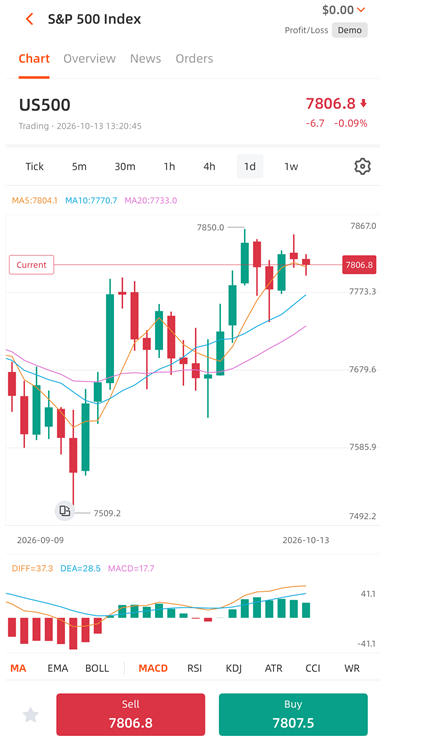
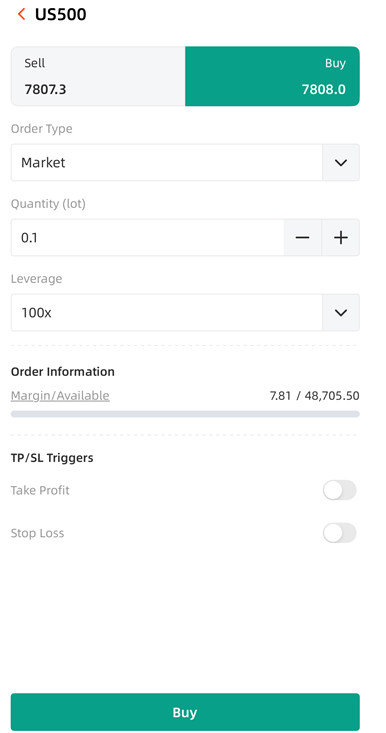
You can trade CFDs for both spot assets and future contracts. The major difference lies in expiry dates and fee structures. Spot CFDs: Designed for short-term trades, these contracts do not expire. Instead, positions held past the end of the day incur an overnight swap charge. Futures CFDs: These have a fixed expiry and build financing costs directly into the price. Without daily swap fees, they are ideal for positions held over longer periods. Many market participants prefer futures contracts for medium to long-term strategies. To place a CFD trade is simple and straightforward. Whether you want to open a long (buy) or short (sell) position, executing a trade requires just a few clicks on the platform.
Is CFD Trading Right for Beginners?
CFD trading indeed has some appealing features for beginners. First, traders can trade various assets through one CFD trading account without opening multiple separate accounts. Secondly, CFD trading requires small capital to start, with no heavy financial burden surrounded, which allows most beginners to gain some hands-on experience.
VG Markets offers a free demo account funded with $100,000, letting beginners practice trading strategies and get used to the platform with risk-free money. Few brokers provide virtual money this large for practice.
Trading Costs Involved in CFD Trading
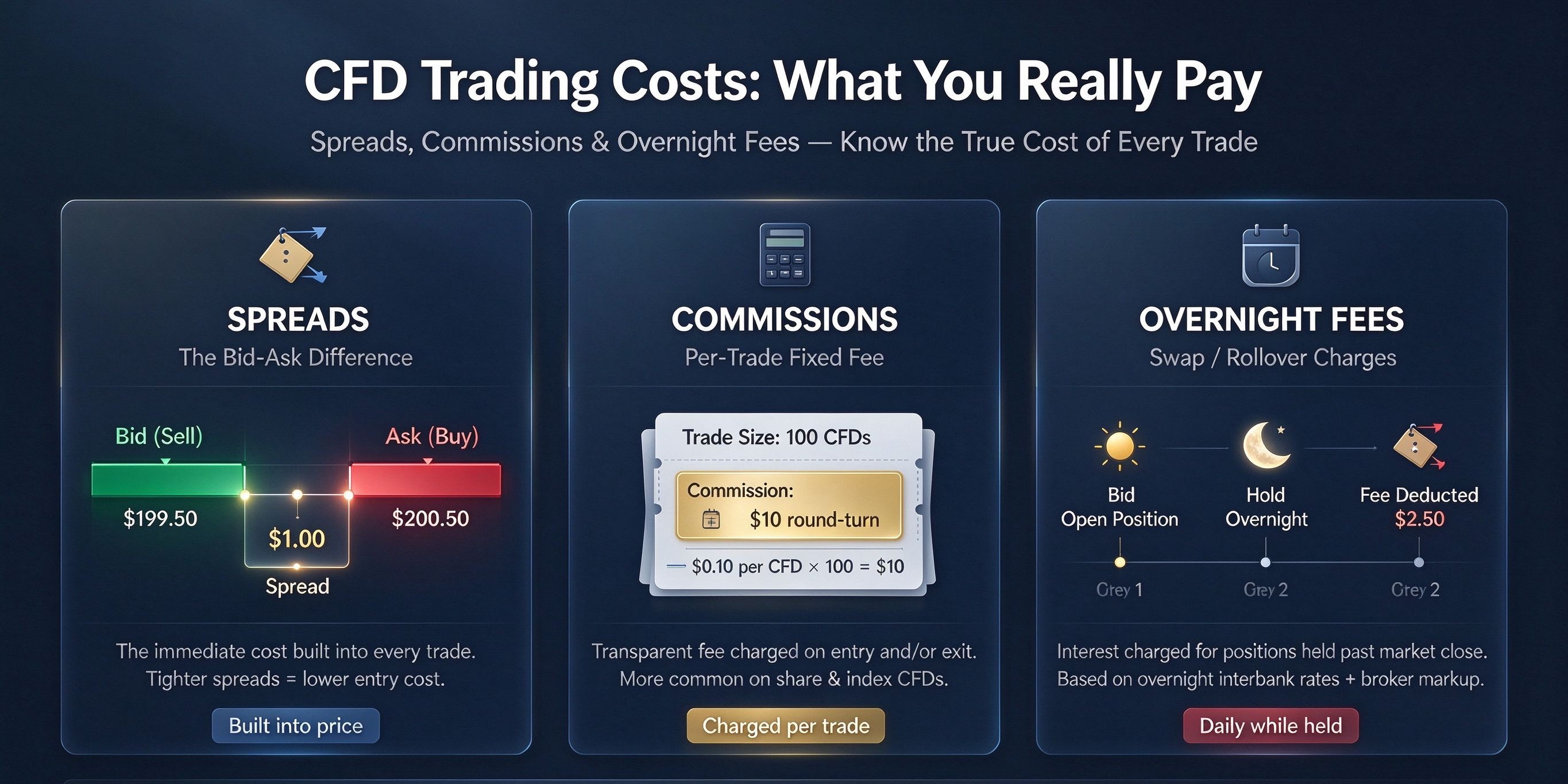
Trading costs remain the core part of CFD trading. It directly decides your overall profits or losses. Most CFD brokers charge via spreads, commissions, or both. While commission-based models often feature narrower spreads, spread-only accounts roll the entire cost into the quoted market price for simplicity. So choosing a CFD broker is therefore crucial to your long-term performance.
VG Markets offers transparent pricing with no hidden fees, routing orders directly into liquidity providers with middleman markups. Learn more about fees on VG Markets.
It is also worth noting that, unlike traditional asset investing, which holds for free, CFD trading asks for overnight fees (known as swap rates) for positions held past the end of the trading day.
Day CFDs Trading to Explore
Intraday CFD trading captures short-term price fluctuations. This can capture profit opportunities from single-day volatility without holding positions overnight.
Say you are tracking a major stock index like the S&P 500, and a strong morning economic report pushes the price upward right after the market opens at 9:30 AM.
Entering the Trade: You open a long position at 5,000 points. Thanks to margin, you control a $10,000 position with a $500 deposit.
The Price Move: Over the next few hours, the index climbs 1% to reach 5,050 points.
Closing Out: You close the trade manually at 12:30 PM to lock in your gains.
The Result: Because your profit is based on the total $10,000 position value, you make a $100 profit on your initial $500 capital outlay.
Like any strategy, day trading has its pros and cons.
Pros of CFD Day Trading
Protection Against Overnight Gaps: Holding trades overnight exposes capital to price gaps from off-hours news—a risk day trading eliminates entirely.
Profit Potential in Both Directions: CFDs allow you to go long if you expect prices to rise, or go short if you anticipate a decline.
Lower Initial Capital Requirements: Leverage allows market participants to control full contract sizes with a smaller initial deposit.
Cons of CFD Trading
Higher Risk of Fast Losses: While leverage enhances exposure, it accelerates losses just as quickly. A sudden adverse price movement can result in rapid capital depreciation or margin calls.
Heavy Trading Costs: While you save on overnight fees, opening and closing several positions daily means spread costs build up quickly, reducing overall returns.
Intraday Market Noise: Short-term timeframes (such as 1-minute or 5-minute charts) contain significant price noise, frequently generating false technical signals.
Psychological Pressure: Fast-moving markets often trigger behavioral traps, including overtrading, emotional decision-making, and panic-trading to recover losses.
Risks Involved When Trading CFDs
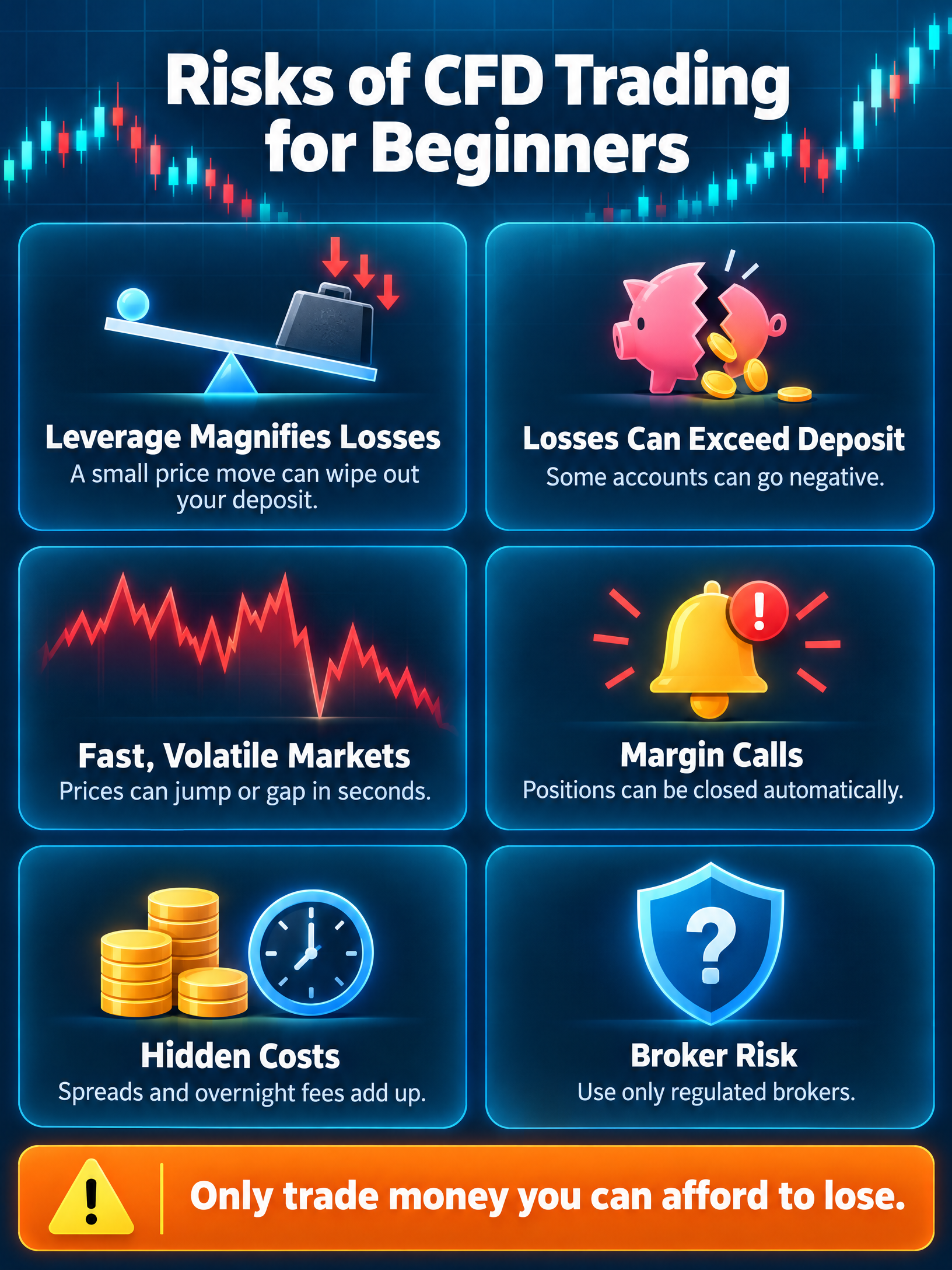
CFD trading is not a guaranteed win. Instead, it comes with huge risks, especially for beginners. First, trading with an unregulated CFD broker is bound to end poorly. Unregulated brokers don’t provide basic fund protection measures. Specifically, there is no safety net if the broker mismanages funds or goes out of business. It is common for unregulated brokers to manipulate their trading costs- mainly through widening spreads- to steal your profits. Worse still, many uncover their masks to refuse withdrawal requests, leaving traders with no way to recover their funds.
Secondly, CFD trading is heavily exposed to market volatility. Imagine a hotter-than-expected US CPI report suddenly hits the market; gold can plunge 1.5% in seconds as traders reprice Fed rate expectations. That 1.5% drop can turn into a $3,000 loss—instantly wiping out your $2,000 margin, triggering liquidation, and causing slippage that executes your trade at an even worse price.
It is also important to importnat note that CFDs can easily trigger emotional trading among beginners. Beginners often use small sums to start as an experiment, frequently neglecting to set stop-loss orders. Once initial losses occur, the urge to recover that money often leads to larger, riskier trades—a dangerous psychological trap known as "revenge trading".
FAQ
What is a CFD?
CFD, short for "Contract for Difference", is a contract with a broker to trade the price movement of an asset between opening and closing. You never own the underlying asset.
How is CFD trading different from buying a real asset?
Traditional investing requires owning physical assets and profiting only when prices rise. CFDs let you trade price contracts without ownership, enabling you to profit from both rising and falling markets using leverage.
How does leverage work?
Leverage lets you control a large position with a small upfront deposit (margin). While it increases your purchasing power, remember that profits and losses are based on the full trade size.


