
U.S. inflation is expected to accelerate sharply in September. But for markets, the more important question is why.
Economists expect headline CPI to rise 0.6% from August, lifting the annual rate to 3.6%, largely as higher gasoline and other energy costs feed through to consumers. Core CPI, however, is expected to rise a more moderate 0.2% on the month and 2.5% from a year earlier.
That divergence matters. An energy-driven spike in headline inflation is uncomfortable for the Federal Reserve, but it does not necessarily demand an immediate policy response. A renewed acceleration in underlying inflation would be far more consequential.
And that is where Wednesday's CPI report could move markets.
The Number Behind the Number
Goldman Sachs expects headline inflation to come in slightly above consensus at 3.7% year on year, driven in part by a roughly 5% monthly increase in energy prices.
The market may be able to look through some of that increase if core inflation remains contained. But the calculation changes if higher energy costs are beginning to spill into transportation, goods and services.
That distinction is increasingly important for the Fed. Policymakers remain divided over how much further tightening is needed, leaving markets highly sensitive to any evidence that inflation is becoming more entrenched.
The first reaction to headline CPI, therefore, may not tell the whole story.
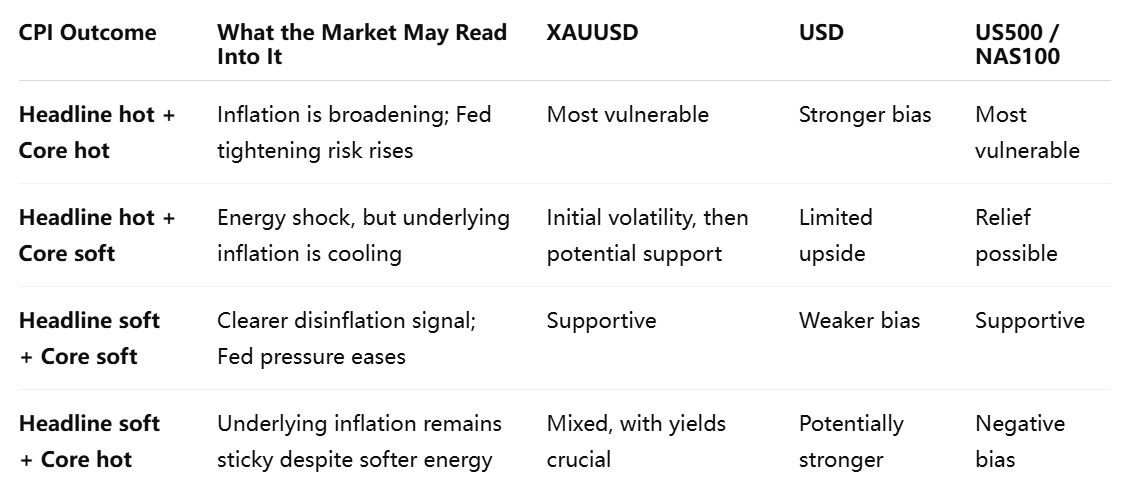
The second scenario may be the most interesting. A strong headline number could initially look inflationary, but if core CPI continues to cool, markets may decide that the Fed has less reason to respond aggressively than the headline suggests.
That is why simply asking whether CPI “beats” or “misses” expectations may not be enough.
Gold: Watch Yields, Not Just CPI
Gold is particularly exposed because its recent weakness has coincided with elevated Treasury yields and a firm dollar.
A hotter-than-expected core CPI reading would challenge the idea that September's inflation surge is mainly an energy story. That could bring rate-hike expectations forward, push Treasury yields and the dollar higher, and renew pressure on XAUUSD.
A high headline number accompanied by a benign core reading would be more complicated — and potentially less damaging for gold. If investors conclude that the inflation spike is concentrated in energy rather than spreading across the economy, Treasury yields could struggle to extend their recent rise.
There is also a deeper tension developing in the gold market. Higher rates raise the opportunity cost of holding a non-yielding asset, but persistently high borrowing costs also increase the government's debt-servicing burden and can intensify concerns over fiscal sustainability.
In other words, higher yields can hurt gold in the immediate reaction while strengthening part of its longer-term investment case.

Stocks and the Dollar Face a Different Test
For US500 and NAS100, the risk is not simply “higher inflation.” It is a CPI report that forces markets to price a more aggressive Fed while Treasury yields are already elevated.
That combination would raise the discount rate applied to future corporate earnings, leaving richly valued growth stocks particularly sensitive to another leg higher in yields. A softer core reading could do the opposite, easing pressure on valuations even if headline inflation remains elevated because of energy.
The dollar faces a cleaner transmission mechanism. A core CPI upside surprise would strengthen the case for higher-for-longer U.S. rates and could reinforce support for the greenback, putting pairs such as EURUSD and USDJPY firmly in focus.
What Matters After 8:30 PM
The most revealing signal after the release may not be CPI itself.
Watch the 2-year Treasury yield for the Fed reaction, real yields for gold, and the U.S. dollar for confirmation.
If headline inflation jumps but yields and the dollar fail to follow, markets are probably treating September as an energy shock rather than the start of a new inflation wave.
If core inflation surprises higher and both yields and the dollar accelerate, the message becomes much harder to dismiss: underlying inflation is proving sticky, and the Fed may not be finished yet.