A forex broker claims to be regulated by ASIC, a tier-1 regulator. You visit the Australian regulator's website, enter the licence number, and find a matching record.
Does that mean the broker is safe to trade with?
Not quite.
The licence could belong to the broker's Australian company, while your trading account is actually opened under another company registered offshore.
This arrangement is fairly common among international forex brokers. A single brand often operates through several legal entities, each serving clients in different regions. Depending on where you live, you could be offered different leverage limits, account conditions, and regulatory protections.
For beginners, checking a broker's regulatory status does not have to involve complicated legal research. Three questions will get you most of the way:
- Is the regulatory licence genuine and still valid?
- What financial services is the licensed company authorised to provide?
- Which legal entity will actually hold your trading account?
Why Should You Check a Broker's Licence Yourself?
Consider this: you find a broker that claims to be regulated by a well-known financial authority. Its website displays a licence number, a registered company name, and even a link to the regulator's website.
Everything looks legitimate. So, is there anything else you need to check?
Yes. Having a genuine regulatory licence does not necessarily mean that your trading account is covered by it.
A forex broker operates through several companies, a common situation. Its Australian entity holds a licence from the Australian Securities and Investments Commission (ASIC), while clients from certain other countries are registered under a separate offshore entity.
Both companies use the same brand name and website. However, they operate under different regulatory rules, and the protections available to their clients are not necessarily the same.
Solely focusing on the ASIC licence number displayed on the broker's homepage is misleading. You assume that your account is regulated in Australia, yet the truth is that your account could be held with the offshore company.
More worryingly, there is another problem. Some fraudulent websites copy the names, licence numbers, and addresses of legitimate brokers. The information looks convincing because the licence itself is real. What is false is the website's claim to be associated with the licensed company.
This is why checking a broker's licence yourself matters. You are not simply confirming that a licence number exists. You are checking whether the licensed company is genuinely connected to the broker and whether that company will actually hold your trading account.
Fortunately, you do not need any legal or financial expertise to make these checks. A few minutes on an official regulatory register can help you identify discrepancies before you deposit your money.
How to Verify A Broker's Licence in 5 Minutes?
Let's take a broker that claims to be regulated by the Australian Securities and Investments Commission (ASIC).
Step 1: Find the Broker's Full Legal Name
Visit the broker's official website and scroll to the footer. Let's take VG Markets as an example.
You might see a statement such as:
VG Markets Pty Ltd is authorised and regulated by the Australian Securities and Investments Commission under AFSL No. 24 664 991 799.

Two details matter here:
- VG Markets Pty Ltd: The company's registered legal name.
- AFSL Registration Number: Its Australian Financial Services Licence number.
VG Markets is the brand customers recognize, but VG Markets Pty Ltd is the company you need to investigate.
Step 2: Search ASIC's Official Register
Visit ASIC's official website and open its Professional Registers Search.
Select the relevant financial services licence register and enter the AFSL number. If you do not have the number, try searching by the company's full legal name.
One detail often confuses beginners: Australia uses several different business identifiers.
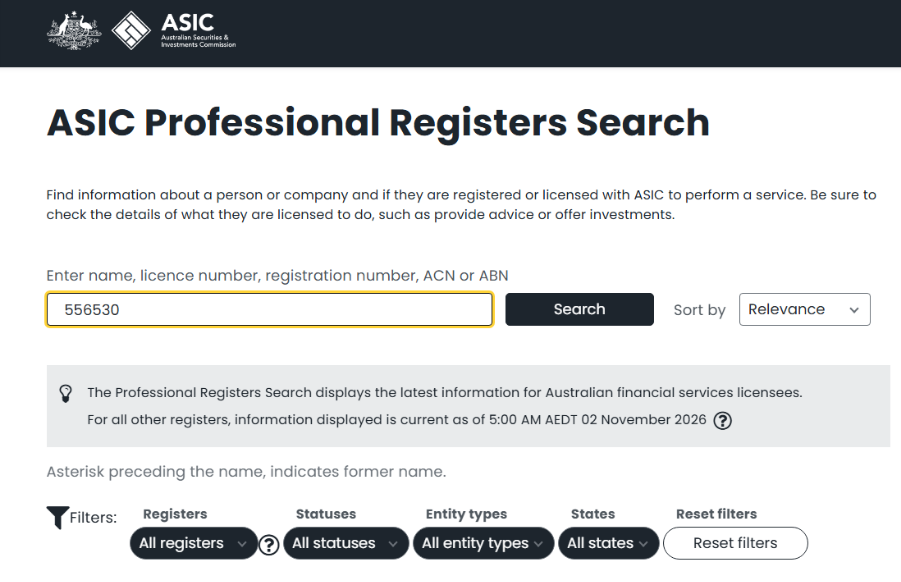
An Australian Business Number (ABN) or Australian Company Number (ACN) identifies a registered business or company. An Australian Financial Services Licence (AFSL), by contrast, relates to authorisation to provide specified financial services.
Finding a company's business registration does not automatically mean it is licensed to offer forex or CFD trading.
Step 3: Look Beyond the Search Result
Here we can get a result: ASIC's database returns a record for VG Markets Pty Ltd.
That is a useful start, but there are several details worth checking.
Is the licence still active?
Does the company name match the one shown on the broker's website?
Does its authorisation cover the financial products or services being advertised?
Are there any restrictions, suspensions, or cancellations?
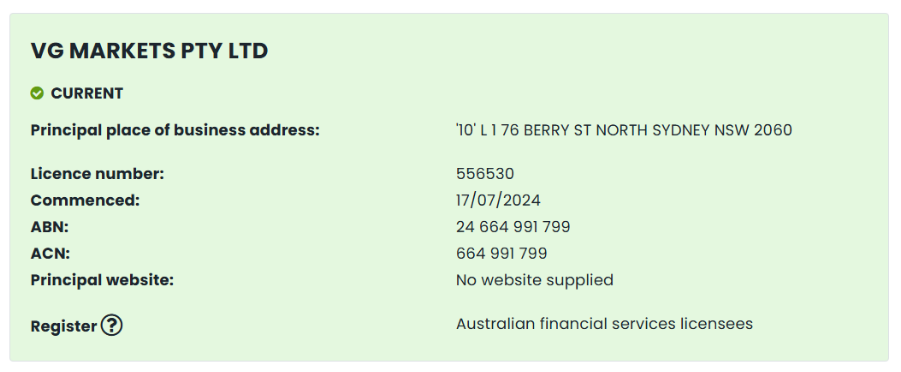
A genuine licence number is only part of the picture. If the register shows a different company, even one with a similar name, do not assume the two businesses are connected.
Which Registered Company Holds Your Account?
This is arguably the most useful part of the regulatory check. Opening a trading account under a different registered entity determines the varied trading conditions, account policies, and protection policies you can get.
Leverage largely differs.
In the UK and Australia, leverage on major forex pair CFDs is generally capped at 1:30 for retail clients. Brokers operating under certain offshore regulatory regimes can offer considerably higher leverage.
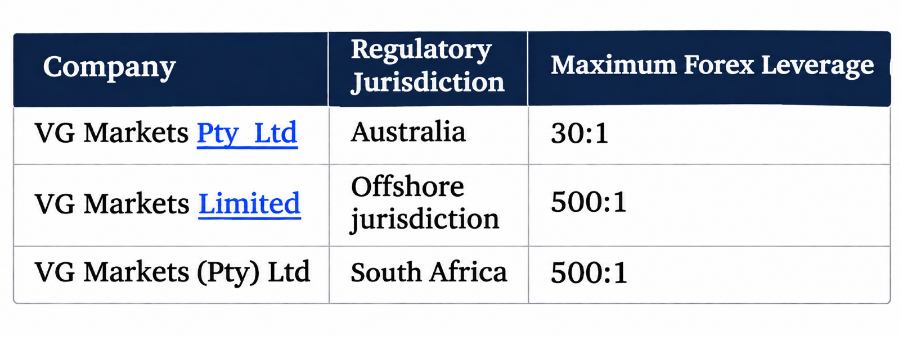
A broker advertising maximum leverage of 1:500 looks more attractive than one offering only 1:30. Traders starting with a small deposit, typically, love
Yet the difference reflects more than the broker's pricing or account policy.
Consider a simple EUR/USD trade.
Suppose EUR/USD is trading at 1.1000 and you want to open a position of 0.1 standard lots, equivalent to 10,000 euros.
The position has a notional value of approximately $11,000.
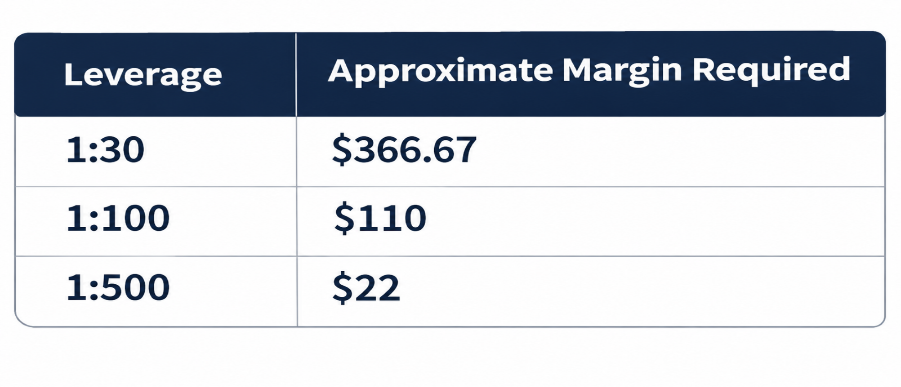
At 1:500 leverage, you need only around $22 to open the position. That sounds affordable, but it does not make the trade less risky.
For a 0.1-standard-lot EUR/USD position, each pip is generally worth approximately $1. A 50-pip adverse move would therefore produce a loss of about $50, regardless of whether the position was opened using 1:30 or 1:500 leverage.
Higher leverage reduces the margin needed to open a trade. It does not reduce the losses that the same position can generate.
A broker offering 500:1 leverage or even higher does not necessarily operate illegally. Traders need to spend some time checking which entity offers the leverage they prefer.
What Does Regulation Actually Protect? A Look at ASIC's Data
Many beginners mistakenly think that trading with a broker means their money is safe. In practice, regulation does more than prevent misconduct. It can also set limits on leverage, establish margin close-out rules, and help protect retail traders from running up negative account balances.
Australia offers a useful example.
In March 2021, ASIC introduced stricter rules for contracts for difference (CFDs) offered to retail clients. These included leverage limits, standardised margin close-out requirements, and negative balance protection.
Six months after the rules took effect, ASIC reported three notable changes:
Indicator | Change |
Quarterly net losses among retail CFD clients | Down 91% |
Margin close-outs | Down 87% |
Negative balance incidents | Down 88% |
The figures suggest that trading rules can make a measurable difference to investor outcomes.
That does not mean traders suddenly became better at predicting markets. Lower leverage, stronger account protections, and changing market conditions could all have contributed to the results.
Does Trading with Regulated Brokers Guarantee Profits?
The truth is that a regulated broker does not guarantee profits.
According to ASIC's data for the 2023–24 financial year, around 68% of Australian retail CFD investors lost money, with combined net losses exceeding A$458 million.
In other words, even in a tightly regulated market, most retail CFD traders still end up losing money if they don't employ proper trading strategies. Regulation can limit certain risks, but it cannot make a poor trade profitable.
Lower leverage, however, does not eliminate trading losses, either. Position sizing, stop-loss placement, and trading costs still matter.
Regulation cannot guarantee a profit, but sensible trading rules can help limit certain risks. For beginners, understanding these protections is often more useful than simply comparing which broker offers the highest leverage.
A Real Case: The Licence Was Genuine, but the Website Was Fake
On June 9, 2026, the UK's FCA issued a warning about a clone firm operating under the name Claims Check Live.
The website had used the identity of a legitimate financial company to make itself appear authorised.
The genuine company was CSM Financial Limited, registered with the FCA under reference number 734820.
According to the regulator, the two businesses used different contact details.
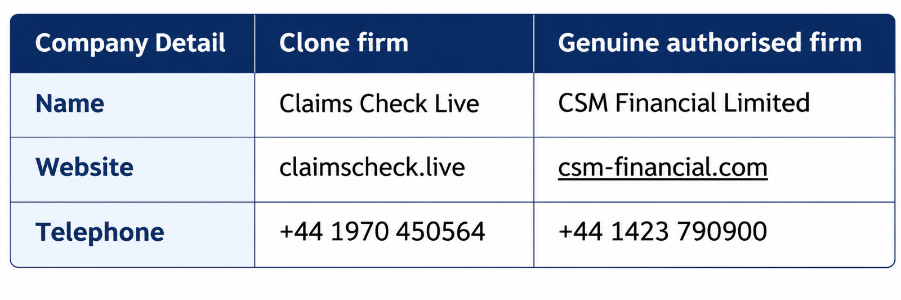
The FCA stated that the genuine company had no connection with the clone. The case is not about a typical forex broker, yet it shows how easily a fake trading platform can borrow the identity of a legitimate financial firm.
Fraudsters do not necessarily need to invent a fake regulator or forge an entire licensing database. They can simply borrow the identity of a real financial company.
Someone who checks only the licence number could easily miss the difference.
That is why one additional step matters: compare the website and contact details with those in the regulator's records, and contact the genuine company independently if anything looks suspicious.
What If You Discover a Regulatory Problem After Depositing Money?
Suppose you have already deposited $500 with a forex broker.
A few days later, you notice that the company named in your Client Agreement is different from the licensed entity advertised on its website.
This cannot say the broker is illegal. International broker groups commonly operate through several companies.
Still, you should stop adding funds until you understand the arrangement.
First, save your Client Agreement, deposit receipts, account statements, customer support conversations, and screenshots of the broker's regulatory claims.
These records can help establish what information was provided when you opened the account.
Next, verify the company named in your agreement through the relevant regulator's official website.
If the broker claims to be FCA-regulated, use the FCA's Firm Checker. If it claims to hold an Australian financial services licence, search ASIC's register.
Finally, identify the appropriate complaints process.
If the broker refuses to explain which entity operates your account, or you encounter unexplained withdrawal restrictions, you can submit the relevant information to the regulator it claims to be supervised by.
One particular warning sign deserves attention.
If a platform says you must pay an additional "account unlocking fee", "security deposit", or "tax" before it will release your withdrawal, be extremely careful.
This is especially suspicious when payment must be made to a personal bank account or an unrelated cryptocurrency wallet.
Legitimate charges should have a clear contractual or legal basis. Do not send additional money merely because a customer support representative demands it.
Give Yourself Ten Minutes Before Opening an Account
A regulatory check, for many beginners, does not require considerable time. A simple ten-minute routine can help identify many obvious problems.
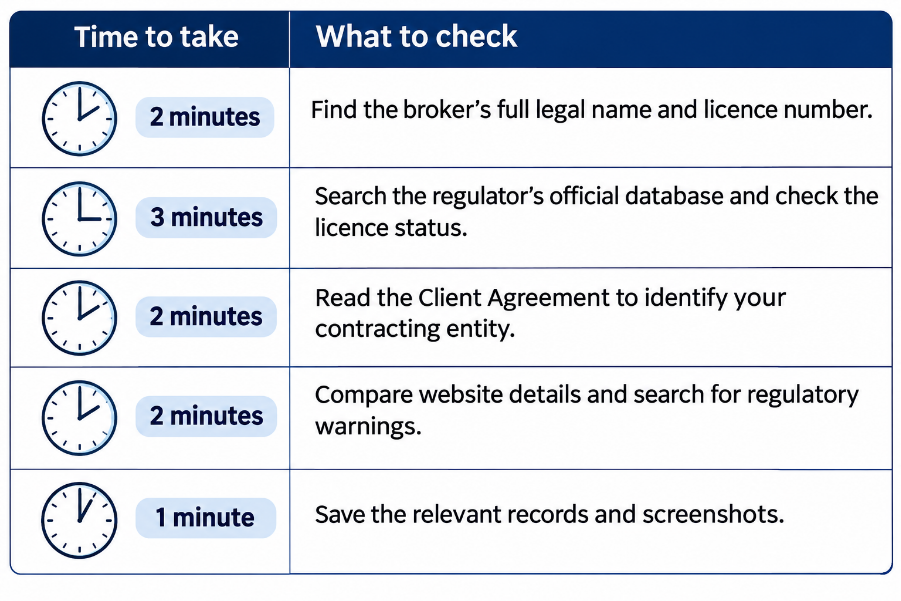
Here are three useful official resources:
These tools are free to use and provide a starting point for checking whether a company is authorized.
These tools are free to use and provide a starting point for checking whether a company is authorised.
The Bottom Line
Spreads, commissions, trading platforms, and minimum deposits all deserve attention when choosing a forex broker. But before comparing these features, you need to know which company will be responsible for your account.
A proper regulatory check goes beyond entering a license number and finding a matching result. It means connecting four pieces of information: the licence, the legal company name, the Client Agreement, and the trading account you will actually use.
This matters just as much if you are starting with $100 or $200 as it does if you are depositing several thousand dollars. Specifically, if a broker can clearly explain which entity operates on your account, where its license can be verified, and how client funds are handled, you have a reasonable basis for further evaluation. If even these basic details cannot be confirmed, there is little reason to rush into a deposit, however attractive the spreads or leverage appear.
In a word, before asking how much it costs to trade, find out who you are trading with.
Risk warning: Trading forex and CFDs involves significant risk and may result in losses that exceed expectations. Leverage magnifies both gains and losses. This article is for educational purposes only and does not constitute investment advice.
FAQs?
Is VG Markets a legit broker?
Yes, VG Markets is a legit broker that operates under the regulation of ASIC in Australia and FSCA in South Africa.
Does the regulation matter most for brokers?
Not really; you still need to consider other conditions, like spreads, the trading app, and withdrawals.
Does VG Markets Offer 500:1 Leverage to All Traders?
No. Leverage limits depend on where your account is registered. For example, retail traders under VG Markets' Australian entity are limited to 30:1 leverage on major currency pairs under ASIC rules.
Clarify Which Pairs Have Limits.