
- USD/JPY's release bar stays inside its range since a session low near 157.50.
- Core Tokyo inflation comes in at the 2.6% forecast, down from 2.7%.
- BoJ Governor Ueda speaks Friday after the decision and a new Outlook Report.
Tokyo's Consumer Price Index (CPI) excluding fresh food rose 2.6% from a year earlier in October, exactly as forecast, and USD/JPY has barely moved on it. It's trading in the lower part of the session's range, a little above a low set before the figures came out.
Headline inflation rose to 2.8% from 2.7%, but prices excluding fresh food and energy slowed to 2.6% from 3%, undoing two-fifths of September's full-point rise. The first adds to the case for a Bank of Japan (BoJ) hike that would narrow USD/JPY's rate gap, and the second takes from it. A Friday hold was widely expected before either came out.
Japan's jobless rate fell to 2.4% in September against a 2.5% forecast, and employers had 1.19 jobs on offer per applicant, up from 1.18. Both came out with the Tokyo figures, and USD/JPY had climbed further off its session low before any of them than it has moved since.
On the calendar
The BoJ's decision is due around 03:00 GMT on Friday with its quarterly Outlook Report, the first since September's hike. BoJ Governor Ueda's press conference follows at 06:30 GMT, and both bear on the pace of further hikes, the Japanese side of the rate gap.
The US Employment Cost Index (ECI) for the third quarter is due at 12:30 GMT on Friday, and the Chicago Purchasing Managers Index (PMI) follows at 13:45 GMT. Both feed the Fed's December decision, where a hike would widen the gap between US and Japanese rates.
On the charts
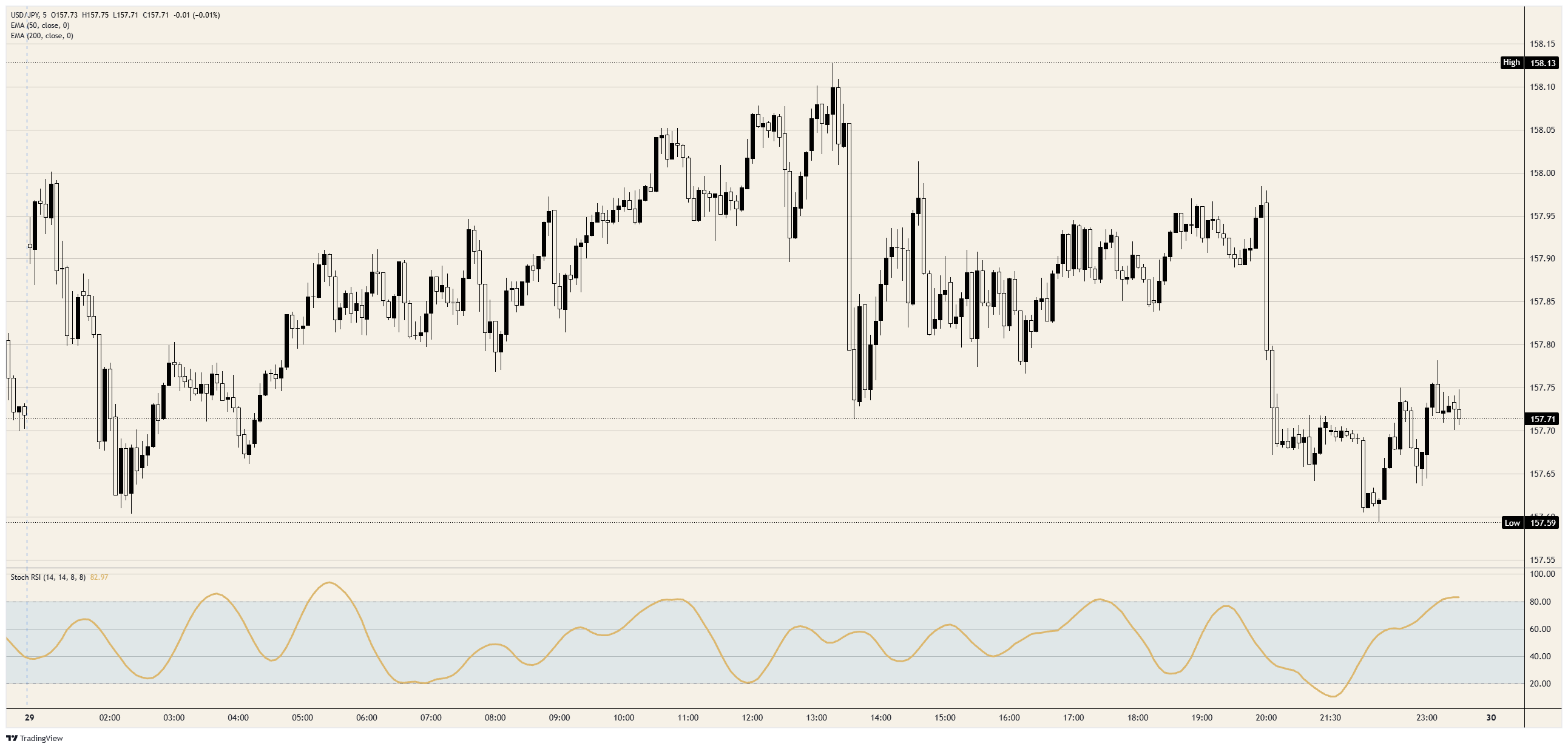
The session's range runs from a high just above 158.00 to a low just above 157.50, and USD/JPY has made back about a fifth of the slide between them. Intraday momentum has gone from oversold before the low to overbought on the climb.
USD/JPY 5-minute chart
Inflation FAQs
Inflation measures the rise in the price of a representative basket of goods and services. Headline inflation is usually expressed as a percentage change on a month-on-month (MoM) and year-on-year (YoY) basis. Core inflation excludes more volatile elements such as food and fuel which can fluctuate because of geopolitical and seasonal factors. Core inflation is the figure economists focus on and is the level targeted by central banks, which are mandated to keep inflation at a manageable level, usually around 2%.
The Consumer Price Index (CPI) measures the change in prices of a basket of goods and services over a period of time. It is usually expressed as a percentage change on a month-on-month (MoM) and year-on-year (YoY) basis. Core CPI is the figure targeted by central banks as it excludes volatile food and fuel inputs. When Core CPI rises above 2% it usually results in higher interest rates and vice versa when it falls below 2%. Since higher interest rates are positive for a currency, higher inflation usually results in a stronger currency. The opposite is true when inflation falls.
Although it may seem counter-intuitive, high inflation in a country pushes up the value of its currency and vice versa for lower inflation. This is because the central bank will normally raise interest rates to combat the higher inflation, which attract more global capital inflows from investors looking for a lucrative place to park their money.
Formerly, Gold was the asset investors turned to in times of high inflation because it preserved its value, and whilst investors will often still buy Gold for its safe-haven properties in times of extreme market turmoil, this is not the case most of the time. This is because when inflation is high, central banks will put up interest rates to combat it. Higher interest rates are negative for Gold because they increase the opportunity-cost of holding Gold vis-a-vis an interest-bearing asset or placing the money in a cash deposit account. On the flipside, lower inflation tends to be positive for Gold as it brings interest rates down, making the bright metal a more viable investment alternative.