
At its core, scalping is about making frequent trades to capture tiny, fast-moving price gains throughout the session. This trading strategy is often employed in forex trading. In forex trading, scalpers commonly monitor highly traded currency pairs such as EUR/USD, GBP/USD and USD/JPY. They often use one-minute (M1) or five-minute (M5) charts to identify potential entries and exits.
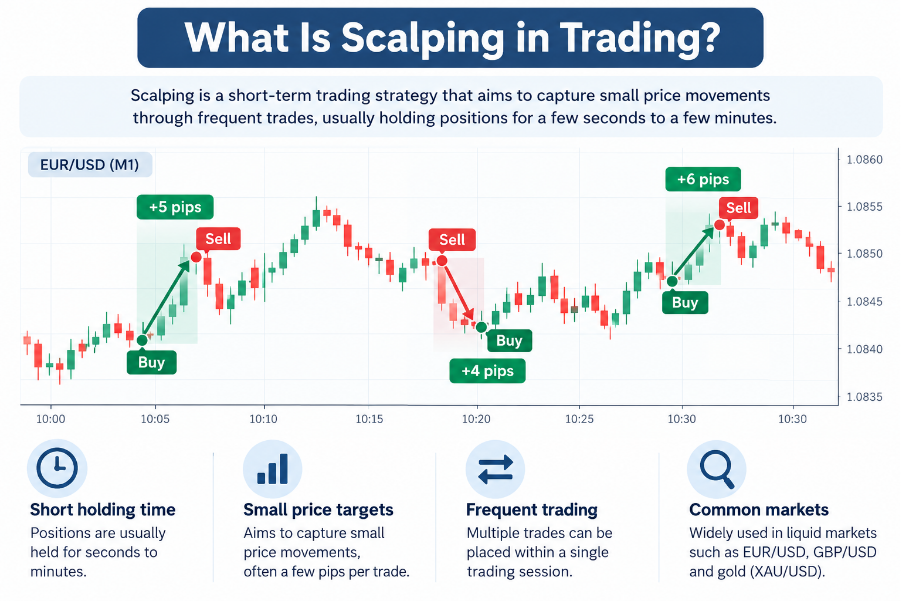
Here is a quick example:
A trader named Nick buys EUR/USD at 1.08500 and closes the position at 1.08550. The price has risen by five pips. Nick, the scalper, regards this as a complete trade, whereas a swing trader may consider the movement too small to justify opening a position.
The difference lies not only in the profit target but also in how the trade is managed. Specifically, scalpers depend on frequent opportunities, disciplined exits, and relatively low execution costs.
How Does Forex Scalping Work?
A typical forex scalping strategy relies on capturing a short-term price pattern, entering a position and exiting once a modest target or predetermined loss level is reached.
A trader can use a moving-average crossover, a breakout from a narrow trading range, or a pullback towards a support level. These indicators do not predict price movements reliably on their own. They provide a framework for deciding when to enter and, equally importantly, when not to trade.
Suppose a beginner is observing EUR/USD on an M5 chart during an active trading session. The pair is moving upwards, and the trader identifies a possible continuation after a brief pullback.
The trader plans to buy at 1.08500, place a stop-loss at 1.08460, and set a take-profit at 1.08560.
Currency pair | EUR/USD |
Entry price | 1.085 |
Stop-loss | 1.0846 |
Take-profit | 1.0856 |
Risk distance | 4 pips |
Reward distance | 6 pips |
Gross reward-to-risk ratio | 1.5:1 |
Why Is Scalping Attractive to Beginners?
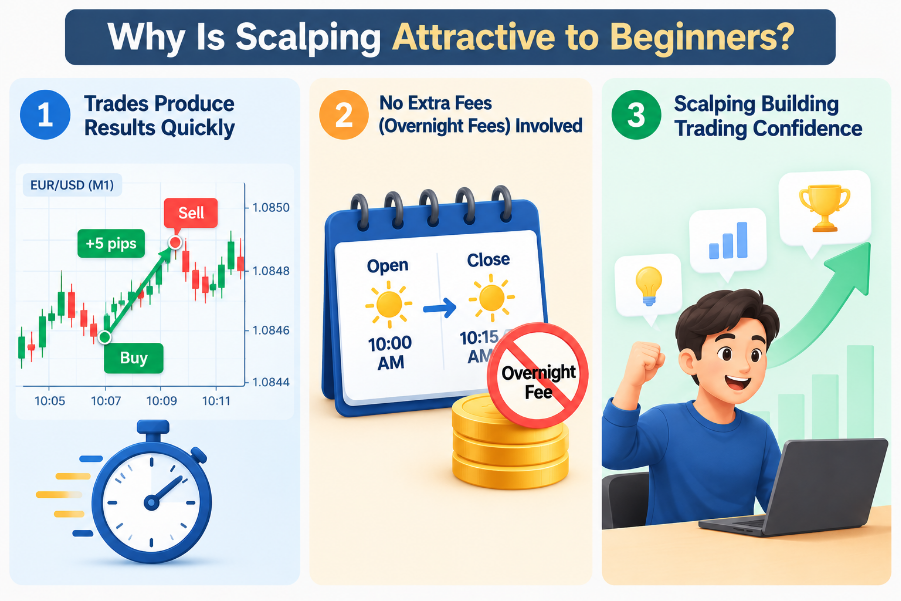
Scalping features great attractions to beginners because it involves quickness without carrying too much trading burden. Closing positions rapidly keeps traders from leaving money at the mercy of market volatility. On top of that, scalping can help traders build a better trading habit, forcing them to set aside certain trading hours instead of letting them consume their whole working day.
Trades Produce Results Quickly
A scalping position is often closed within minutes. Therefore, for someone learning to interpret price charts, this can make the market feel more accessible than a strategy requiring several days to evaluate a single trade. This leads many beginners to judge their skills based on just a handful of trades—quickly building a false sense of confidence when a few go their way. The truth is that, however, a profitable trade often results from favorable market conditions rather than a sound decision.
No Extra Fees (Overnight Fees) Involved
Scalpers typically close positions within the trading session, reducing exposure to some overnight market developments and avoiding overnight financing charges on positions that are not held past the broker's rollover time.
This appeals to beginners who prefer not to monitor positions outside their chosen trading hours.
Scalping Building Trading Confidence
For traders with limited availability, concentrating on a focused 30- or 60-minute block to the market—rather than watching charts all day—is often a more effective approach. For instance, an employee in Malaysia working regular office hours could focus on the EUR/USD pair during an active evening session in Malaysia. Developing this routine naturally builds steadier trading confidence.
Why Is Scalping Difficult for Beginners?
Scalping isn't easy for beginners. Most struggle to nail precise entry and exit points. Frankly speaking, this skill takes time and practice to foster your feelings. It’s not something you master overnight. Plus, frequent trading quietly eats away at your returns. Costs pile up fast, snowballing before you even realize it. Last but not least, scalping can easily trigger emotional trading and overtrading—a dangerous trap for beginners. Simply put, the more trades you take, the more room you leave for costly mistakes.
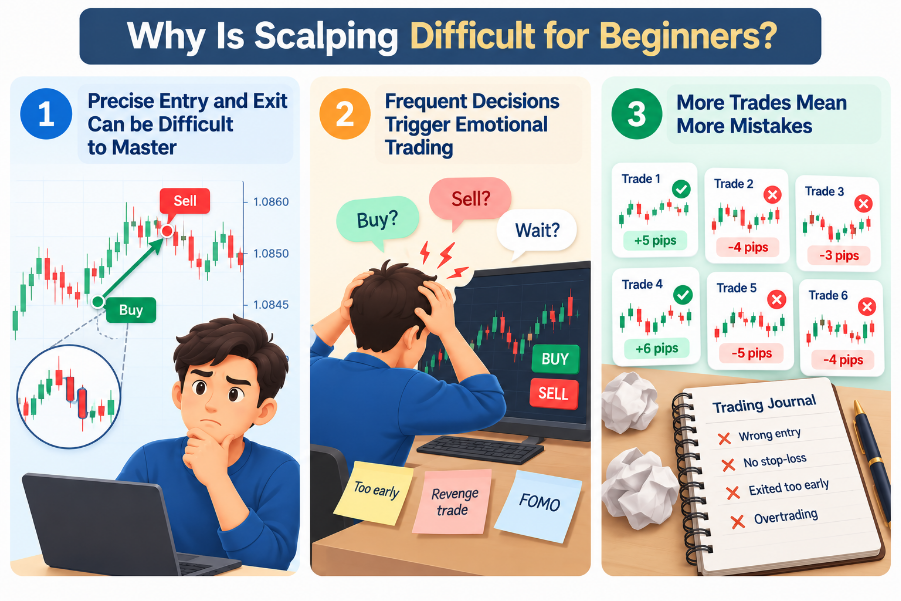
Precise Entry and Exit Can Be Difficult to Master
90% of traders fail to step into the markets with precise entry and exit points. Getting to that level of precision takes a long time and a mountain of bruised trades to help you build familiarity with the markets and the assets you are trading. No one picks it up overnight. Plenty of beginners rush into scalping without understanding the mechanics or recognizing the risks involved.
Suppose a trader intends to buy EUR/USD at 1.08500 with a five-pip profit target. If the order is executed at 1.08520 instead, the entry is two pips worse than expected. That gap adds up fast—it accounts for nearly 40% of your entire five-pip goal right off the top. These price gaps are especially common during rapid market movements, although execution quality depends on the broker, account type, order type, and market conditions.
Frequent Decisions Trigger Emotional Trading
Scalping requires repeated decisions under time pressure. A trader must decide whether to enter, whether to wait, when to exit, and whether changing market conditions invalidate the original plan.
After several losses, beginners naturally feel the urge to increase their position size in an effort to win it all back quickly. Conversely, following a series of wins, they begin to become less selective about their entries.
Both responses can undermine a strategy that depends on relatively small gains.
The difficulty is not simply maintaining concentration. It is applying the same rules when recent trading results create pressure to behave differently.
More Trades Mean More Mistakes
A trader placing only one or two trades a week has relatively few opportunities to make execution errors. By contrast, a scalper placing 20 trades in one session encounters far more decision points. Common mistakes include entering the wrong position size, forgetting a stop-loss, misreading a breakout, or opening a new trade immediately after a loss.
Even if each error appears minor, their cumulative effect can be substantial.
This is why scalping requires a repeatable process rather than merely an ability to recognise short-term chart patterns.
Can Beginners Make Money from Scalping?
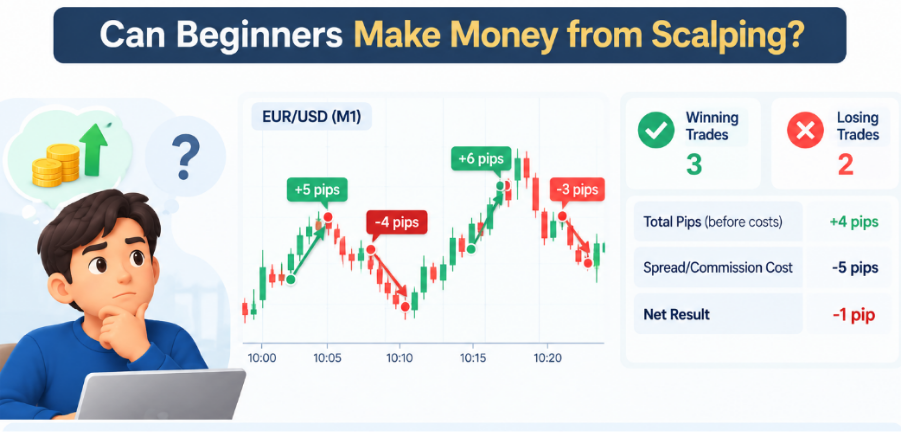
Frankly, few beginners can make profitable scalping trades. Despite a modest 10% success rate, a few successful transactions do not establish that a strategy is profitable over time.
The relevant question is whether average gains, average losses, and the proportion of winning trades produce a positive result after costs.
Consider a strategy with a five-pip average winning trade and a five-pip average losing trade, before trading costs.
If the trader wins 60 out of 100 trades, the gross result is:
60 winning trades × 5 pips = 300 pips
40 losing trades × 5 pips = 200 pips
Gross result = 100 pips
Now assume the combined trading cost is one pip per completed trade, expressed on the same basis as those gross results.
Across 100 trades, costs amount to 100 pips, leaving the strategy at approximately break-even.
The trader wins 60% of the time but earns no net profit in this simplified example.
This explains a hard truth: a relatively high win rate does not necessarily translate into profitability.
Real results also depend on varying spreads, commissions, slippage, trade size, and whether losing positions are closed as planned.
Which Currency Pairs Are Better for Beginner Scalpers?
Beginners exploring forex scalping often start by observing major currency pairs because they tend to have relatively deep liquidity during active trading periods. However, the most suitable pair depends on the trading session, spread conditions, and the economic calendar.
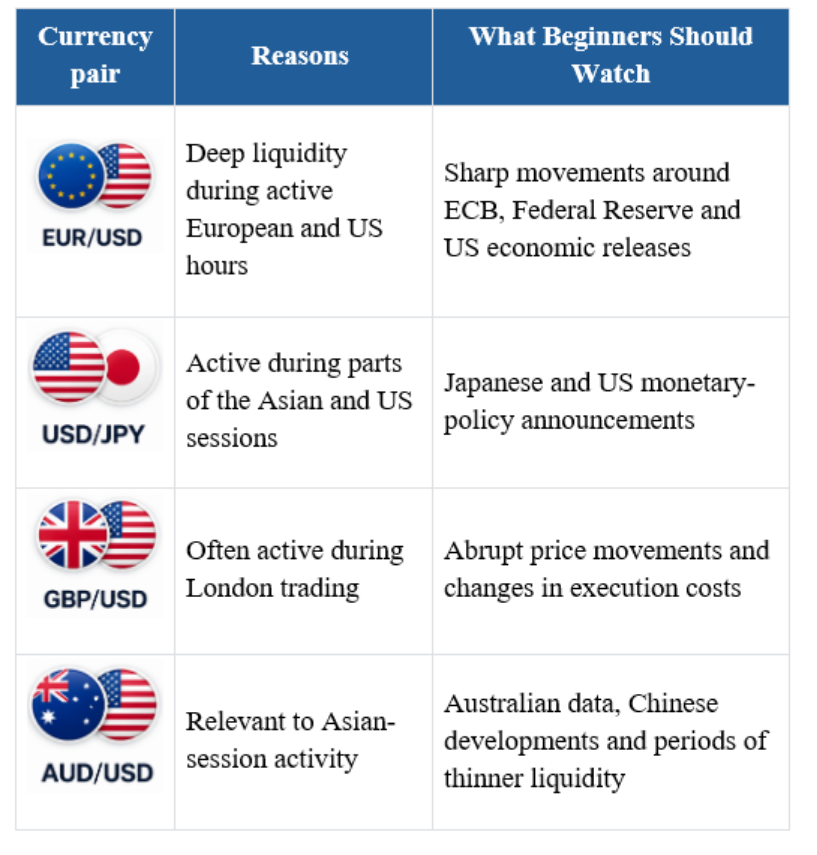
For a beginner, observing one pair consistently is more useful than switching between several instruments. It allows the trader to study how spreads, volatility, and price behaviour change across sessions without introducing too many variables at once.
No currency pair is consistently easy to scalp, and historically active trading hours do not guarantee favourable conditions.
What Is the Best Time for Forex Scalping?
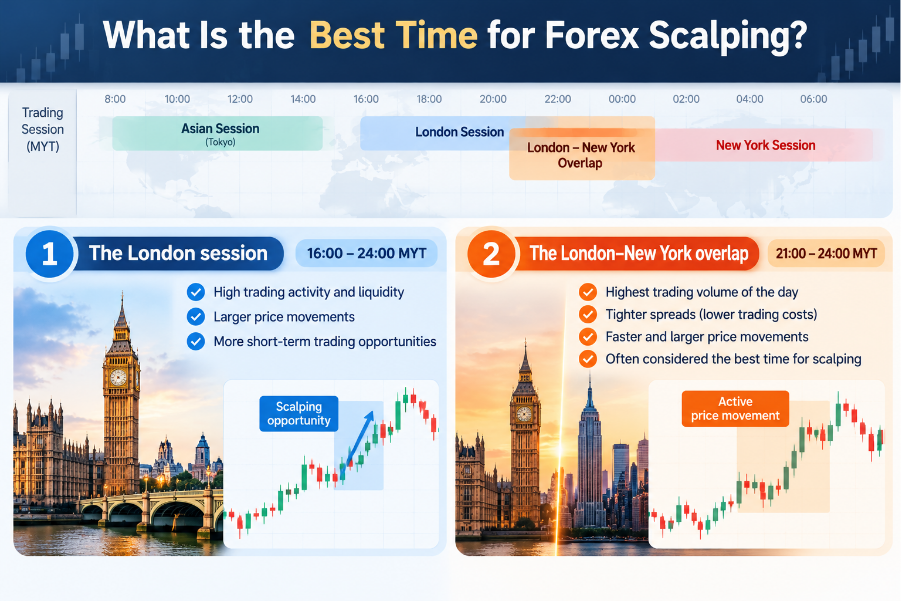
Scalpers often favour periods when major financial markets are active, as higher participation drives liquidity and opens the door to more frequent trading opportunities. For Malaysian traders, two periods are considered particularly relevant.
The London session: London typically opens at 3 pm Malaysia Time during British summer time and 4 pm during British winter time. EUR/USD and GBP/USD may attract greater attention as European trading becomes active.
The London–New York overlap: This period begins at approximately 8 pm or 9 pm MYT, depending on US daylight-saving time, and is often associated with substantial activity in major currency pairs.
These are observation windows, not guarantees of tighter spreads or profitable trades.
Major economic releases can create rapid price movements, but they may also produce spread widening and slippage. Beginners should be particularly cautious about interpreting volatility as an opportunity without accounting for execution risk.
The Bottom Line
Scalping is possible for beginners to learn, but it is rarely the easiest starting point. Its apparent simplicity—entering a trade and taking a small profit—conceals demanding requirements. Transaction costs matter more when targets are small. Execution differences can materially affect results, and frequent decisions increase the scope for mistakes.
Beginners who are interested in scalping may be better served by first learning order types, position sizing, and stop-loss management, then testing a narrowly defined strategy on a demo account.
The question is not whether a beginner can place a scalping trade. It is whether they can repeat the process consistently, account for every cost, and manage losses when the market moves against them.
Until those skills are established, slower trading strategies may provide a more manageable introduction to forex markets.
Risk warning: Trading forex and CFDs involves significant risk and may result in losses that exceed expectations. Leverage magnifies both gains and losses. This article is for educational purposes only and does not constitute investment advice.
FAQs
Is scalping good for forex beginners?
Scalping can help beginners study short-term price movements, but it demands quick decisions, cost awareness, and disciplined risk management. For most newcomers, it is better practised on a demo account before considering live trading.
Is scalping riskier than day trading?
Scalping can involve greater execution pressure and higher cumulative trading costs because positions are opened and closed frequently. However, risk also depends on leverage, position size, stop-loss placement and the trader's behaviour. Day trading is not automatically safer.
Can I start scalping with $100?
Some brokers permit small accounts and minimum trade sizes, but a $100 balance offers limited room for losses and trading expenses. Whether it is practical depends on the instrument, account conditions and risk limits. The ability to open a trade should not be confused with the ability to manage its risks.
What timeframe is best for beginner scalpers?
M1 and M5 are commonly used for scalping. M5 may give beginners more time to assess a setup, while M1 exposes them to more frequent short-term fluctuations. Neither timeframe guarantees better results.