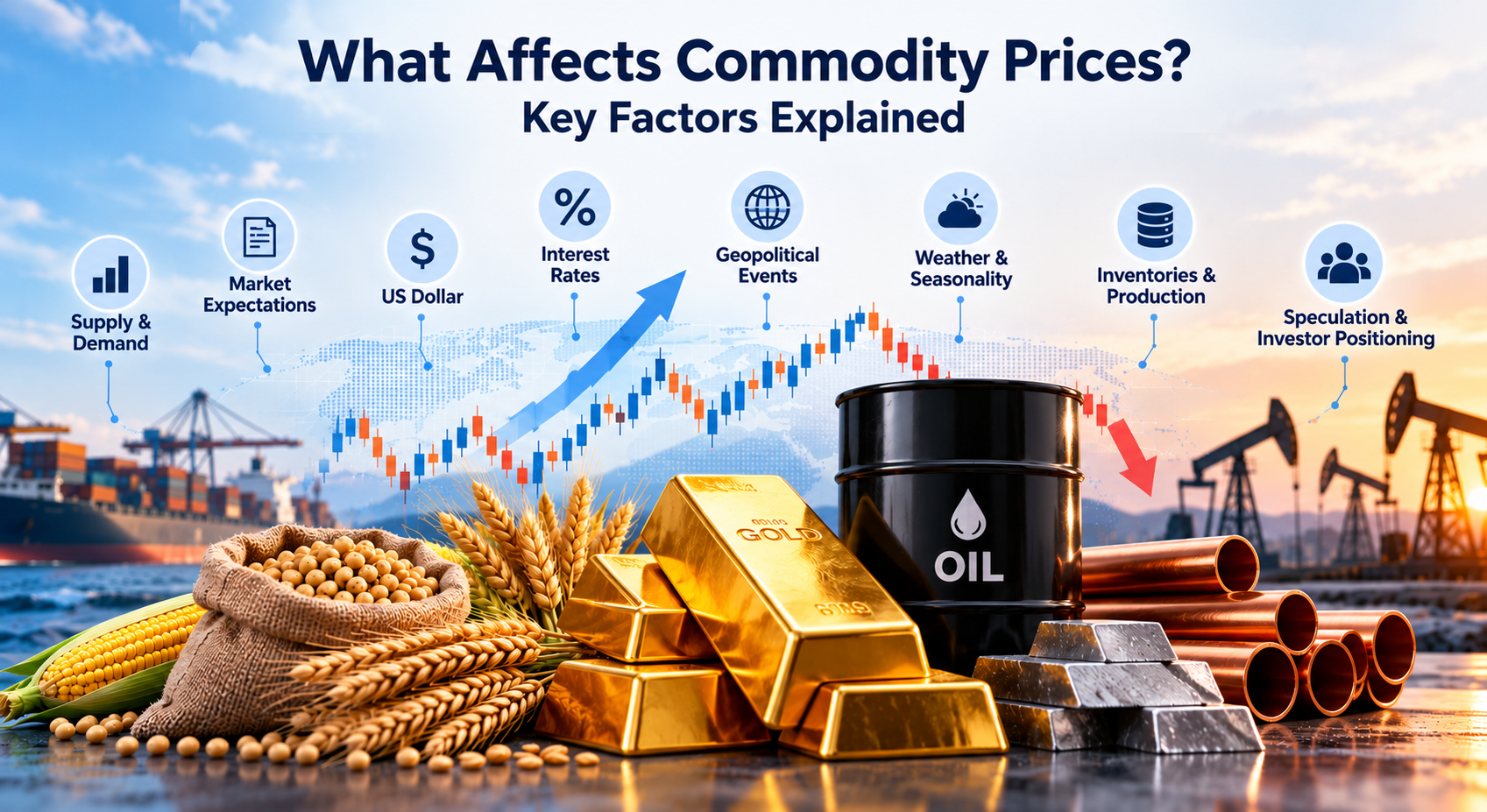
Commodities markets seldom follow simple logic. Oil can fall when demand is spiking, gold can rise as rates rise, and bad crops don't always cause rallies. But commodity pricing is not only about supply and demand. It is also about inventory levels, currency swings, market sentiment and immediate physical delivery needs. Crucially, different commodities react to completely different signals. An oil trader pays attention to refinery capacity and inventory reports, whereas a gold trader keeps an eye on real yields and the US Dollar Index. Understanding these subtle differences is key to making sense of price action
How Are Commodity Prices Determined?
Commodity prices are driven by a constant mix of physical and financial players. Producers, manufacturers, merchants, and traders all share the market, though their goals couldn't be more different.
A food producer purchases wheat futures to lock in the cost of the raw material for the next year. An airline hedges oil contracts to cushion itself against sudden fuel price spikes. A speculative trader buys crude simply betting that price will tick higher before the week ends.
At its core, the engine is basic supply and demand. When buyers outnumber available supply, competition pushes prices up. When production swaddles consumption, sellers cut prices to move inventory.
But commodity markets don't just price today's physical reality—they price tomorrow's expectations. This is why crude can surge long before an actual oil embargo hits the news. If traders anticipate supply tightening next month, the market reprices instantly today. Physical supply sets the foundation, but market expectations dictate how fast price actually moves
8 Key Factors That Affect Commodity Prices
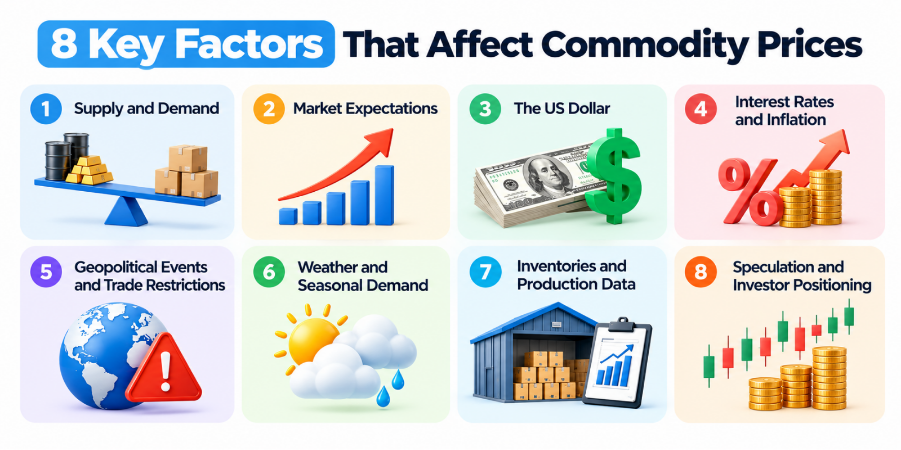
Supply and Demand: The Starting Point
Supply and demand look simple on paper, but every commodity plays by its own rules.
Demand for oil tracks global trade and travel, copper follows construction and grid builds, and grains depend on weather and yields. But the real variable is how fast supply can react to price.
You can't fast-forward a crop yield or build a copper mine overnight. Even OPEC faces capacity bottlenecks. When demand shifts faster than physical supply can adjust, prices don't just move—they explode. That supply lag is where major trading opportunities (and risks) lie.
Market Expectations: Why Good News Can Send Prices Lower
New traders often get caught off guard when good news triggers a price drop.
What matters isn't whether news is objectively good or bad, but whether it beats or misses what traders were bracing for.
Take oil: if the market expects a 3% surge in demand, a report showing 1% growth is a net negative. The market instantly recalibrates to a weaker outlook.
This is why prices frequently fall right after a major headline breaks. If a geopolitical supply disruption turns out to be less severe than feared, the risk premium evaporates—and and prices slide.
The US Dollar: Why Exchange Rates Matter
Many commodities that are traded internationally, such as gold and crude oil, are priced in US dollars.
If their prices in dollars are fixed, then as the dollar gets stronger these commodities get more expensive in other currencies. This can impact purchasing power and demand.
For example, suppose gold trades at $3,000 per troy ounce.
A Malaysian buyer would face the following approximate currency costs:
Illustrative exchange rates and gold price, excluding premiums, fees and taxes.
Even without a change in the international gold price, the ringgit cost increases as USD/MYR rises.
However, the relationship between the dollar and commodity prices is not always negative.
During periods of financial uncertainty, both the US dollar and gold may attract demand. Similarly, an economic slowdown can strengthen the dollar while reducing expectations for oil consumption.
Currency movements therefore need to be considered alongside the economic conditions driving them.
Interest Rates and Inflation
Rates and inflation dictate the backdrop for commodity markets, but the mechanics vary by asset.
Gold doesn’t pay interest and so when inflation-adjusted yields spike, there is an opportunity cost to holding gold over cash or treasuries. But gold is not really a one-variable asset – heavy central bank buying or geopolitical shocks often overwhelm real rate forces.
Meanwhile, industrial commodities face direct pressure from high rates because tight credit curbs construction, manufacturing, and machinery investments.
Remember: commodity prices both cause and respond to inflation. Reading an inflation headline and expecting every commodity to react the same way is a recipe for bad trades.
Geopolitical Events and Trade Restrictions
Geopolitical shocks—whether wars, economic sanctions, or export bans—routinely destabilize commodity supply chains. But the size of the price reaction comes down to where the friction occurs and how long it's expected to last.
A flare-up near a major shipping strait might spark instant panic over oil transit. An export quota on grain can suddenly cut off overseas buyers. Yet if global stockpiles are high, a brief shipping delay might cause little more than a temporary blip. If inventories are already dangerously low, that same delay can trigger a violent rally.
Headlines also introduce heavy risk premiums. Traders usually price in the absolute worst-case scenario the second breaking news hits, only to aggressively unwind those positions once the physical reality becomes clear. This is precisely why commodities frequently spike on initial headlines, then collapse back down—even while the political crisis itself remains completely unresolved.
Weather and Seasonal Demand
Weather influences both supply disruptions and demand surges across commodity markets.
Agricultural yields depend heavily on mild weather, while energy consumption fluctuates with the seasons—rising in winter for heating and peaking in summer for cooling.
However, because seasonal demand is predictable, baseline weather changes are already priced in. An average winter won't send natural gas surging. Instead, prices react to surprises: unseasonably cold snaps, unexpected heat domes, or sudden shifts in weather models. In trading, the forecast matters far more than current conditions."
Inventories and Production Data
Inventories are the ultimate reality check for commodity pricing.
When stockpiles are overflowing, the market can easily absorb supply disruptions. When inventories are scraping the bottom of the barrel, even minor supply scares send prices flying.
This expectation dynamic plays out weekly in crude oil via the EIA report. If traders expect a massive 5-million-barrel inventory drop and get a tiny 1-million-barrel draw instead, crude prices typically slide. The inventory dropped, but it missed the market's expectation.
Simply asking 'Did inventories go up or down?' isn't enough. You have to factor in refinery demand, import volumes, and seasonal trends to understand how the market will actually price the news.
Speculation and Investor Positioning
Most commodity trades never end with a physical shipment. Financial traders trade paper contracts like futures and CFDs solely to profit from price fluctuations.
But when speculative positioning gets overcrowded, price action becomes fragile. If everyone is already long oil, even a minor bearish update can trigger a cascade of selling as traders race to close positions. The resulting price drop usually reflects leverage clearing out rather than a sudden physical glut.
Speculation gets a bad rap, but without it, producers and commercial buyers wouldn't have the liquidity needed to hedge their risk. Just keep in mind that over short horizons, price action is driven by trader positioning as much as physical economics.
What Moves Gold, Oil, Copper and Agricultural Prices Differently?
Although these commodities share broad economic influences, their individual price drivers differ.
Gold stands apart from almost every other commodity. Because virtually all the gold ever mined still exists above ground, new mining output barely dents overall supply. Instead, its price swings on investor sentiment, central bank policy, interest rates, and inflation expectations.
Crude oil operates on the exact opposite logic—it gets consumed the moment it's refined. That makes physical output, storage levels, and transport bottlenecks the absolute drivers of its price.
Copper sits right in the middle. It’s an industrial workhorse tied to factory output and construction, but mining delays and mine closures can quickly starve the supply chain.
The core lesson for new traders is clear: no single indicator or headline rule explains every market. Each commodity has its own distinct DNA.
Why Can Commodity Prices Fall Even When Demand Is Rising?
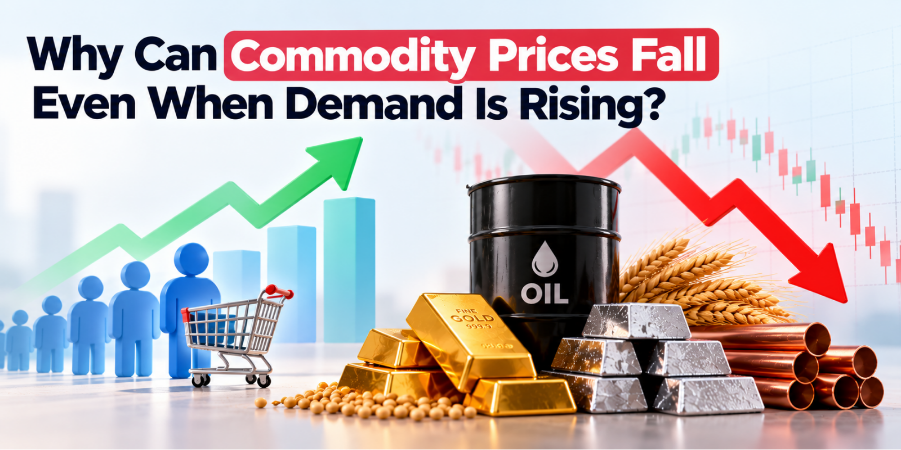
Rising demand doesn't guarantee rising prices. What matters is whether supply is growing faster or slower than consumption.
Take a simple example: if copper demand increases by 2% but supply climbs by 5%, you end up with a market surplus and falling prices. On the flip side, if demand ticks up a minor 1% while supply drops 3% from mine disruptions, prices jump because the market got tighter.
Demand figures tell only part of the story. To understand where prices are actually headed, you have to analyze supply, demand, inventories, and market sentiment as a single connected system.
Spot vs Futures Prices: Why Are They Different?
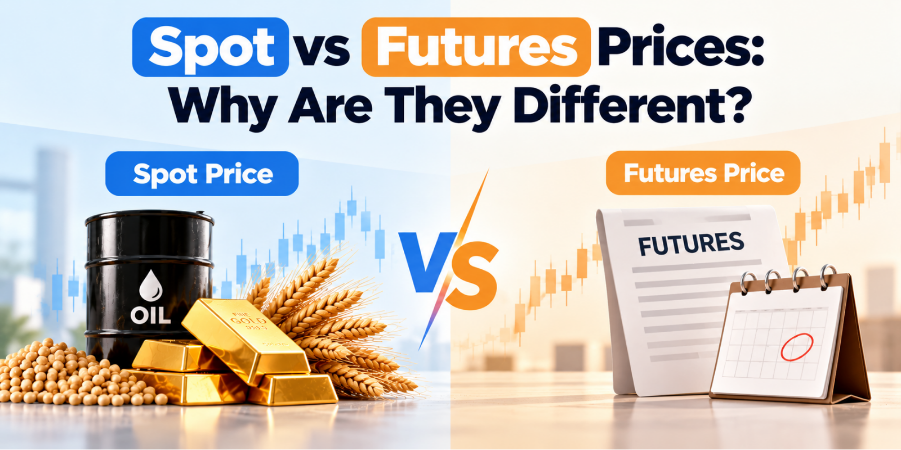
The spot price is what you pay for immediate delivery of a commodity today. A futures contract, on the other hand, locks in a price for delivery or cash settlement on a specific date down the road.
The gap between spot and futures prices comes down to what it costs—and what it’s worth—to hold physical inventory.
Carrying physical goods isn't free: you have to pay for storage, insurance, and financing. At the same time, holding physical stock in hand gives you a immediate buffer if sudden shortages hit. The balance of these forces creates two distinct market structures:
Contango: Later-delivery futures trade at a premium over nearer-delivery contracts. If next month's crude futures trade at $75 per barrel while a contract expiring six months out costs $79, the market is in contango.
Backwardation: Nearer-delivery contracts trade higher than later ones. If that six-month contract drops to $71 while next month stays at $75, the forward curve is backwardated.
This difference is where many retail traders get caught off guard. Commodity ETFs don't buy physical crude—they buy futures. As expiring contracts are rolled into new ones every month, contango bleeds capital through negative roll yield. That is why an oil fund can lose money even while spot oil prices stay flat.
Which Economic Reports Should Commodity Traders Watch?
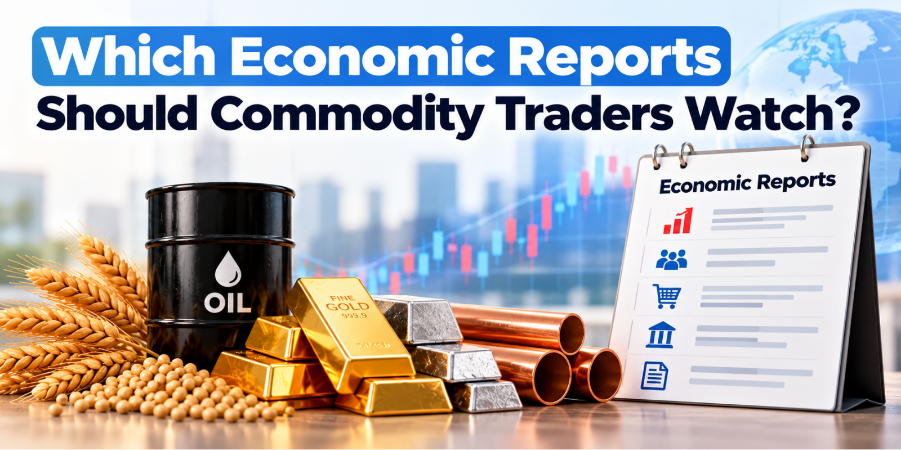
Beginners do not need to follow every economic release. A smaller selection of relevant indicators is usually more useful.
The purpose of monitoring these reports is not to predict every price movement.
Instead, they help traders identify which assumptions about supply, demand or monetary conditions may be changing.
It is also useful to record the market consensus before a release. Without that comparison, a seemingly strong or weak figure can be misleading.
How Do Commodity Prices Affect Traders in Malaysia?
For Malaysian investors, watching global commodity quotes in US Dollars is only half the battle.
Because commodities are priced globally in USD, exchange rate swings heavily dictate your actual local costs. If the US Dollar appreciates against the Ringgit (USD/MYR rises), the cost of physical gold, imported raw materials, or foreign commodity funds climbs locally—even if the underlying dollar price doesn't budge.
Local market dynamics play a huge role too. Malaysia is a major global producer of Crude Palm Oil (CPO), a market driven by harvest yields, export tariffs, competition from soybean oil, and monsoon weather.
But the ultimate impact on your wallet depends entirely on how you access the market. Buying a physical gold bar means absorbing dealer markups and wide buy-sell spreads. Buying shares in a plantation or mining firm ties your money to corporate management and operational risks. Meanwhile, trading a Gold CFD exposes you to short-term price fluctuations of a derivative contract—where leverage, overnight swaps, and spread drag dictate your survival."
How Do Commodity CFDs Work?
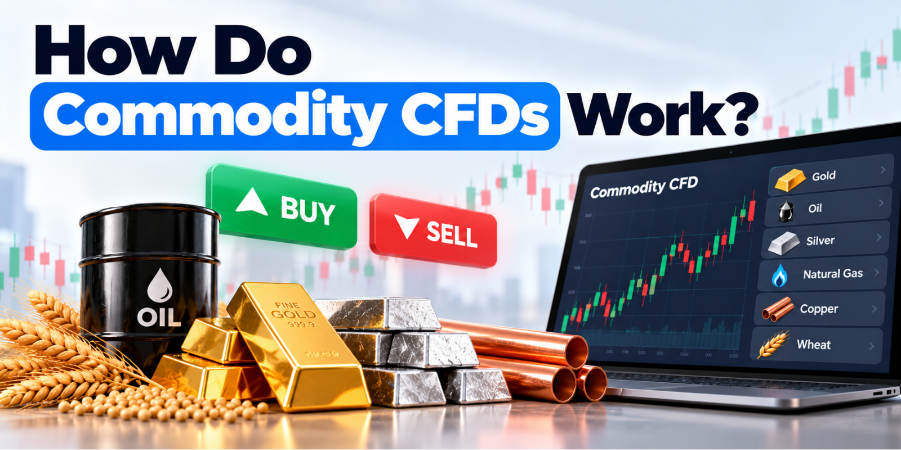
Trading CFDs provides financial exposure to raw materials without the logistical headache of holding physical assets.
Consider a $1,000 Gold CFD position. A 1% rise in the spot price yields a $10 gain (excluding trading fees), while a 1% fall results in a $10 loss.
Leverage allows you to control this $1,000 position with a fraction of the capital—say, $100 in required margin. However, leverage acts as an amplifier, not a safety buffer. That same $10 price movement still occurs, but now it impacts your $100 margin by a full 10%.
Always separate the asset's price change from your return on margin. A tiny 1% market move can easily wipe out or double a heavily leveraged trading account.
How Can Beginners Analyse Commodity Price Movements?
A practical approach begins with five questions.
First, what has changed? Identify whether the latest development concerns supply, demand, monetary policy or investor positioning.
Second, was the change expected? Compare the announcement with forecasts and previous market assumptions.
Third, which commodity is most directly affected? Higher interest rates may influence gold differently from copper or crude oil.
Fourth, is the effect temporary or structural? A short shipping delay differs from a prolonged reduction in production capacity.
Finally, what could challenge the initial interpretation? An apparent supply shortage may be offset by weak demand or the release of inventories.
Consider a headline announcing lower crude oil inventories.
Rather than immediately assuming prices will rise, a trader could check whether the decline exceeded expectations, whether refinery demand increased and whether production or imports changed.
This process does not eliminate uncertainty. It simply replaces a one-headline reaction with a more complete assessment of the market.
The Bottom Line
Supply and demand set the baseline, but raw commodities are multi-variable assets.
Inventory data, interest rate policy, exchange rates, and sudden geopolitical news constantly clash. A headline that sends gold surging might leave wheat completely untouched, and a draw in crude oil stockpiles can easily be ignored if global growth concerns dominate the news cycle.
As a beginner, you don't need to predict every market swing. Your main job is simply to figure out what new information just hit the market, how it compares to existing expectations, and whether it actually matters for the commodity on your chart.
Risk warning: Trading forex and CFDs involves significant risk and may result in losses that exceed expectations. Leverage magnifies both gains and losses. This article is for educational purposes only and does not constitute investment advice.
FAQs
What is the main factor affecting commodity prices?
Supply and demand set the baseline for prices, but market expectations, inventories, currencies, and economic conditions act as powerful compounding variables.
Why do commodity prices rise during inflation?
Rising input costs and heavy demand push many commodities higher, but inflation is selective—it does not automatically cause every commodity price to inflate.
Does a stronger US dollar always lower commodity price?
A stronger U.S. dollar typically exerts downward pressure on dollar-denominated commodities; however, acute supply disruptions or surging investment demand can easily offset or reverse that effect.