
Obviously, the answer is yes. $20 is totally enough to start forex trading with certain brokers. Many forex brokers accept deposits of $20 or less, making live trading accessible to people with limited capital.
But whether it is enough to trade sensibly is a different question. The truth is, a small deposit cannot provide enough room to manage losses, cover transaction costs, or use conventional position sizes.
The distinction matters for beginners. A broker's minimum deposit tells traders how much money they need to fund an account. It says little about how much they should risk in an individual trade. For someone starting with $20, the more useful questions concern the minimum trade size, available leverage, margin requirements, and the proportion of the account that could be lost when a stop-loss is triggered.
What Can I Actually Trade With $20?
Among global markets, the amount of forex exposure available from $20 depends largely on the minimum position of size and leverage. Forex positions are commonly measured in lots. For most major currency pairs, a standard lot represents 100,000 units of the base currency.
Some platforms also allow position sizes to be entered in individual currency units rather than conventional lots. This can offer more flexibility, although availability depends on the provider and platform.
Position size | Currency units | Approximate EUR/USD pip value |
1 standard lot | 100,000 | $10.00 |
0.1 mini lot | 10,000 | $1.00 |
0.01 micro lot | 1,000 | $0.10 |
0.001 lot | 100 | $0.01 |
How Much Can I Lose Trading EUR/USD With $20?
Consider a beginner with a $20 account who wants to buy EUR/USD.
The trader identifies an entry at 1.08500 and places a stop-loss at 1.08300, a distance of 20 pips.
The planned loss depends on the position size.
Trade parameter | 0.01 lot | 0.001 lot |
Account balance | $20 | $20 |
Position size | 1,000 EUR | 100 EUR |
Approximate pip value | $0.10 | $0.01 |
Stop-loss distance | 20 pips | 20 pips |
Planned price-movement loss | $2.00 | $0.20 |
Share of account | 10% | 1% |
The difference is substantial.
At 0.01 lot, a 20-pip loss represents approximately 10% of the entire account. At 0.001 lot, the same movement represents only 1%.
For beginners using a 1% risk limit as a planning example, a $20 account allows just $0.20 of planned loss per trade.
That may be difficult to achieve when the broker's minimum position size is 0.01 lot.
The problem is not necessarily that $20 is too little to open a position. It is that the smallest available position may still be too large for the account.
How Does Leverage Affect a $20 Forex Account?
Leverage gives much trading flexibility for traders to control positions larger than their deposited capital.
For example, suppose EUR/USD is trading at 1.0850, and a trader opens a 0.01-lot position, representing 1,000 euros.
The approximate position value is $1,085.
The margin required depends on the leverage available.
Leverage | Margin for Micro lot EUR/USD | Can a $20 account meet this initial margin? |
6:01 | $36.17 | No |
2:01 | $21.70 | No |
100:1 | $10.85 | Yes, before other requirements |
500:1 | $2.17 | Yes, before other requirements |
These calculations assume a USD-denominated account, a EUR/USD rate of 1.0850, and simplified margin requirements.
At 100:1 leverage, the trader would use approximately $10.85 of the $20 balance as initial margin, leaving about $9.15 before trading costs and market movements.
At 500:1 leverage, the initial margin requirement would fall to approximately $2.17.
But the risk of the position would not change.
A 20-pip adverse movement on 0.01 lot would still produce approximately $2 of price-movement loss, regardless of whether the position was opened using 100:1 or 500:1 leverage.
Higher leverage reduces the margin needed to open the trade. It does not reduce the amount lost when the market moves against the position.
Leverage is also subject to regulation. For example, the UK's Financial Conduct Authority limits leverage on retail CFDs to between 30:1 and 2:1, depending on the underlying asset. Other jurisdictions apply different requirements.
Beginners should not assume that leverage advertised by an offshore broker is available or appropriate in their country.
Why Is Risk Management Difficult With Only $20?
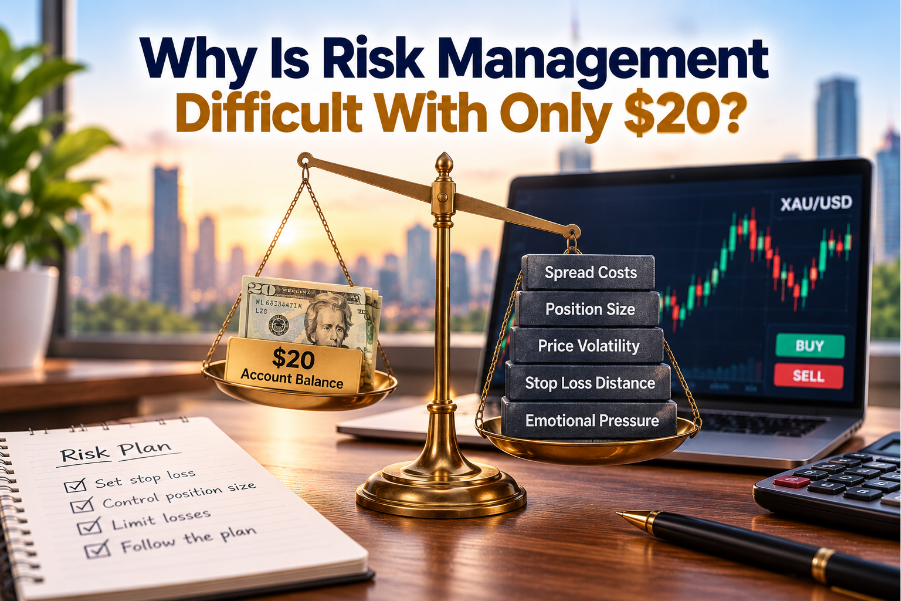
A small account leaves little room for mistakes.
Suppose a trader starts with $20 and loses $2 on each unsuccessful trade.
After five such losses, the balance would fall to $10, excluding additional costs.
The trader would have lost half the account, despite losing only $10 in absolute terms.
Recovering from that decline is harder than it may initially appear.
Account decline | Gain needed to recover to the original balance |
10% | 11.10% |
20% | 25% |
30% | 42.90% |
50% | 100% |
A 50% loss requires a 100% gain on the remaining balance merely to return to the starting point.
This mathematical asymmetry applies to accounts of every size. It becomes particularly visible with $20 because a small dollar loss can represent a large percentage of the balance.
A beginner should therefore assess risk in percentages, not just dollars.
Losing $2 may seem insignificant, but it represents one-tenth of a $20 trading account.
Is a Cent Account Better for Trading With $20?

Technically, a cent account offers a far more practical way to experiment with small position sizes. For traders starting out with limited capital, it feels like an ideal entry point. Although attractive for small balances, a cent account is not that superior for low-deposit trading. The truth is that cent accounts generally don't offer much preferable trading conditions. First, it starts with expensive spreads, much wider than a standard account or the ECN account. Second, cent accounts usually restrict your choice of base currency. For instance, HFM's Cent account supports USC only, whereas its other account gives more choices in this regard. Another downside is that cent accounts are not standardized across the industry. Only a few brokers give this option.
Consequently, a $20 deposit need not restrict traders to cent accounts. Operating a micro-sized standard account with alternative brokers often yields far superior execution and lower overall transaction costs.
Can You Make a Profit Trading Forex With $20?

A $20 account can generate profits, but the amounts are likely to be modest when position sizes are kept small.
Suppose a trader earns a net return of 5% over a month.
On a $20 account, that amounts to $1.
A 10% monthly return would produce $2.
These figures are hypothetical illustrations, not forecasts or realistic targets that traders should expect to achieve consistently.
They demonstrate the difference between percentage performance and absolute income.
Starting Balance | Hypothetical 5% Gain | Hypothetical 10% Gain |
$20 | $1 | $2 |
$100 | $5 | $10 |
$500 | $25 | $50 |
$1,000 | $50 | $100 |
The temptation is to increase leverage or position size to make the dollar profits more noticeable.
But doing so increases the potential losses as well.
A trader who risks half the account to pursue a $10 profit is not making the account more efficient. They are accepting a substantial possibility of losing much of their starting capital.
For beginners, a $20 account is better viewed as a limited learning exercise than a realistic source of trading income.
What Should Beginners Look for in a Low-Deposit Broker?
Among markets today, many CFD and forex brokers offer low entry, so choosing one is not difficult. The more important question is whether the broker's trading conditions allow a small account to operate without excessive risk. Here, we will explore it based on the following aspects:
Regulation and Client Protections
Above all else, trading with a well-regulated CFD broker should be a trader's non-negotiable first step. Prior to depositing funds, traders must verify the exact corporate entity holding their account alongside its supervising regulatory authority. A broker may advertise several regulatory licences, but the protections available to a customer depend on the specific contracting entity and jurisdiction.
An offshore license should never be treated as equivalent to regulatory authorization in a trader’s home country. Traders should instead prioritize brokers operating under strict Tier-1 regulators like ASIC, the FCA, or the FSCA.
Minimum Deposit Starting from $20
The second step is to choose a regulated broker with a low minimum deposit requirement under $20. Many reputable brokers—such as XM, FBS, HFM, and Vantage—allow traders to start with minimal capital and trade micro-lot sizes.
Spreads and Commissions
The truth is, $20 can only open the most basic trading account with average trading conditions. Here, it will take some time to compare typical trading costs for the currency pairs you intend to trade. Brokers advertising spreads from 0.0 pips may charge high commissions. Don't consider low spreads alone—it is always a good idea to open a demo account and test their actual trading conditions.
Deposit and Withdrawal Conditions
Actually, many brokers set their withdrawal limits, so it is necessary for traders to check the minimum withdrawal amount, payment-processing charges, currency-conversion fees, and available funding methods. For a $20 account, even a small fixed withdrawal fee can represent a meaningful share of the balance.
Margin and Stop-Out Rules
Make sure you understand your broker's margin requirements, margin call triggers, and stop-out levels. This detail is typically listed in its account description. Knowing Margin and Stop-Out rules matters because a small account has limited capacity to absorb adverse price movements.
The Bottom Line
Overall, $20 can be enough to open a forex account and, under suitable broker conditions, place small live trades. However, it is rarely enough to pursue meaningful trading income while maintaining conventional risk limits.
The decisive factor is not the deposit requirement but the relationship between account balance, minimum trade size, and potential loss.
For beginners, that distinction is more important than the advertised minimum deposit. A small live account can serve as a practical introduction to order execution and trading discipline. But it should be approached as money that can be lost, not as a shortcut to substantial profits.
Risk warning: Trading forex and CFDs involves significant risk and may result in losses that exceed expectations. Leverage magnifies both gains and losses. This article is for educational purposes only and does not constitute investment advice.
FAQs
Can I trade forex with $20 on MT4?
Yes, if your broker accepts a $20 deposit, offers sufficiently small positions, and provides enough available margin. MT4 itself does not set the broker's minimum deposit or minimum trade size.
Can I trade forex with $20 on MT5?
Yes, subject to the broker's account requirements, contract specifications, and margin rules. MT5 supports forex trading, but the platform does not guarantee that $20 will be sufficient for a particular position.
Is $20 enough to trade EUR/USD?
It may be, particularly when the broker supports very small trade sizes. However, a 0.01-lot EUR/USD position can expose a $20 account to a substantial percentage loss even with a relatively ordinary stop-loss distance.
What leverage do I need to trade forex with $20?
There is no single required leverage ratio. The answer depends on the position size, currency pair, exchange rate, and applicable margin requirements. Higher leverage can reduce initial margin but does not reduce the market risk of a position.